 Back
BackMotion in One, Two, and Three Dimensions: Kinematics and Acceleration
Study Guide - Smart Notes
 Tailored notes based on your materials, expanded with key definitions, examples, and context.
Motion Along a Straight Line (1D Kinematics)
Kinematic Equations for Constant Acceleration
When a particle moves along a straight line with constant acceleration, its motion can be described using a set of kinematic equations. These equations relate displacement, velocity, acceleration, and time, and are fundamental for solving problems in one-dimensional motion.
Displacement:
Final velocity:
Velocity squared:
Average velocity:
Each equation is useful depending on which variables are known and which are unknown. The excluded variable method helps select the appropriate equation for a given problem.
Acceleration-Time Graphs
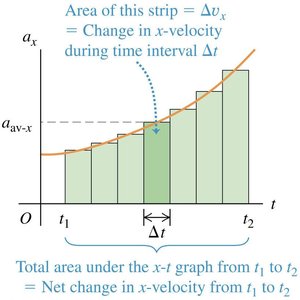
Acceleration can vary with time. The area under an acceleration-time graph represents the change in velocity over a given time interval.
Area under the vs. graph: Net change in -velocity from to .
Mathematical expression:
Motion in Two or Three Dimensions (2D/3D Kinematics)
Introduction to 2D and 3D Motion
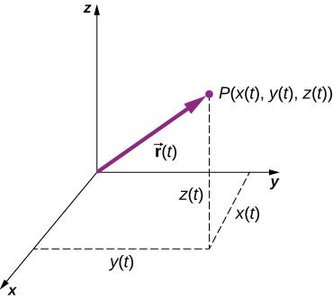
In two and three dimensions, motion is described using vectors for position, displacement, velocity, and acceleration. This allows for the analysis of more complex trajectories, such as projectile motion and circular motion.
Position vector:
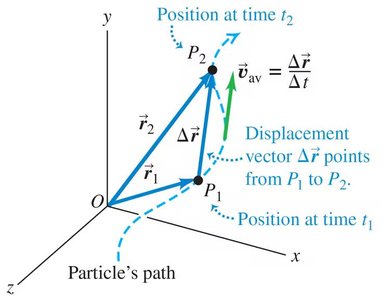
Displacement vector:
Velocity vector:
Acceleration vector:
Displacement and Average Velocity
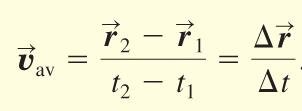
Displacement is the vector difference between two position vectors. Average velocity is the displacement divided by the time interval.
Formula:
Instantaneous Velocity
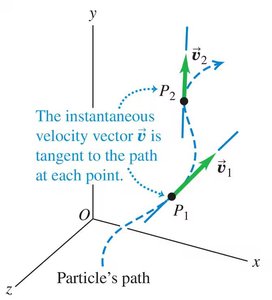
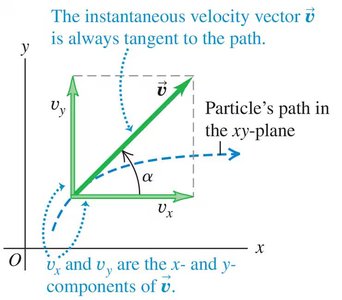
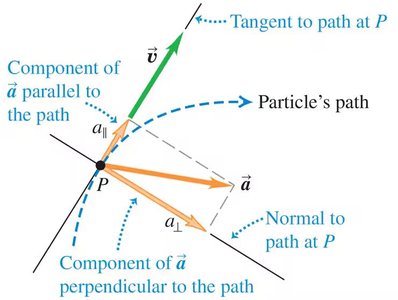
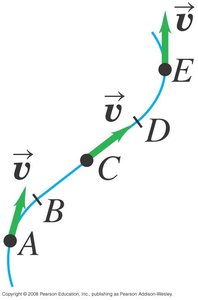
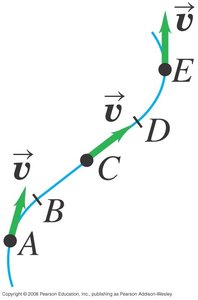
The instantaneous velocity vector is tangent to the path at each point and represents the rate of change of position at a specific instant.
Formula:
Magnitude: Speed at that instant
Direction: Tangent to the trajectory
Instantaneous Acceleration
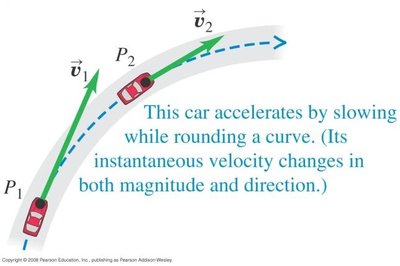
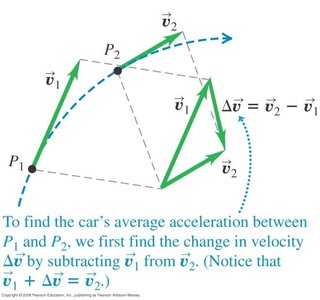
Acceleration is the rate of change of velocity. The instantaneous acceleration vector can change both the magnitude and direction of velocity.
Formula:
Components: , ,
Parallel and Perpendicular Components of Acceleration
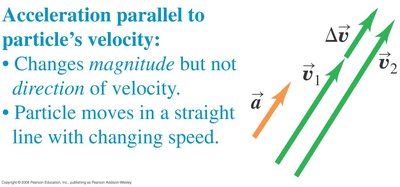
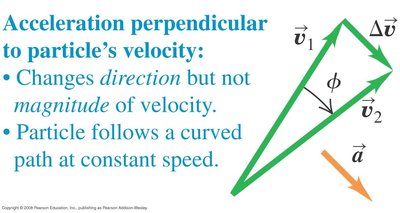
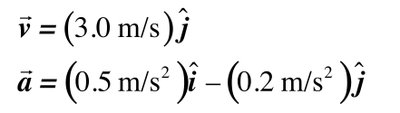
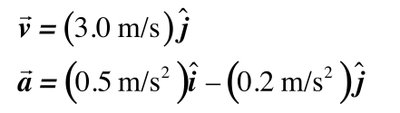
Acceleration can be decomposed into components parallel and perpendicular to the velocity vector. The parallel component changes the speed, while the perpendicular component changes the direction of motion.
Parallel acceleration (): Changes speed, not direction.
Perpendicular acceleration (): Changes direction, not speed.
Projectile Motion and Uniform Circular Motion
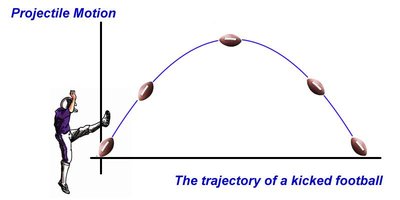
Projectile motion and uniform circular motion are classic examples of 2D kinematics. In projectile motion, the trajectory is parabolic due to constant acceleration from gravity. In uniform circular motion, the speed is constant but the direction changes continuously.
Projectile motion: Both horizontal and vertical components of motion are analyzed separately.
Uniform circular motion: Acceleration is always directed toward the center of the circle (centripetal acceleration).

Practice and Conceptual Questions
Conceptual questions and practice problems reinforce understanding of kinematic concepts, such as the relationship between speed, acceleration, and direction of motion.
Key concept: Any object following a curved path is accelerating, even if its speed is constant.
Acceleration direction: Depends on whether speed is constant, increasing, or decreasing.
Summary Table: Vector Quantities in Kinematics
Quantity | Definition | Formula |
|---|---|---|
Position | Location in space | |
Displacement | Change in position | |
Velocity | Rate of change of position | |
Acceleration | Rate of change of velocity |
Key Takeaways
Kinematic equations are essential for solving problems in 1D motion with constant acceleration.
Vector representation is crucial for analyzing motion in 2D and 3D.
Acceleration can change both the speed and direction of an object, depending on its components relative to velocity.
Practice problems help solidify understanding of these concepts.
