 Back
Motion in Two and Three Dimensions: Physics with Calculus Study Notes
Study Guide - Smart Notes
 Tailored notes based on your materials, expanded with key definitions, examples, and context.
Motion in Two and Three Dimensions
Introduction to Multidimensional Motion
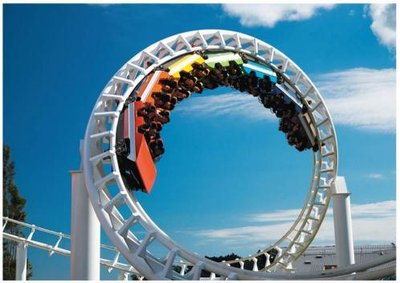
Motion in two and three dimensions is fundamental to understanding real-world physical phenomena, such as the flight of a baseball, the path of a roller coaster, or the movement of a bird. Unlike one-dimensional motion, multidimensional motion requires the use of vectors to describe position, velocity, and acceleration.
Position Vector: Describes the location of a particle in space using coordinates (x, y, z).
Displacement: The change in position, represented as a vector difference between two points.
Velocity and Acceleration: Both are vector quantities that describe how position changes over time and how velocity changes over time, respectively.
Applications: Projectile motion, circular motion, and motion along curved paths.
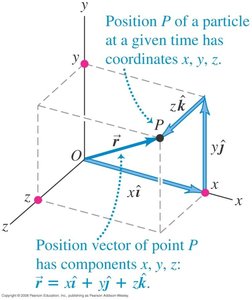
Position and Displacement in 3D
The position of a particle at any time is given by a vector \( \vec{r} \) with components along the x, y, and z axes. Displacement is the vector difference between two position vectors.
Position Vector: \( \vec{r} = x\hat{i} + y\hat{j} + z\hat{k} \)
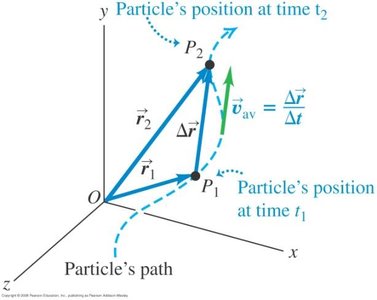
Displacement: \( \Delta \vec{r} = \vec{r}_2 - \vec{r}_1 = (x_2 - x_1)\hat{i} + (y_2 - y_1)\hat{j} + (z_2 - z_1)\hat{k} \)
Example: If a particle moves from (2, 1, 0) to (3, 5, -4), its displacement is (1, 4, -4).
Velocity in 3D
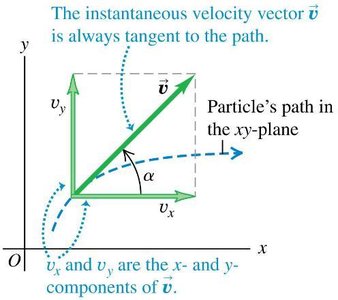
Velocity describes how position changes with time. The average velocity is the displacement divided by the time interval, while the instantaneous velocity is the derivative of position with respect to time.
Average Velocity: \( \vec{v}_{\text{ave}} = \frac{\Delta \vec{r}}{\Delta t} \)
Instantaneous Velocity: \( \vec{v} = \lim_{\Delta t \to 0} \frac{\Delta \vec{r}}{\Delta t} = \frac{d\vec{r}}{dt} \)
Component Form: \( \vec{v} = \frac{dx}{dt}\hat{i} + \frac{dy}{dt}\hat{j} + \frac{dz}{dt}\hat{k} \)
Example: Calculating Average Velocity
Consider Temoc the Comet moving from point P1 (2.0 m, 1.0 m, 0.0 m) to P2 (3.0 m, 5.0 m, -4.0 m) in 4.0 seconds. The average velocity is calculated as:
\( \Delta \vec{r} = (1.0\hat{i} + 4.0\hat{j} - 4.0\hat{k}) \) m
\( \vec{v}_{\text{ave}} = \frac{\Delta \vec{r}}{4.0\text{ s}} = (0.25\hat{i} + 1.0\hat{j} - 1.0\hat{k}) \) m/s

Acceleration in 3D
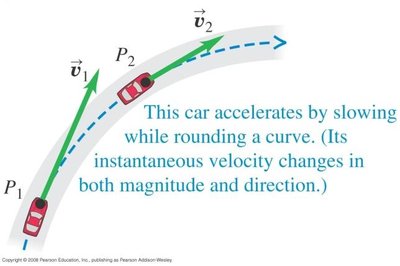
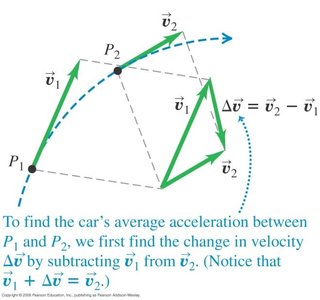
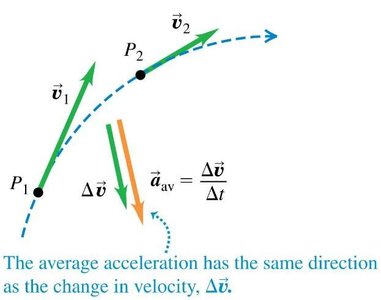
Acceleration is the rate of change of velocity. The average acceleration is the change in velocity over a time interval, while the instantaneous acceleration is the derivative of velocity with respect to time.
Average Acceleration: \( \vec{a}_{\text{ave}} = \frac{\vec{v}_2 - \vec{v}_1}{t_2 - t_1} \)
Instantaneous Acceleration: \( \vec{a} = \lim_{\Delta t \to 0} \frac{\Delta \vec{v}}{\Delta t} = \frac{d\vec{v}}{dt} \)
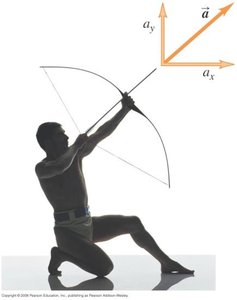
Component Form: \( \vec{a} = \frac{dv_x}{dt}\hat{i} + \frac{dv_y}{dt}\hat{j} + \frac{dv_z}{dt}\hat{k} \)
Components of Acceleration
When an object moves along a curved path, its acceleration can be decomposed into two components:
Parallel Component (\( a_{\parallel} \)): Changes the speed of the object.
Perpendicular Component (\( a_{\perp} \)): Changes the direction of the object's motion.
Example: A car rounding a curve experiences both types of acceleration.
Uniform Circular Motion
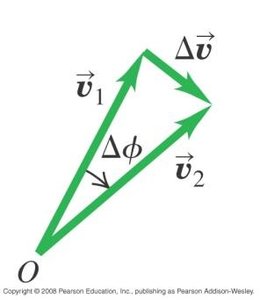
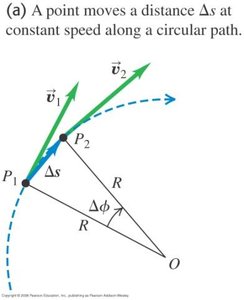
Uniform circular motion occurs when an object moves at constant speed along a circular path. The velocity vector changes direction but not magnitude, resulting in a centripetal acceleration directed toward the center of the circle.
Path Length: \( \Delta s = R \Delta \phi \), where R is the radius and \( \Delta \phi \) is the angle swept.
Instantaneous Acceleration: Always points radially inward.
Centripetal Acceleration: \( a_c = \frac{v^2}{R} \)
Period of Revolution: \( T = \frac{2\pi R}{v} \)
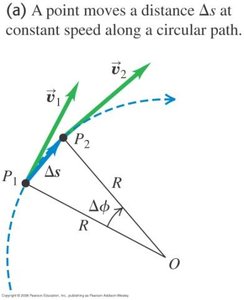
Example: Uniform Circular Motion and "1 g" Turn
A commercial tire claims to complete a "1 g" turn at 60 mi/hr. To find the minimum radius for this turn:
Convert speed: 60 mi/hr = 27 m/s
Acceleration due to gravity: 9.8 m/s2
Minimum radius: \( R = \frac{v^2}{a_c} = \frac{(27)^2}{9.8} \approx 74.4 \) m
Summary Table: Key Equations for Motion in 2D/3D
Quantity | Equation | Description |
|---|---|---|
Position Vector | Location in space | |
Displacement | Change in position | |
Average Velocity | Rate of change of position | |
Instantaneous Velocity | Velocity at a specific instant | |
Average Acceleration | Rate of change of velocity | |
Instantaneous Acceleration | Acceleration at a specific instant | |
Centripetal Acceleration | Acceleration toward center in circular motion | |
Period of Revolution | Time for one complete circle |
