 Back
BackMotion in Two or Three Dimensions: Kinematics and Uniform Circular Motion
Study Guide - Smart Notes
 Tailored notes based on your materials, expanded with key definitions, examples, and context.
Motion in Two or Three Dimensions
Projectile Motion
Projectile motion describes the movement of an object that is launched into the air and follows a curved trajectory under the influence of gravity, assuming air resistance is negligible. The motion can be analyzed by decomposing it into horizontal and vertical components.
Key Equations:
Horizontal displacement:
Vertical displacement:
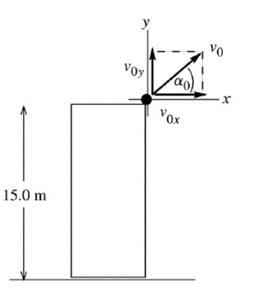
Initial velocity components: ,
Maximum Height: The maximum height above the launch point is given by .
Velocity Before Impact: The magnitude of the velocity just before striking the ground can be found using energy conservation or kinematic equations.
Horizontal Range: The range is the horizontal distance from the base to the landing point, calculated by , where is the total flight time.
Example: A rock is thrown from a 15.0-m-tall building with an initial speed of 30.0 m/s at 33.0° above the horizontal. Calculations yield a maximum height of 13.6 m above the roof, a velocity of 34.6 m/s before impact, and a horizontal range of 103 m.
Uniform Circular Motion
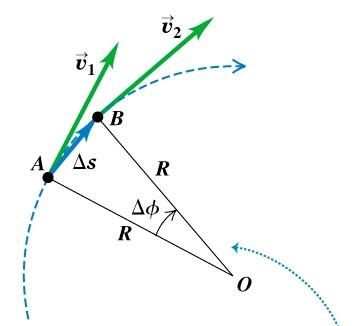
Uniform circular motion occurs when an object moves in a circle at constant speed. Although the speed remains unchanged, the direction of velocity continuously changes, resulting in a non-zero acceleration.
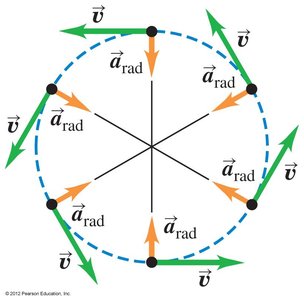
Acceleration: The acceleration in uniform circular motion is always directed toward the center of the circle (centripetal acceleration).
Key Formulas:
Centripetal acceleration:
Speed in terms of period:
Acceleration in terms of period:
Direction: Acceleration is perpendicular to velocity and points toward the circle's center, regardless of the direction of motion.
Example: The speed of a point on Earth's equator (radius m, period 24 h) is 460 m/s, and the centripetal acceleration is 0.034 m/s2.
Applications of Uniform Circular Motion
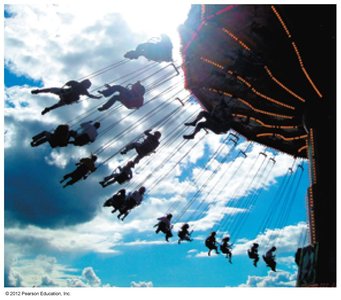
Uniform circular motion is observed in various real-world scenarios, such as carnival rides, planetary orbits, and rotating machinery. Passengers in a high-speed carnival ride experience centripetal acceleration, which is responsible for the sensation of being pushed outward.
Example: Carnival rides demonstrate the effects of centripetal acceleration as riders move in a circle at constant speed.
Relative Motion
Frames of Reference and Relative Velocity
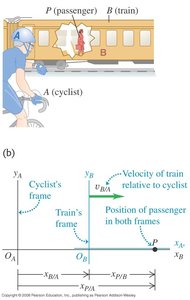
Relative motion refers to the observation of movement from different frames of reference. The velocity of an object depends on the observer's frame, and the position and velocity can be transformed between frames using vector addition.
Position Transformation:
Velocity Transformation:
Example: If a person walks at 1.0 m/s on a train moving at 3.0 m/s, their velocity relative to the ground is 4.0 m/s.
In 2D or 3D: Vector notation is used for position and velocity transformations.
Acceleration in Periodic Motion
Pendulum Acceleration at the Lowest Point
When a pendulum swings through its lowest point, the direction of acceleration is determined by the net force acting on the bob. At the lowest point, the acceleration is directed upward, toward the center of the circular path, due to the tension in the string providing centripetal force.
Key Point: At the lowest point, the pendulum's acceleration is not zero; it is directed upward (toward the pivot).
Application: This concept is important in analyzing forces in periodic motion and understanding the dynamics of pendulums.
Additional info: The direction of acceleration at the lowest point is often misunderstood; it is always toward the center of the circle for uniform circular motion.
