 Back
BackMotion with Constant Acceleration and Free Fall
Study Guide - Smart Notes
 Tailored notes based on your materials, expanded with key definitions, examples, and context.
Motion with Constant Acceleration
Equations of Motion
When an object moves with constant acceleration, its velocity and position as functions of time can be determined using calculus. These relationships are fundamental in kinematics and are widely applicable in physics.
Velocity as a function of time: The velocity at any time t is given by integrating the constant acceleration a:
Position as a function of time: The position at any time t is found by integrating the velocity function:
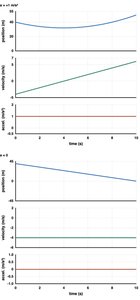
Graphical Representation: The velocity-time graph is a straight line, and the position-time graph is a parabola for constant acceleration.
Special Case: Zero Acceleration
When a = 0, the velocity remains constant, and the position changes linearly with time:
The position-time graph is a straight line with constant slope.
Free Fall
Acceleration Due to Gravity
Objects in free fall near the Earth's surface experience a constant acceleration directed downward, regardless of their mass (assuming negligible air resistance). This acceleration is denoted by g:
Direction: The sign of acceleration depends on the chosen coordinate system. If upward is positive, then .
Assumptions: Air resistance is negligible for heavy, slow, or aerodynamic objects.

Demonstration: In a vacuum, all objects (e.g., an apple and a feather) fall at the same rate, illustrating the universality of gravitational acceleration.
Problem-Solving Strategies for Constant Acceleration
Key Kinematic Equations
For motion with constant acceleration, the following equations are essential:
Where:
: Initial velocity
: Final velocity
: Initial position
: Final position
: Acceleration
: Time interval
: Displacement ()
Steps for Solving Problems
Clearly identify the initial (i) and final (f) states of the scenario.
Define a coordinate system (choose the origin and positive direction).
List all known quantities, including their signs.
Determine the unknown quantity to solve for.
Select the equation that contains only one unknown and solve for it.
If there are two unknowns, use two equations to solve for both.
Example Problem: Free Fall
Problem: If a ball is dropped from a height of 20 m above the ground, how long does it take to hit the ground?
Knowns: , , ,
Unknown:
Solution: Use and solve for .
Result:
Follow-up: To find the velocity when the ball hits the ground, use with the calculated .
