 Back
BackMotions in Accelerating Systems: Non-Inertial Frames and Fictitious Forces
Study Guide - Smart Notes
 Tailored notes based on your materials, expanded with key definitions, examples, and context.
Motions in Accelerating Systems
Introduction to Reference Frames
In physics, the concept of a reference frame is crucial for describing motion. A reference frame is a perspective from which an observer measures positions, velocities, and accelerations. There are two main types: inertial frames (not accelerating) and non-inertial frames (accelerating).
Inertial Frame: A frame of reference that is either at rest or moves with constant velocity. Newton's laws hold without modification.
Non-Inertial Frame: A frame that is accelerating. Observers in these frames experience additional apparent forces called fictitious forces.
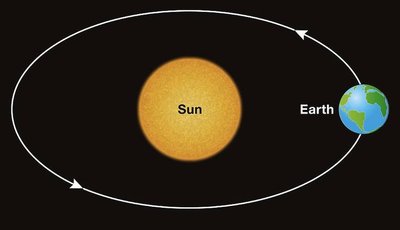
Example: Observing the Sun's motion: From outside the solar system, Earth orbits the Sun (inertial frame). From Earth's surface, the Sun appears to orbit Earth (non-inertial frame).
Fictitious Forces in Non-Inertial Frames
Centrifugal Force
When an observer is in a rotating or accelerating frame, they may perceive forces that do not arise from any physical interaction but from the acceleration of the frame itself. These are called fictitious forces. The centrifugal force is one such force, experienced in rotating systems.
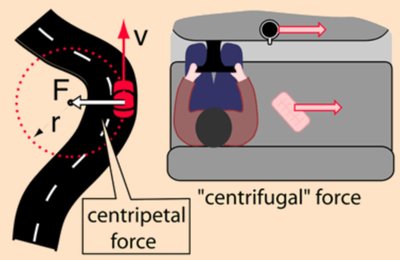
Centrifugal Force: An apparent force that seems to push objects outward from the center of rotation. It is not a real force but a result of inertia in a rotating frame.
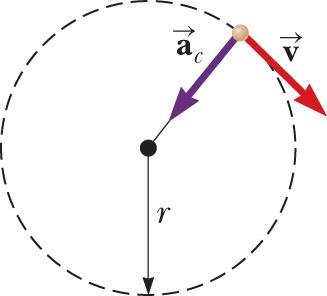
Centripetal Force: The real force that acts toward the center of a circular path, keeping an object in circular motion.
Formula for Centripetal Acceleration:
Formula for Centripetal Force:
Example: A car turning in a circle: The friction between the tires and the road provides the centripetal force, while passengers feel pushed outward due to the centrifugal effect.
Effective Gravity in Rotating Systems
In a rotating frame, the combination of real gravity and centrifugal force creates an effective gravity that can be much larger than Earth's gravity. This principle is used in centrifuges and rotating space stations to simulate gravity.
Effective Gravitational Acceleration:
Application: Centrifuges separate substances by spinning samples at high speeds, increasing the effective gravity and causing denser particles to settle faster.
Example Calculation: If a centrifuge produces and a sample has mass , the apparent weight is:

Other Fictitious Forces in Accelerating Frames
Translational (Linear) Fictitious Force
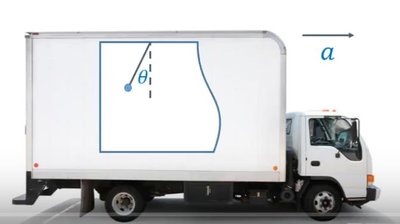
When a frame accelerates linearly, objects appear to experience a force opposite to the acceleration. This is called the translational fictitious force.
Example: A pendulum in an accelerating truck swings backward, as if acted on by a force opposite to the truck's acceleration.
Explanation: In the inertial frame, the pendulum lags due to inertia. In the accelerating frame, a fictitious force appears to act on the mass.
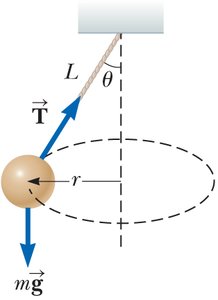
Conical Pendulum
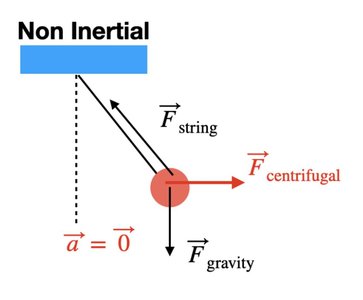
A conical pendulum is a mass attached to a string, moving in a horizontal circle. The forces acting on the mass include gravity, tension, and, in a rotating frame, the centrifugal force.
Forces: Tension provides both the centripetal force (horizontal component) and balances gravity (vertical component).
Equilibrium in Non-Inertial Frame: The centrifugal force balances the horizontal component of tension.
Coriolis Force
Definition and Effects
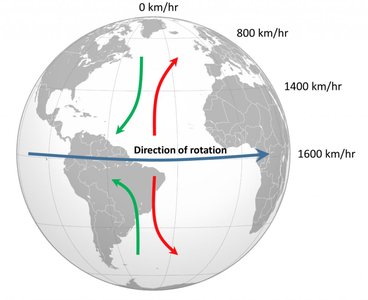
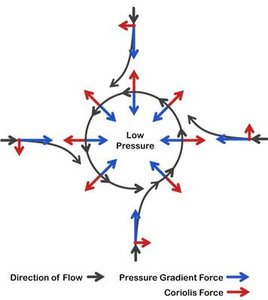
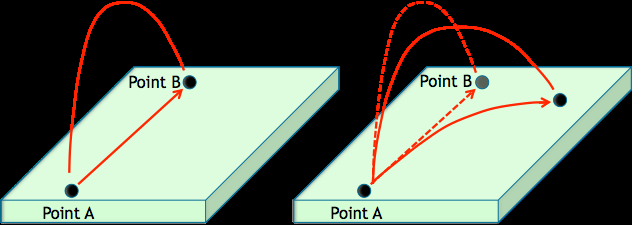
The Coriolis force is a fictitious force experienced in rotating frames, causing moving objects to appear to curve relative to the surface. It is crucial in meteorology and ballistics.
Formula for Coriolis Force: where is the angular velocity vector of the rotating frame, and is the velocity of the object relative to the frame.
Direction: In the Northern Hemisphere, moving objects are deflected to the right; in the Southern Hemisphere, to the left.
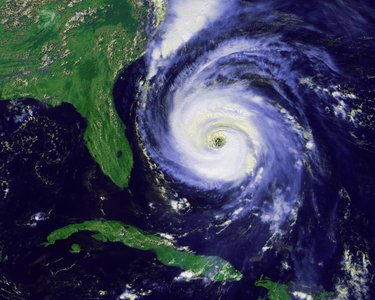
Applications: Explains the rotation of weather systems (cyclones, hurricanes) and the deviation of long-range projectiles.
Summary Table: Fictitious Forces in Non-Inertial Frames
Fictitious Force | Frame Type | Direction | Formula | Example/Application |
|---|---|---|---|---|
Centrifugal Force | Rotating | Outward from center | Feeling pushed outward in a turning car | |
Translational Fictitious Force | Linearly Accelerating | Opposite to acceleration | Pendulum in an accelerating truck | |
Coriolis Force | Rotating | Perpendicular to velocity and axis of rotation | Deflection of winds, projectile paths |
Key Equations
Centripetal Acceleration:
Centripetal Force:
Effective Gravity in Rotating Frame:
Coriolis Force:
Summary
Understanding motion in accelerating (non-inertial) frames requires introducing fictitious forces such as centrifugal, translational, and Coriolis forces. These forces are not real interactions but arise due to the acceleration of the observer's frame. They are essential for analyzing systems like rotating rides, centrifuges, and atmospheric phenomena.
