 Back
BackNewtonian Gravity: Elliptical Orbits and Gravitational Forces
Study Guide - Smart Notes
 Tailored notes based on your materials, expanded with key definitions, examples, and context.
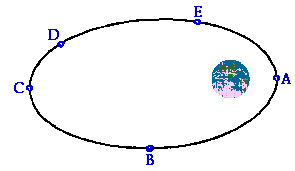
Q1. An object orbits the Earth in an elliptical path (A-B-C-D-E-A). Assume the Earth's mass is much larger than the object's. What are the consequences of this assumption?
Background
Topic: Newtonian Gravity and Orbital Motion
This question explores the two-body problem in Newtonian gravity, focusing on the simplification when one mass (Earth) is much larger than the other (the orbiting object). This is a common assumption in planetary motion problems.
Key Concepts:
Center of mass and reduced mass simplifications
Negligible effect of the smaller mass on the larger mass's motion
Earth can be considered stationary for calculations
Step-by-Step Guidance
Recall that in Newtonian gravity, both masses exert equal and opposite forces on each other, but the acceleration of the larger mass (Earth) is much smaller due to its much greater mass.
When , the center of mass of the system is very close to the center of the Earth, so the Earth's motion can be neglected.
This allows you to treat the orbit as if the object is moving around a fixed Earth, simplifying calculations of orbits, forces, and energies.
Think about how this affects the equations of motion and the conservation laws (energy, angular momentum) for the system.
Try solving on your own before revealing the answer!
Q1a. At point B, draw the velocity vector and the gravitational force vector. Split the force into components parallel and perpendicular to the motion. What effect does each component have on the velocity?
Background
Topic: Forces and Motion in Orbits
This question tests your understanding of vector decomposition and the effects of force components on an object's velocity in an elliptical orbit.
Key Terms and Formulas:
Velocity vector (): Tangent to the orbit at point B.
Gravitational force (): Points toward the center of the Earth.
Decomposition:
Step-by-Step Guidance
At point B, sketch the velocity vector tangent to the orbit (direction of motion).
Draw the gravitational force vector from point B toward the center of the Earth.
Decompose the gravitational force into two components: one parallel to the velocity (affects speed), and one perpendicular (affects direction).
Consider how the parallel component changes the magnitude of the velocity (increases or decreases speed), and how the perpendicular component changes the direction (curves the path).
Try solving on your own before revealing the answer!
Q1b. Repeat part a) for point D. What is qualitatively the same or different? How do the magnitudes of the velocity and gravitational force vectors at D and B compare?
Background
Topic: Variation of Orbital Speed and Force in Elliptical Orbits
This question asks you to compare the situation at two different points in the orbit, focusing on the direction and magnitude of vectors and their physical implications.
Key Concepts:
Conservation of angular momentum
Kepler's second law (equal areas in equal times)
Variation of gravitational force with distance ()
Step-by-Step Guidance
At point D, repeat the vector analysis: draw the velocity (tangent) and gravitational force (toward Earth).
Decompose the force into parallel and perpendicular components relative to the velocity.
Compare the distances from Earth at B and D to infer which has a stronger gravitational force (closer means stronger).
Use conservation of angular momentum to reason about the relative speeds at B and D.
Try solving on your own before revealing the answer!
