 Back
BackNewtonian Gravity: Orbits, Forces, and Energies – Step-by-Step Study Guidance
Study Guide - Smart Notes
 Tailored notes based on your materials, expanded with key definitions, examples, and context.
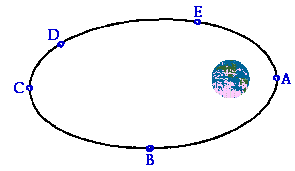
Q1. An object orbits the Earth in an elliptical path (A-B-C-D-E-A). Assume the Earth's mass is much larger than the object's. What are the consequences of this assumption?
Background
Topic: Newtonian Gravity and Orbital Motion
This question explores the two-body problem in Newtonian gravity, focusing on the simplification when one mass (Earth) is much larger than the other (the orbiting object). This is foundational for understanding satellite motion and planetary orbits.
Key Terms and Concepts:
Two-body problem
Center of mass
Negligible mass approximation
Step-by-Step Guidance
Consider the effect of the mass difference: When the Earth's mass is much larger than the object's, the center of mass of the system is essentially at the center of the Earth.
Think about the motion: The Earth remains nearly stationary, and the object traces an orbit around the Earth's center.
Reflect on gravitational force: The gravitational force is determined almost entirely by the Earth's mass, and the object's influence on the Earth is negligible.
Try solving on your own before revealing the answer!
Q2. At point B, draw the velocity vector and the gravitational force vector. Split the force into parallel and perpendicular components relative to the motion. What effect does each component have on the velocity?
Background
Topic: Forces in Orbital Motion
This question tests your understanding of vector decomposition and how forces affect velocity in elliptical orbits.
Key Terms and Formulas:
Velocity vector ($\vec{v}$): Tangent to the orbit at any point.
Gravitational force ($\vec{F}_g$): Points toward the center of the Earth.
Decomposition: $\vec{F}_g = F_{\parallel} + F_{\perp}$
Step-by-Step Guidance
At point B, sketch the velocity vector tangent to the orbit and the gravitational force vector pointing toward the Earth.
Decompose the gravitational force into two components: one parallel to the velocity (affecting speed), and one perpendicular (affecting direction).
Consider the effect: The parallel component changes the magnitude of the velocity (speed), while the perpendicular component changes the direction of the velocity vector.
Try solving on your own before revealing the answer!
Q3. Repeat part a) for point D. What is qualitatively the same or different? How do the magnitudes of the velocity and gravitational force vectors at D and B compare?
Background
Topic: Variation of Orbital Speed and Force in Elliptical Orbits
This question asks you to compare the situation at two different points in the orbit, focusing on how speed and force change with position.
Key Terms and Formulas:
Conservation of angular momentum
Kepler's second law
Gravitational force: $F_g = \frac{GMm}{r^2}$
Step-by-Step Guidance
At point D, repeat the vector analysis: draw the velocity (tangent) and gravitational force (toward Earth).
Compare the direction and magnitude of the vectors at D and B, considering their distances from Earth.
Discuss how the speed and force magnitudes relate to the object's position in the orbit (closer means faster and stronger force).
Try solving on your own before revealing the answer!
Q4. Based on your answers to parts a) and b), explain why the speed is maximum at point A and minimum at point C. Discuss the relative kinetic and gravitational potential energies at these points.
Background
Topic: Conservation of Energy in Orbits
This question tests your understanding of how energy is exchanged between kinetic and potential forms in elliptical orbits.
Key Terms and Formulas:
Kinetic energy: $K = \frac{1}{2}mv^2$
Gravitational potential energy: $U = -\frac{GMm}{r}$
Conservation of mechanical energy: $E = K + U$ (constant)
Step-by-Step Guidance
Recall that at the closest approach (A), $r$ is smallest, so $|U|$ is largest (most negative), and $v$ is largest (maximum kinetic energy).
At the farthest point (C), $r$ is largest, so $|U|$ is smallest (less negative), and $v$ is smallest (minimum kinetic energy).
Use conservation of energy to relate the values at A and C.
Try solving on your own before revealing the answer!
