 Back
BackNewton’s First Law of Motion—Inertia: Foundations, Concepts, and Applications
Study Guide - Smart Notes
 Tailored notes based on your materials, expanded with key definitions, examples, and context.
Chapter 2: Newton’s First Law of Motion—Inertia
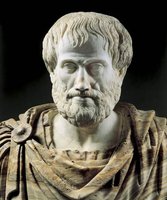
Aristotle’s Ideas of Motion
Early physics was shaped by Aristotle, who classified motion into two types: natural motion and violent motion. These ideas dominated scientific thought until the Renaissance.
Natural motion: Objects move to their 'proper place' determined by the four elements (earth, water, air, fire). On Earth, this meant straight up or down; in the heavens, circular motion.
Examples: Stones fall to the ground (earth seeking earth), smoke rises (air seeking air).
Violent motion: Motion imposed by external forces, such as wind moving a ship.
Galileo’s Concept of Inertia
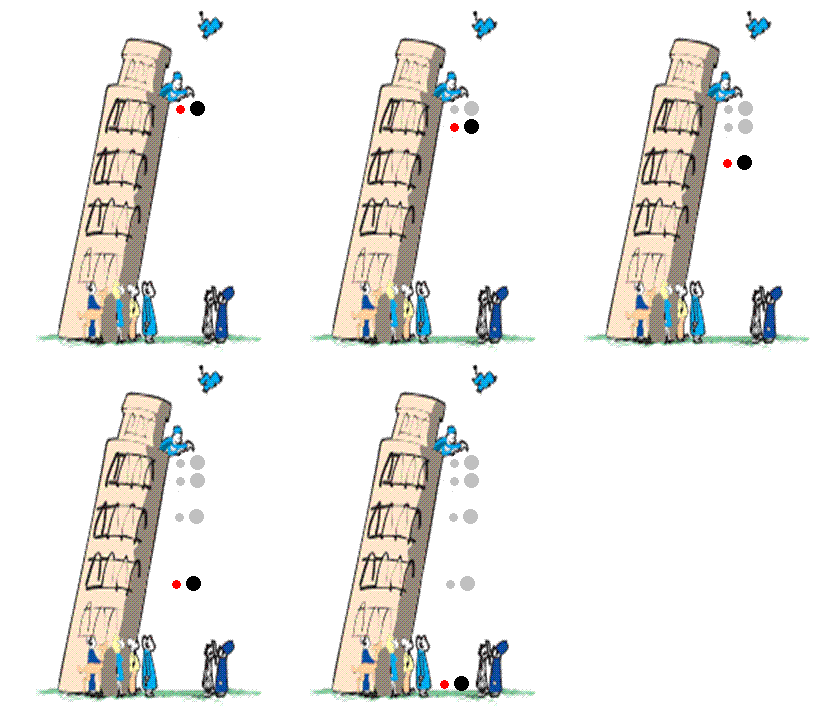
Galileo challenged Aristotle’s views in the 1500s, laying the groundwork for modern physics. He introduced the concept of inertia and demonstrated that objects of different weights fall at the same rate in the absence of air resistance.
Key discovery: A moving object does not need a force to keep moving if friction is absent.
Inertia: The property of matter to resist changes in motion; depends on mass.
Force: A push or pull acting on an object.
Galileo’s Inclined Plane Experiments
Galileo used inclined planes to study motion, showing that:
Balls rolling down a slope increase in speed.
Balls rolling up a slope decrease in speed.
Balls on a horizontal plane maintain their speed unless acted on by friction.
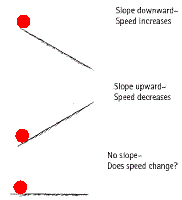
Additional info: These experiments helped Galileo isolate the effects of gravity and friction, leading to the concept of inertia.
Newton’s First Law of Motion (Law of Inertia)
Isaac Newton formalized Galileo’s findings in his First Law of Motion:
Statement: Every object continues in a state of rest or uniform motion in a straight line unless acted upon by a nonzero net force.
Implication: Objects resist changes to their state of motion due to inertia.
Inertia, Mass, and Weight
Understanding the differences between inertia, mass, and weight is fundamental in physics.
Inertia: Resistance to change in motion; proportional to mass.
Mass: The quantity of matter in an object; a measure of inertia (SI unit: kilogram).
Weight: The force of gravity acting on a mass. Calculated as:
Where W is weight (in newtons), m is mass (in kilograms), and g is acceleration due to gravity (9.8 m/s2 on Earth).
Mass vs. Weight: Mass is constant everywhere; weight varies with gravity.
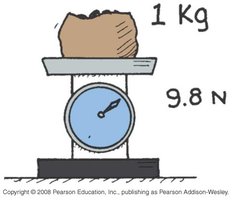
Example: A 1 kg object weighs 9.8 N on Earth but less on the Moon, though its mass remains 1 kg.
Force and Net Force
Forces are vector quantities, meaning they have both magnitude and direction. The net force is the vector sum of all forces acting on an object and determines changes in motion.
Vector representation: Arrows indicate magnitude and direction.
Examples of vectors: Force, velocity, acceleration.
Net force: If multiple forces act, they combine algebraically (taking direction into account).
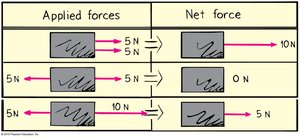
Example: If two people pull a box in opposite directions with 10 N and 5 N, the net force is 5 N in the direction of the larger force.
The Equilibrium Rule
An object is in equilibrium when the vector sum of all forces acting on it is zero. This is expressed as:
Static equilibrium: Object at rest (e.g., a bag hanging from a string).
Dynamic equilibrium: Object moving at constant velocity (e.g., puck sliding at constant speed).
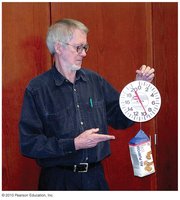
Example: A bag of flour suspended by a string is at rest because the upward tension equals the downward weight.
Support Force (Normal Force)
The support force (or normal force) is the upward force that balances the weight of an object resting on a surface.
Produced by the compression of atoms in the supporting surface.
Always acts perpendicular to the surface.
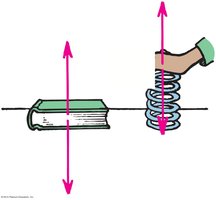
Example: A book on a table is supported by the upward normal force from the table.
Equilibrium of Moving Things
Equilibrium applies to both stationary and moving objects. If the net force is zero, the object is in equilibrium, whether at rest or moving at constant velocity.
Static equilibrium: No motion (e.g., crate at rest).
Dynamic equilibrium: Constant velocity (e.g., crate pushed at steady speed).
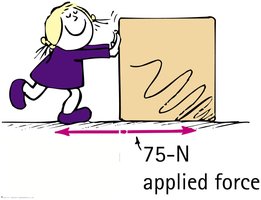
Example: If you push a crate at a steady speed and friction is 75 N, you must apply a force of 75 N in the opposite direction to maintain equilibrium.
The Moving Earth and Inertia
Copernicus proposed that Earth moves, which was controversial. Inertia explains why objects on Earth move with it: they retain their state of motion unless acted upon by a net force.
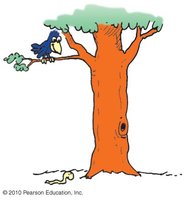
Example: A bird swooping from a branch to catch a worm moves with the Earth, as do the tree and worm.
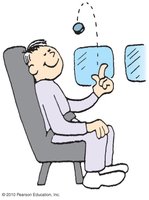
Example: Tossing a coin in a moving vehicle: the coin lands back in your hand because it retains the vehicle's horizontal motion due to inertia.
Summary Table: Mass, Weight, and Inertia
Property | Definition | SI Unit | Depends on Location? |
|---|---|---|---|
Mass | Amount of matter; measure of inertia | kilogram (kg) | No |
Weight | Force of gravity on mass | newton (N) | Yes |
Inertia | Resistance to change in motion | — | No (but proportional to mass) |
