 Back
Newton’s Law of Universal Gravitation, Satellite Motion, and Kepler’s Laws
Study Guide - Smart Notes
 Tailored notes based on your materials, expanded with key definitions, examples, and context.
Gravitation and Universal Gravity
Newton’s Law of Universal Gravitation
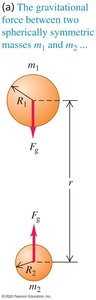
Newton’s Law of Universal Gravitation describes the attractive force between any two masses in the universe. This force is fundamental to understanding planetary motion, satellite orbits, and the structure of galaxies.
Definition: The gravitational force between two point masses is proportional to the product of their masses and inversely proportional to the square of the distance between their centers.
Formula: where is the gravitational constant, and are the masses, is the distance between centers.
Vector Form: The force acts along the line joining the centers of the masses.
Newton’s Third Law: The force is mutual; both masses experience equal and opposite forces.

Gravitational Force and Weight
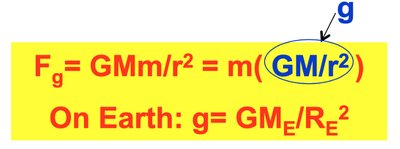
The weight of an object near the Earth’s surface is the gravitational force exerted by the Earth. For most practical purposes, only the Earth’s gravity is considered.
Formula: where is the mass of the Earth, is the radius of the Earth, is the mass of the object.
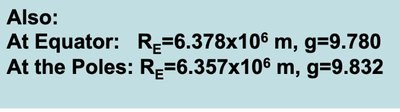
Acceleration due to Gravity: is nearly constant near the surface, but decreases with altitude.
Examples:
On Earth’s surface:
On top of Everest:
On the Moon:


Variation of g with Altitude
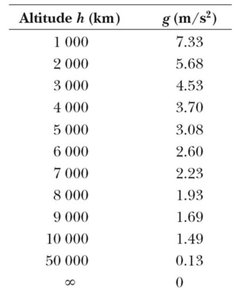
The acceleration due to gravity decreases as altitude increases above the Earth’s surface. This is important for understanding satellite motion and space travel.
Formula: where is the altitude above the surface.
Table: Altitude vs. values.
Altitude h (km) | g (m/s2) |
|---|---|
1,000 | 7.33 |
2,000 | 5.68 |
3,000 | 4.53 |
4,000 | 3.70 |
5,000 | 3.08 |
6,000 | 2.60 |
7,000 | 2.23 |
8,000 | 1.93 |
9,000 | 1.69 |
10,000 | 1.49 |
50,000 | 0.13 |
∞ | 0 |
Motion of Satellites and Orbits
Orbital Motion and Speed
Satellites and planets move in orbits due to the balance between gravitational force and their inertia. The speed and period of an orbit depend on the radius and the mass of the central body.
Orbital Speed: where is the mass of the central body, is the orbital radius.
Period of Orbit: For circular orbits around Earth:
Key Point: The speed of a satellite does not depend on its mass, only on the mass of the central body and the orbital radius.
Gravitational Potential Energy
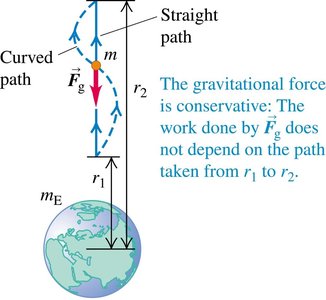
Gravitational potential energy is the energy associated with the position of an object in a gravitational field. The work done by gravity is path-independent, making it a conservative force.
Formula: where is the gravitational potential energy, is the distance from the center of the Earth.
Conservation of Energy: The total mechanical energy (kinetic + potential) is conserved in the absence of non-conservative forces.

Kepler’s Laws of Planetary Motion
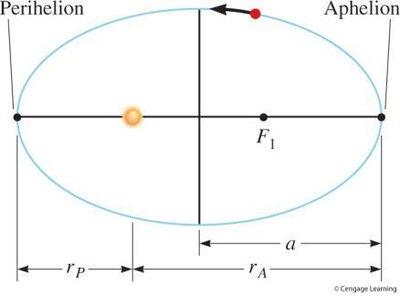
Kepler’s First Law: Elliptical Orbits
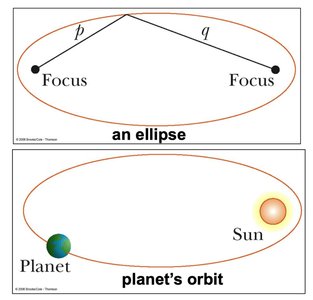
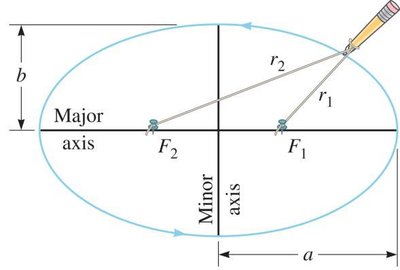
Kepler’s First Law states that planets move in elliptical orbits with the Sun at one focus. This law describes the shape of planetary orbits and is fundamental to celestial mechanics.
Ellipse: An ellipse has two foci; the sum of the distances from any point on the ellipse to the two foci is constant.
Planetary Orbit: The Sun occupies one focus; the other focus is empty.
Kepler’s Second Law: Equal Areas in Equal Times
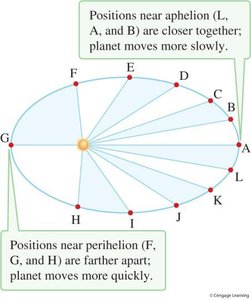
Kepler’s Second Law states that the radius vector from the Sun to a planet sweeps out equal areas in equal time intervals. This means planets move faster when closer to the Sun and slower when farther away.
Implication: Orbital speed varies; planets accelerate near perihelion and decelerate near aphelion.
Kepler’s Third Law: Period and Semimajor Axis
Kepler’s Third Law relates the orbital period of a planet to the size of its orbit. The square of the period is proportional to the cube of the semimajor axis.
Formula: is a constant for all planets orbiting the same star.
For the Solar System:
General Formula: where is the semimajor axis, is the mass of the Sun.
Cosmology: Dark Matter and Galaxy Rotation
Existence of Dark Matter
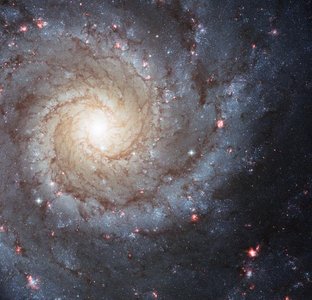
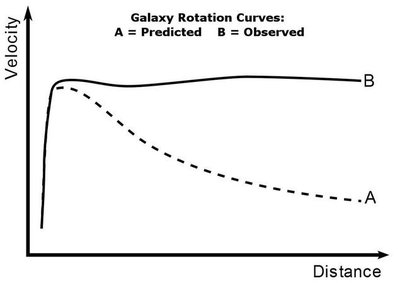
Observations of galaxy rotation curves reveal that the visible matter cannot account for the observed velocities. This discrepancy suggests the existence of dark matter, which exerts gravitational influence but does not emit light.
Galaxy Rotation Curves: Predicted curves based on visible matter differ from observed curves, indicating more mass is present than can be seen.
Formula for Orbital Velocity: Higher velocities imply greater mass.
Summary Table: Key Gravitation Formulas
Concept | Formula | Variables |
|---|---|---|
Newton’s Law of Gravitation | , , , | |
Weight on Earth | , | |
Acceleration due to Gravity | , , | |
Orbital Speed | , , | |
Orbital Period | , , | |
Gravitational Potential Energy | , , , | |
Kepler’s Third Law | , , |
Additional info:
Gravitational field is a concept where a mass creates a field in space, and another mass placed in this field experiences a force.
Satellite motion and planetary orbits are governed by the same gravitational principles.
Cosmological observations of galaxies provide evidence for dark matter due to discrepancies in rotation curves.
