 Back
BackNewton’s Laws and Forces: Calculus-Based Physics for Engineers
Study Guide - Smart Notes
 Tailored notes based on your materials, expanded with key definitions, examples, and context.
Newton’s Laws and Forces
Introduction to Forces
Forces are fundamental to understanding motion and interactions in physics. A force is defined as a push or pull exerted on an object by an agent. Forces are vector quantities, meaning they have both magnitude and direction. They can be classified as either contact forces (requiring physical contact) or long-range forces (acting at a distance, such as gravity).
Contact forces: Friction, tension, normal force, spring force, etc.
Long-range forces: Gravitational, electric, and magnetic forces.
Learning Outcomes
Define and describe the concept of force and its effects on objects.
Explain Newton’s First Law and the concept of inertial frames.
Differentiate between mass and weight and apply Newton’s Second Law to solve motion problems.
Describe gravitational force and its relationship to weight.
Explain Newton’s Third Law and its implications in different physical situations.
Apply Newton’s Second Law to analyze motion using free-body diagrams and problem-solving techniques.
Understand and calculate forces of friction in different scenarios.
Force Vectors
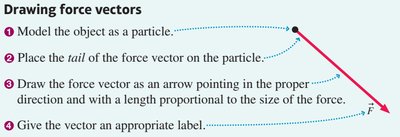
Forces are represented as vectors. To visualize forces acting on an object, we use force diagrams or free-body diagrams. The direction and length of the arrow represent the direction and magnitude of the force, respectively.

Combining Forces
When multiple forces act on an object, the net force (or resultant force) is found by vector addition of all individual forces. The net force determines the object's acceleration according to Newton's Second Law.
Example: Finding a Missing Force
Given two of three forces acting on an object, the third force can be found by ensuring the vector sum matches the net force direction.

Types of Forces
Type of Force | Description | Diagram |
|---|---|---|
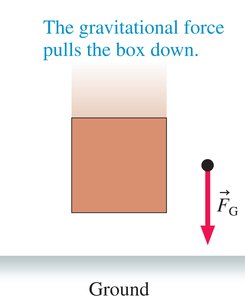
Gravity | Attractive force between two masses |
|
Spring Force | Restorative force exerted by a stretched or compressed spring |
|
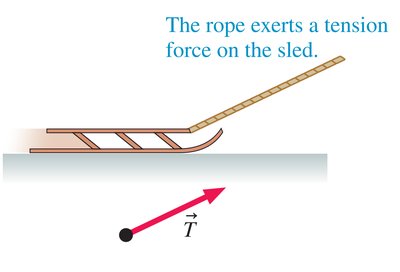
Tension | Pulling force transmitted by a rope, string, or cable |
|
Normal Force | Support force exerted by a surface perpendicular to an object |
|
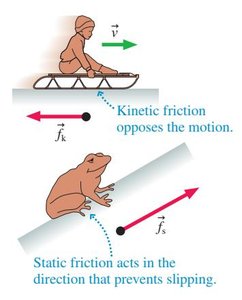
Friction | Resistive force between two surfaces in contact |
|
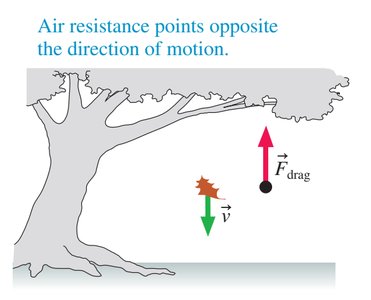
Drag | Air or fluid resistance opposing motion |
|
Thrust | Force applied to propel an object forward |
|
Electric & Magnetic | Forces due to electric and magnetic fields |
|




Identifying Forces in Physical Situations
To analyze a physical situation, identify all forces acting on the object. Common examples include:
Bungee jumper: Gravity, tension in the cord, air resistance (if significant).
Skier towed uphill: Tension from the rope, gravity, normal force from the ground, friction.
Rocket launch: Thrust, gravity, air resistance (drag).
Sliding rock: Gravity, normal force, friction (if present).
Newton’s Laws of Motion
Newton’s First Law (Law of Inertia)
Newton’s First Law states: An object at rest remains at rest, and an object in motion continues in a straight line at constant velocity, unless acted upon by a net external force. This law introduces the concept of inertia, the tendency of objects to resist changes in their state of motion.
Newton’s Second Law
Newton’s Second Law quantifies the relationship between force, mass, and acceleration:
Acceleration is directly proportional to the net force and inversely proportional to the object's mass.
More mass means less acceleration for the same force (greater inertia).
Example: If a 1500 kg car is pulled by a 2500 N force with 200 N friction, its acceleration is:
Newton’s Third Law
Newton’s Third Law states: For every action, there is an equal and opposite reaction. This means that forces always occur in pairs, acting on different objects.
If object A exerts a force on object B, then object B exerts an equal and opposite force on object A.
Mass and Weight
Mass is a measure of an object's resistance to acceleration (inertia). Weight is the gravitational force acting on an object:
On Earth, .
Weight changes with location (e.g., on Mars, ), but mass remains constant.
Free-Body Diagrams
A free-body diagram is a visual tool used to show all the forces acting on a single object. Each force is represented by an arrow pointing in the direction the force acts, with the length proportional to the force's magnitude.
Identify the object of interest.
Draw all forces acting on the object (gravity, normal, friction, tension, etc.).
Label each force clearly.
Equilibrium
An object is in equilibrium if the net force acting on it is zero. In this state, the object is either at rest or moving with constant velocity (no acceleration).
Problem-Solving with Newton’s Laws
Draw a free-body diagram for the object.
Write Newton’s Second Law for each direction (x and y components).
Solve for the unknowns (acceleration, force, tension, etc.).
Sample Problems and Applications
Finding acceleration: Given forces and mass, use .
Finding tension: For objects suspended or pulled by ropes, analyze forces and solve for tension.
Inclined planes: Resolve forces parallel and perpendicular to the surface; consider gravity, normal force, and friction.
Friction: Kinetic friction opposes motion; static friction prevents slipping. Use and .
Summary Table: Common Forces
Force | Symbol | Equation | Description |
|---|---|---|---|
Weight | Gravitational force on an object | ||
Normal | — | Perpendicular support force from a surface | |
Tension | — | Pulling force from a rope or cable | |
Friction | Resistive force opposing motion | ||
Spring | Restoring force from a spring (Hooke’s Law) |
Additional info: These notes expand on the provided slides by including definitions, equations, and structured examples for clarity and completeness. The images included are only those directly illustrating force concepts, vector addition, and types of forces as described in the text.
