 Back
BackNewton's Laws and Forces: Practice Questions with Step-by-Step Guidance
Study Guide - Smart Notes
 Tailored notes based on your materials, expanded with key definitions, examples, and context.
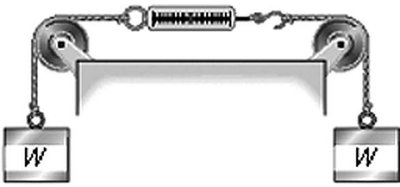
Q4. Two objects, each of weight W, hang vertically by spring scales as shown in the figure. The pulleys and the strings attached to the objects have negligible weight, and there is no appreciable friction in the pulleys. What is the reading in each scale?
Background
Topic: Newton's Third Law and Tension in Strings
This question tests your understanding of how forces are transmitted through strings and pulleys, and how spring scales measure tension in such systems.
Key Terms and Formulas:
Tension (T): The force transmitted through a string, rope, or cable when it is pulled tight by forces acting from opposite ends.
Newton's Third Law: For every action, there is an equal and opposite reaction.
Equilibrium: If the system is at rest, the forces must balance (net force is zero).
Step-by-Step Guidance
Consider the forces acting on each weight. Each weight experiences a downward force equal to its weight, .
Analyze the tension in the string. Since the pulleys and strings are massless and frictionless, the tension throughout the string is the same.
Think about what the spring scale measures. It measures the tension in the string connecting the two weights.
Set up the force balance for one of the weights: the upward tension must balance the downward weight for equilibrium.
Try solving on your own before revealing the answer!
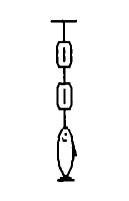
Q5. A fish weighing 16 N is weighed using two spring scales, each of negligible weight, as shown in the figure. What will be the readings of the scales?
Background
Topic: Tension in Series and Parallel Arrangements
This question checks your understanding of how forces are distributed in a system with two spring scales and a single hanging weight.
Key Terms and Formulas:
Spring Scale: Measures the tension force in the direction it is pulled.
Equilibrium: The sum of the upward forces (tensions) must equal the downward force (weight of the fish).
Step-by-Step Guidance
Identify the forces acting on the fish: its weight (16 N) acts downward.
Consider the arrangement: the two spring scales are in series (one above the other).
Think about what each scale measures. The tension in the string above and below the fish must support the fish's weight.
Set up the force balance for the system: the tension in each scale must balance the weight of the fish for equilibrium.
Try solving on your own before revealing the answer
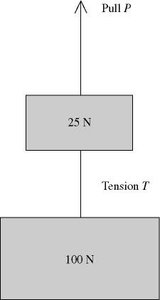
Q8. Two weights are connected by a massless wire and pulled upward with a constant speed of 1.50 m/s by a vertical pull P. The tension in the wire is T (see figure). Which one of the following relationships between T and P must be true?
Background
Topic: Tension, Forces in Connected Objects, and Equilibrium
This question tests your ability to analyze forces in a system of connected objects moving at constant velocity (implying zero acceleration).
Key Terms and Formulas:
Tension (T): The force in the wire connecting the two weights.
Pull (P): The total upward force applied to the system.
Equilibrium (constant velocity): The net force on the system is zero, so upward forces must balance downward forces (weights).
Step-by-Step Guidance
Identify the forces acting on each block: the lower block has weight 100 N, the upper block has weight 25 N.
Since the system moves at constant speed, the net force on each block is zero (no acceleration).
For the lower block, the tension T must balance its weight (100 N).
For the upper block, the pull P must balance both its own weight and the tension from the lower block.
Try solving on your own before revealing the answer!
