 Back
BackNewton’s Laws, Equilibrium, and Friction: Study Notes
Study Guide - Smart Notes
 Tailored notes based on your materials, expanded with key definitions, examples, and context.
Newton’s Laws and Friction
Core Concepts and Learning Objectives
Newton’s laws of motion form the foundation for understanding the dynamics of objects. This section covers the application of Newton’s laws to equilibrium, interacting objects, ropes, pulleys, and friction. Students will learn to distinguish between mass, weight, and apparent weight, and analyze systems using free-body diagrams.
Apply Newton’s 2nd and 3rd laws to equilibrium and dynamics problems.
Distinguish mass, weight, and apparent weight in various contexts.
Analyze systems of interacting objects and identify action-reaction pairs.
Calculate tension in ropes and pulleys using the massless approximation.
Equilibrium
Static and Dynamic Equilibrium
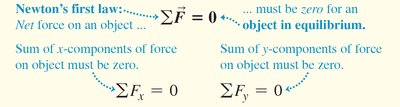
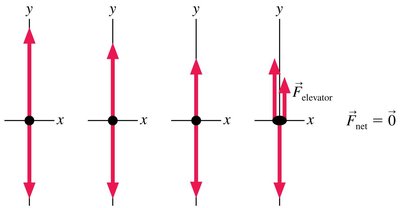
An object is in equilibrium when it is at rest (static equilibrium) or moving with constant velocity (dynamic equilibrium) in an inertial frame. The essential principle is Newton’s first law: the net force on an object must be zero.
Static equilibrium: Object at rest.
Dynamic equilibrium: Object moving at constant velocity.
Mathematical condition:
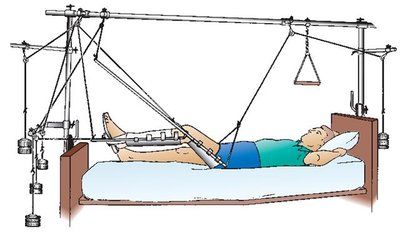
Example: A person lying in a hospital bed with traction apparatus is in static equilibrium; all forces (weights, tensions) balance.
Dynamics and Newton’s Second Law
Newton’s Second Law and Acceleration
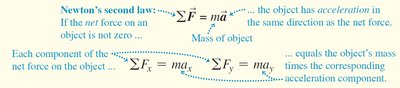
Newton’s second law describes how the net force on an object causes acceleration. The law can be decomposed into components for analysis in two dimensions.
Newton’s second law:
Component form: ,
Objects not in equilibrium experience acceleration; their velocity changes in magnitude or direction.
Mass, Weight, Apparent Weight, and Weightlessness
Definitions and Physical Context
Mass is a measure of an object’s inertia. Weight is the gravitational force exerted by a planet on an object, given by . Apparent weight is the normal force felt by an object, which can differ from true weight in accelerating systems. Weightlessness occurs when the only force acting is gravity, such as in free-fall or orbit.
Weight:
Apparent weight: The normal force, , measured by a scale.
Weightlessness: Apparent weight is zero; occurs in free-fall or orbit.


Elevator Example: Apparent Weight
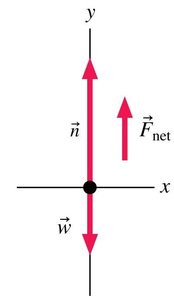
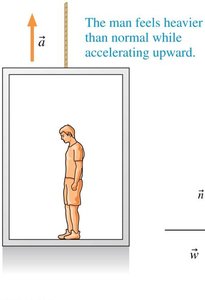
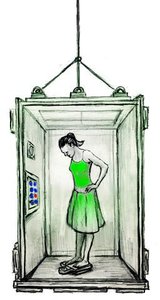
When standing on a scale in an elevator, the apparent weight changes depending on the elevator’s acceleration. If the elevator accelerates upward, the normal force (apparent weight) is greater than the true weight.
Normal force (): The force exerted by the scale.
Upward acceleration:
Downward acceleration:
Interconnecting Objects, Ropes, and Pulleys
Systems of Interacting Objects
When multiple objects are in contact or connected, Newton’s laws apply to each object and the system as a whole. Action-reaction pairs (Newton’s third law) are crucial for analyzing forces between objects.
Acceleration: Objects in contact move together with the same acceleration.
Net force: Different masses mean different net forces for same acceleration.
Normal forces: The normal force by the table equals the weight for each block.
Action-reaction pairs: Forces between blocks are equal in magnitude and opposite in direction.
Example: Two blocks in contact on a frictionless table, pushed by a hand.
Ropes and Tension
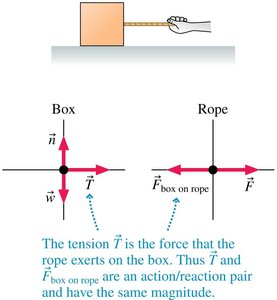
The tension in a massless rope is constant throughout its length and equals the force applied at either end. Tension is an action-reaction pair.
Tension (): Force exerted by a rope or string.
Massless approximation: Tension is the same at both ends.
Action-reaction: Tension and force by box on rope are equal and opposite.
Pulleys and Mechanical Advantage
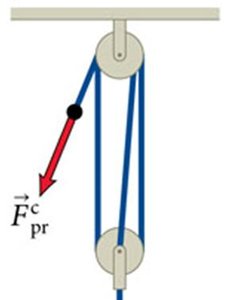
Pulleys are used to change the direction of forces and provide mechanical advantage. In systems with massless ropes and pulleys, the tension is the same in all segments, and the force required to lift a load can be calculated using free-body diagrams.
Mechanical advantage: Multiple rope segments reduce the force needed to lift a load.
Free-body diagram: Essential for analyzing forces in pulley systems.
Summary Table: Forces in Interconnected Systems
Object | Horizontal Forces | Vertical Forces | Acceleration |
|---|---|---|---|
Block 1 | Hand force (), Normal force by block 2 () | Normal force by table (), Weight () | Same as block 2 |
Block 2 | Normal force by block 1 () | Normal force by table (), Weight () | Same as block 1 |
System | Hand force () | Normal force by table (), Weight () | Acceleration of both blocks |
Additional info: The table summarizes the forces acting on each block and the system, highlighting the importance of Newton’s laws in analyzing interconnected objects.
