Back
BackNewton's Laws, Forces, and Free-Body Diagrams: Study Notes
Study Guide - Smart Notes
 Tailored notes based on your materials, expanded with key definitions, examples, and context.
Definition and Identification of Forces
What is a Force?
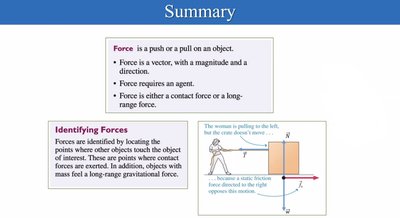
A force is a push or pull exerted on an object. It is a vector quantity, meaning it has both magnitude and direction. Forces require an agent (the source of the force) and can be classified as either contact forces (arising from physical contact) or long-range forces (such as gravity).
Force Vector: Represented by an arrow showing direction and magnitude.
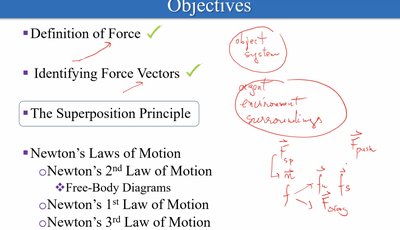
Agent: The entity causing the force (e.g., Earth, cable).
Environment: The surroundings that may exert forces on the object.
Identifying Force Vectors
To analyze forces acting on an object, identify all points of contact and sources of long-range forces. Typical forces include gravity, normal force, friction, tension, and applied forces.
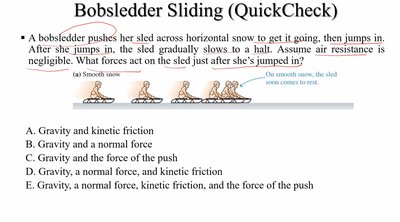
Gravity: Acts downward, due to Earth's mass.
Normal Force: Perpendicular to the surface of contact.
Friction: Opposes motion, acts parallel to the surface.
Tension: Pulling force exerted by a string, rope, or cable.
The Superposition Principle
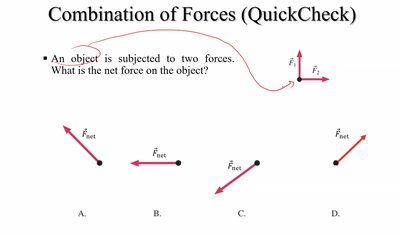
Combination of Forces
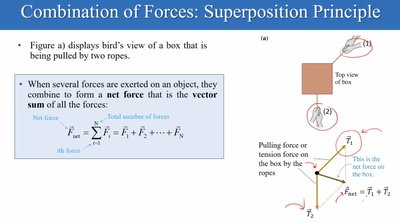
When multiple forces act on an object, the net force is the vector sum of all individual forces. This principle is known as the superposition principle.
Net Force Formula:
Vector Addition: Forces are added using vector addition rules, often visualized with parallelogram or triangle methods.
Application: Predicts the motion of an object based on the net force.
QuickCheck: Net Force Direction
When an object is subjected to two forces, the net force is found by vector addition. The direction and magnitude of the net force determine the object's acceleration.
Newton's Laws of Motion
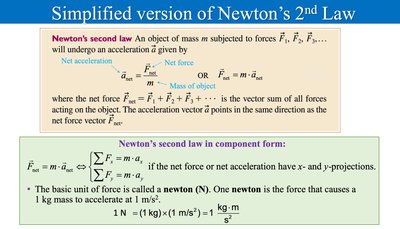
Newton's Second Law
Newton's second law states that the acceleration of an object is proportional to the net force acting on it and inversely proportional to its mass.
Mathematical Form:
Component Form: ,
Unit of Force: The newton (N) is the SI unit of force:
Relationship Between Force and Acceleration
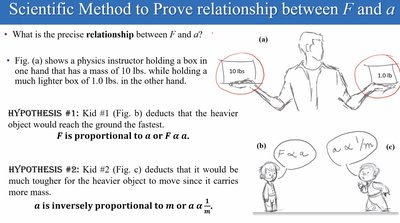
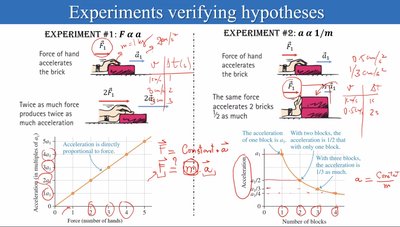
Experiments show that acceleration is directly proportional to force and inversely proportional to mass. This relationship is fundamental to Newton's second law.
Direct Proportionality:
Inverse Proportionality:
Mass as a Measure of Inertia
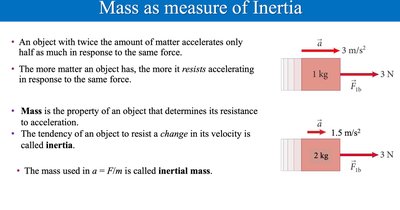
Inertia is the tendency of an object to resist changes in its velocity. The mass of an object quantifies its inertia; more mass means more resistance to acceleration.
Inertial Mass: The mass used in is called inertial mass.
Example: Applying the same force to objects of different masses results in different accelerations.
Typical Magnitudes of Forces
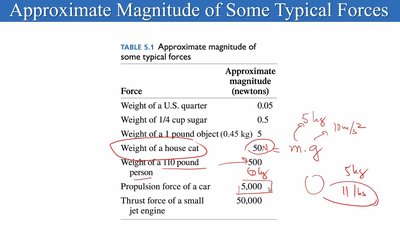
Forces in everyday life vary widely in magnitude. The table below provides examples of typical forces measured in newtons.
Force | Approximate Magnitude (N) |
|---|---|
Weight of U.S. quarter | 0.05 |
Weight of 1/4 cup sugar | 0.5 |
Weight of 1 pound object (0.45 kg) | 5 |
Weight of a house cat | 50 |
Weight of 110 pound person | 500 |
Propulsion force of a car | 5,000 |
Thrust force of a small jet engine | 50,000 |
Limitations of Newton's Second Law
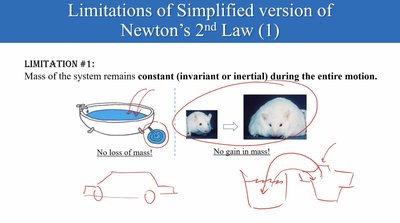
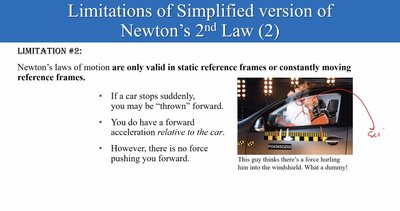
Newton's second law assumes constant mass and validity only in inertial (non-accelerating) reference frames.
Limitation 1: Mass of the system must remain constant during motion.
Limitation 2: Laws are valid only in static or constantly moving reference frames.
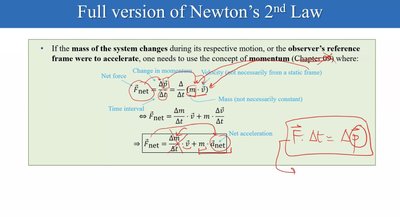
Full Version of Newton's Second Law
If the mass of the system changes or the reference frame is accelerating, Newton's second law must be expressed in terms of momentum:
Momentum Form:
Where: is momentum, is the time interval.
Free-Body Diagrams (FBDs)
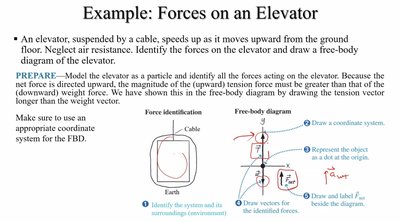
Constructing Free-Body Diagrams
A free-body diagram is a visual tool used to represent all forces acting on an object. It helps in solving dynamics problems by clarifying the sources and directions of forces.
Identify the system and environment.
Draw a coordinate system.
Represent the object as a dot at the origin.
Draw vectors for each identified force.
Draw and label the net force vector if appropriate.
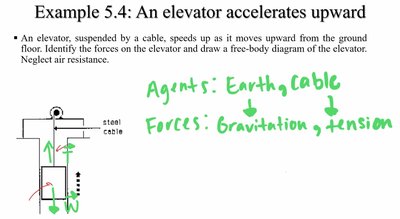
Example: Elevator Accelerating Upward
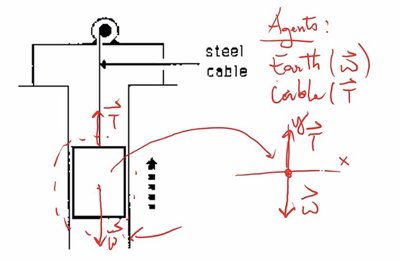
For an elevator moving upward, the forces acting are gravitational force (downward) and tension from the cable (upward). The tension must be greater than the weight for upward acceleration.
Agents: Earth (gravity), cable (tension).
FBD: Shows vectors for tension and weight.
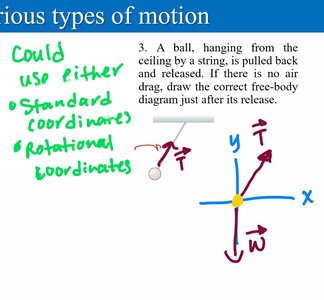
FBDs for Various Types of Motion
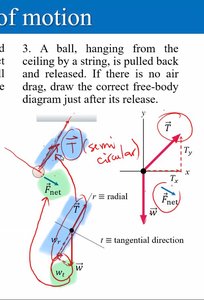
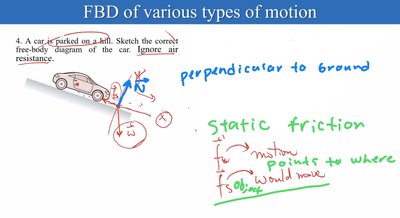
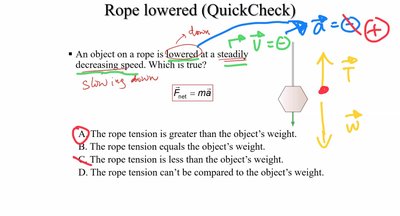
Free-body diagrams can be constructed for objects in different scenarios, such as balls hanging from strings or cars parked on hills. The choice of coordinate system can simplify analysis.
Ball on String: Tension acts upward, weight acts downward.
Car on Hill: Normal force acts perpendicular to ground, static friction opposes motion.
Summary
Force is a vector quantity that causes changes in motion. The net force determines acceleration according to Newton's second law. Free-body diagrams are essential tools for visualizing and analyzing forces in physics problems.