 Back
BackNewton's Laws, Forces, and Friction – Step-by-Step Physics Guidance
Study Guide - Smart Notes
 Tailored notes based on your materials, expanded with key definitions, examples, and context.
Q1. By Newton's 1st Law, what can a net force applied to an object cause the object to do?
Background
Topic: Newton's First Law of Motion
This question tests your understanding of inertia and how a net force affects an object's motion.
Key Terms:
Inertia: The tendency of an object to resist changes in its state of motion.
Net Force: The overall force acting on an object after all forces are combined.
Step-by-Step Guidance
Recall Newton's First Law: An object at rest stays at rest, and an object in motion stays in motion unless acted upon by a net force.
Think about what happens when a net force is applied: The object's velocity will change.
Consider the specific ways the motion can change: The object can start moving, stop moving, or change direction.
Try solving on your own before revealing the answer!
Q2. By Newton's Second Law of Motion:
Background
Topic: Newton's Second Law of Motion
This question tests your understanding of the relationship between force, mass, and acceleration.
Key formula:
: Net force (in Newtons)
: Mass (in kilograms)
: Acceleration (in meters per second squared)
Step-by-Step Guidance
For part (a): Consider how net force and acceleration are related in the formula.
For part (b): Consider how mass and acceleration are related when force is constant.
Think about proportionality: Direct vs. inverse relationships.
Try solving on your own before revealing the answer!
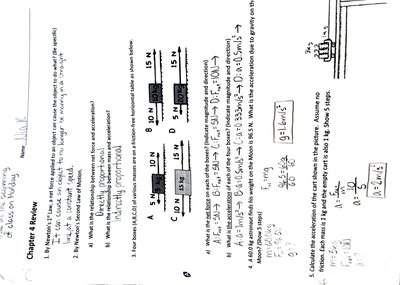
Q3. Four boxes (A, B, C, D) of various masses are on a friction-free horizontal table. What is the net force and acceleration for each box?
Background
Topic: Newton's Second Law, Net Force, and Acceleration
This question tests your ability to calculate net force and acceleration for objects with different masses and applied forces.
Key formula:
: Net force (in Newtons)
: Mass (in kilograms)
: Acceleration (in meters per second squared)
Step-by-Step Guidance
Identify the mass and force for each box from the diagram.
For each box, use to set up the calculation.
Check the direction of the force and acceleration (all to the right in this case).
Plug in the values for each box, but stop before calculating the final acceleration.
Try solving on your own before revealing the answer!
Q4. A 60.0 kg astronaut finds his weight on the Moon is 96.5 N. What is the acceleration due to gravity on the Moon?
Background
Topic: Weight and Gravity
This question tests your ability to relate weight to mass and gravitational acceleration.
Key formula:
: Weight (in Newtons)
: Mass (in kilograms)
: Acceleration due to gravity (in meters per second squared)
Step-by-Step Guidance
Identify the astronaut's mass and weight.
Use the formula to set up the calculation for .
Rearrange the formula to solve for : .
Plug in the values, but stop before calculating the final value.
Try solving on your own before revealing the answer!
Q5. Calculate the acceleration of the cart shown in the picture. Assume no friction. Each mass is 1 kg and the empty cart is also 1 kg. Show 5 steps.
Background
Topic: Newton's Second Law, System of Masses
This question tests your ability to calculate acceleration for a system with multiple masses.
Key formula:
: Net force (in Newtons)
: Total mass (in kilograms)
: Acceleration (in meters per second squared)
Step-by-Step Guidance
Identify the total mass (cart plus all attached masses).
Identify the net force acting on the system.
Set up the formula .
Plug in the values, but stop before calculating the final acceleration.
Try solving on your own before revealing the answer!
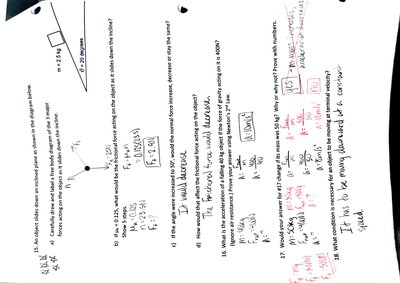
Q15. An object slides down an inclined plane as shown in the diagram below.
Background
Topic: Forces on an Inclined Plane, Friction
This question tests your ability to analyze forces acting on an object sliding down an incline, including friction.
Key Terms and Formulas:
Normal Force (): The perpendicular force exerted by the surface.
Frictional Force ():
Gravity (): The force pulling the object down.
Step-by-Step Guidance
Draw a free body diagram showing gravity, normal force, and friction.
Label each force and indicate their directions relative to the incline.
Use to set up the calculation for friction.
Consider how changing the angle affects the normal force and friction.
Try solving on your own before revealing the answer!
