 Back
BackNewton's Laws, Forces, and Friction: Step-by-Step Physics Guidance
Study Guide - Smart Notes
 Tailored notes based on your materials, expanded with key definitions, examples, and context.
Q1. True or False: Conceptual Physics Statements
Background
Topic: Newton's Laws, Forces, and Friction
This set of questions tests your understanding of basic concepts in Newtonian mechanics, including inertia, acceleration, friction, tension, and the effects of forces on motion.
Key Terms:
Inertia: The tendency of an object to resist changes in its state of motion.
Acceleration: The rate of change of velocity of an object.
Friction: The force that opposes the relative motion of two surfaces in contact.
Tension: The pulling force transmitted through a string, rope, or cable.
Normal Force: The force perpendicular to the surface that supports the weight of an object.
Step-by-Step Guidance
Read each statement carefully and recall the relevant physics principle (e.g., Newton's First Law for inertia, Newton's Second Law for acceleration and mass).
For each statement, ask yourself: Does this match what you know from the laws of motion or definitions of forces?
For statements about friction, remember the difference between static and kinetic friction, and how they act during motion or at rest.
For statements about tension and forces, consider how angles and directions affect the magnitude of forces in a system.
For each, circle True or False based on your reasoning, but be sure to justify your choice with a brief explanation to yourself.
Try solving on your own before revealing the answer!
Q2. Two blocks connected by a string over a pulley: Find the coefficient of kinetic friction
Background
Topic: Dynamics of Connected Objects, Friction
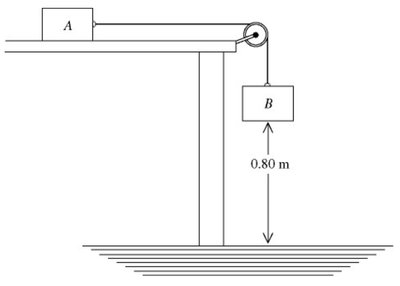
This question involves analyzing the motion of two masses connected by a string over a pulley, with one mass sliding on a horizontal surface with friction and the other hanging vertically. You are asked to find the coefficient of kinetic friction between the table and the sliding block.
Key Terms and Formulas:
Newton's Second Law:
Kinematic Equation:
Kinetic Friction Force:
Normal Force (horizontal surface):
Step-by-Step Guidance
Let the mass of each block be , and the distance the hanging block falls is in .
Use the kinematic equation to solve for the acceleration of the system: (since initial velocity is zero).
Draw free-body diagrams for both blocks. For the hanging block, consider gravity and tension; for the sliding block, consider tension, friction, and normal force.
Write Newton's Second Law for each block:
Hanging block:
Sliding block:
Express the friction force as and combine the equations to solve for in terms of known quantities and the calculated acceleration.
Try solving on your own before revealing the answer!
Q3. Block on a frictionless surface with two forces: Find net force, acceleration, and normal force
Background
Topic: Newton's Second Law, Vector Addition of Forces
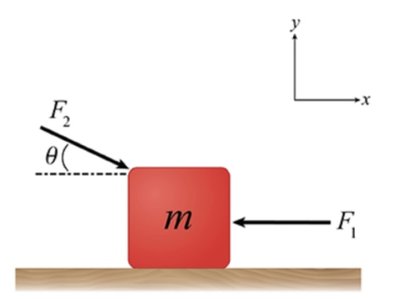
This question asks you to analyze the forces acting on a block on a frictionless surface, resolve the forces into components, and determine the net force, acceleration, and normal force.
Key Terms and Formulas:
Newton's Second Law:
Force Components: ,
Normal Force: (if is downward)
Step-by-Step Guidance
Resolve into its x and y components using the given angle .
Sum the forces in the x-direction: (be careful with signs).
Apply Newton's Second Law in the x-direction to find the acceleration: .
Sum the forces in the y-direction to find the normal force: (if is downward).
Check the direction of each force and ensure all units are consistent before proceeding to calculations.
Try solving on your own before revealing the answer!
Q4. Traffic light suspended by two cables: Draw free-body diagram and find tensions
Background
Topic: Equilibrium of Forces, Tension in Cables
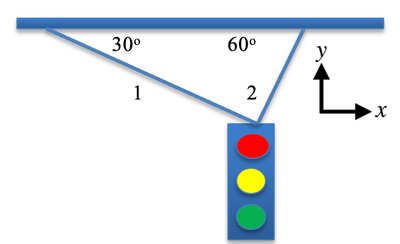
This question involves analyzing a traffic light suspended by two cables at different angles. You are asked to draw a free-body diagram and calculate the tension in each cable.
Key Terms and Formulas:
Equilibrium Condition: ,
Tension Components: , (vertical); , (horizontal)
Weight:
Step-by-Step Guidance
Draw a free-body diagram showing the weight of the traffic light and the tensions in both cables at their respective angles.
Write the equilibrium equations for the x and y directions, setting the sum of forces to zero.
Express the vertical and horizontal components of the tensions using the given angles (30° and 60°).
Set up a system of equations to solve for and using the equilibrium conditions.
Substitute the known values (mass, angles, gravity) into your equations, but stop before solving for the tensions.
Try solving on your own before revealing the answer!
Q5. Crate on a frictionless inclined plane with applied force: Draw diagram, find normal force and applied force
Background
Topic: Forces on an Inclined Plane, Newton's Second Law
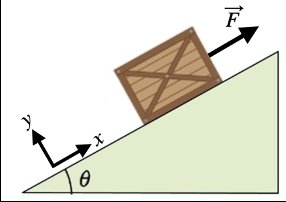
This question asks you to analyze a crate on a frictionless incline, draw a free-body diagram, and calculate the normal force and the applied force needed to achieve a given acceleration up the plane.
Key Terms and Formulas:
Normal Force:
Component of Gravity Parallel to Incline:
Newton's Second Law (along incline):
Step-by-Step Guidance
Draw a free-body diagram showing all forces acting on the crate: gravity, normal force, and applied force up the incline.
Resolve the gravitational force into components parallel and perpendicular to the incline.
Write the equation for the normal force using the perpendicular component: .
Write Newton's Second Law along the incline: .
Substitute the given values (mass, angle, acceleration) into your equations, but stop before calculating the final values for and .
Try solving on your own before revealing the answer!
