 Back
BackNewton’s Laws, Forces, Friction, Circular Motion, and Gravitation – Study Notes
Study Guide - Smart Notes
 Tailored notes based on your materials, expanded with key definitions, examples, and context.
Review of Newton’s Laws and Forces
Overview of Forces
Forces are interactions between objects that can cause changes in motion. Understanding the different types of forces and how they combine is fundamental to analyzing physical systems.
Weight (w): The gravitational force exerted by the Earth on an object, always directed downward. Magnitude: .
Normal Force (n): The perpendicular contact force exerted by a surface on an object resting on it. Magnitude is generally unknown until analyzed.
Tension (T): The pulling force transmitted by a string, rope, or cable when attached to an object and pulled taut.
Friction (f): The force that opposes the relative motion or tendency of such motion of two surfaces in contact. Two types: static and kinetic friction.
Static and Kinetic Friction
Frictional forces arise from the interaction between surfaces. The maximum static friction must be overcome to initiate motion, after which kinetic friction acts.
Static Friction (): Prevents motion up to a maximum value .
Kinetic Friction (): Opposes motion once sliding begins, with constant magnitude .
Coefficients: (static) and (kinetic) are dimensionless and depend on the surfaces in contact. Typically, .
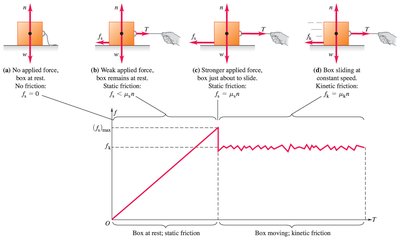
Example: A box at rest requires increasing force to overcome static friction. Once moving, kinetic friction remains constant.
Newton’s Laws of Motion
Newton’s First Law (Law of Inertia)
An object remains at rest or in uniform motion unless acted upon by a net external force. This law defines inertial reference frames.
Inertia: The tendency of an object to resist changes in its state of motion.
Inertial Frame: A frame of reference in which Newton’s first law holds (e.g., Earth’s surface, approximately).
Newton’s Second Law
The acceleration of an object is directly proportional to the net force acting on it and inversely proportional to its mass.
Vector Form:
Component Form: , ,
Mass: A measure of an object’s inertia; the greater the mass, the less acceleration for a given force.
Apparent Weight in an Elevator
The normal force measured by a scale can differ from the true weight depending on the acceleration of the elevator.
At rest or constant velocity:
Accelerating upward:
Accelerating downward:
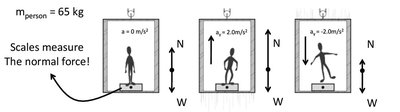
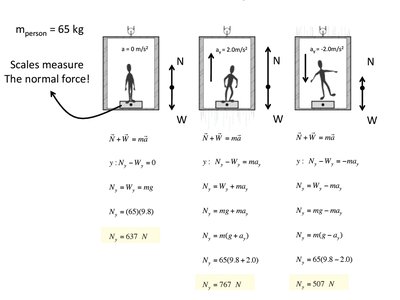
Example: A 65 kg person in an elevator accelerating upward at experiences a normal force of .
Newton’s Third Law
For every action, there is an equal and opposite reaction. Forces always occur in pairs acting on different objects.
If object A exerts a force on object B, then B exerts an equal and opposite force on A: .
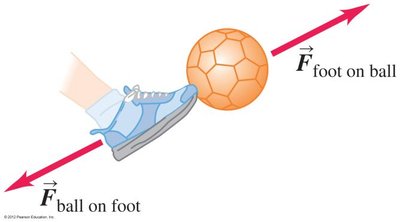
Applications and Problem Solving with Forces
Free-Body Diagrams (FBDs)
FBDs are essential tools for visualizing all forces acting on an object. Each force is represented as a vector arrow pointing in the direction of the force.
Identify all forces: gravity, normal, tension, friction, applied forces, etc.
Draw vectors from the center of mass of the object.
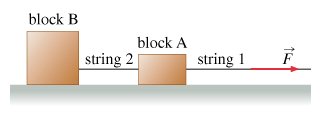
Practice: Pulling Two Blocks
When two blocks are connected by strings and pulled, the tension in the string closer to the pulling force is greater due to the need to accelerate both blocks.
Practice: Friction Force on a Box
Given a box with weight , , :
(a) At rest, friction force balances any applied force up to .
(b) If a 6.0 N force is applied and the box is at rest, friction force is 6.0 N (as long as ).
(c) Minimum force to start motion: .
(d) Minimum force to keep moving: .
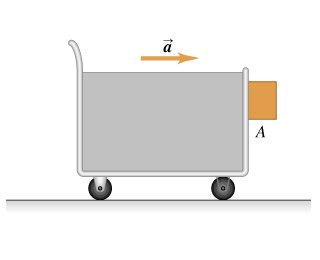
Practice: Block on Accelerating Cart
To prevent a block from falling off a vertically moving cart, the required acceleration is determined by static friction: .
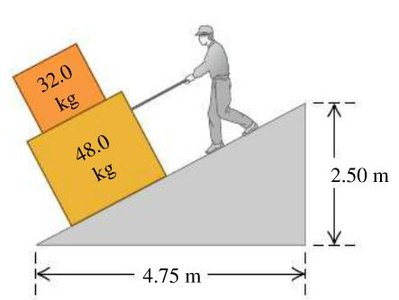
Practice: Two Boxes on an Incline
When lowering two boxes down a ramp at constant speed, friction forces and the direction of friction must be analyzed for both boxes. The static friction between boxes prevents slipping, while kinetic friction acts between the lower box and the ramp.
Dynamics of Uniform Circular Motion (UCM)
Circular Motion and Centripetal Force
For an object moving in a circle of radius at constant speed , the net force and acceleration are directed toward the center (centripetal).
Centripetal acceleration:
Centripetal force:
If the force maintaining circular motion is removed, the object moves in a straight line tangent to the circle (Newton’s first law).
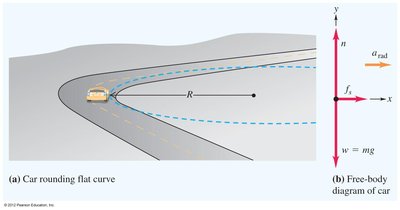
Car Rounding a Flat Curve
Static friction provides the centripetal force for a car rounding a flat curve. The maximum speed before sliding is:
Apparent Weight on a Ferris Wheel
At the top of a Ferris wheel, the normal force (apparent weight) is reduced due to the centripetal acceleration required for circular motion.
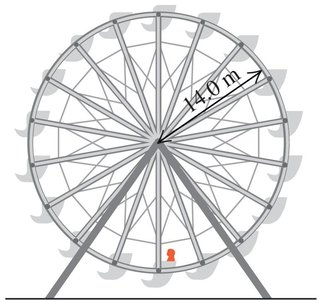
Rotating Cone Problem
A block inside a rotating cone experiences forces from gravity, normal force, and static friction. The minimum and maximum periods for the block to remain at constant height depend on the angle and friction coefficient.
Newton’s Law of Universal Gravitation
Law of Gravitation
Every two masses attract each other with a force proportional to the product of their masses and inversely proportional to the square of the distance between them:
Direction: Along the line joining the centers of the two masses.
Action-reaction pair: Forces are equal in magnitude and opposite in direction.
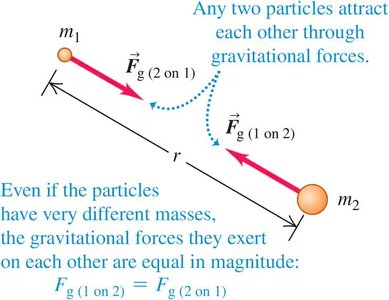
Gravitational Force Near and Inside Earth
On Earth’s surface ():
Above surface:
Inside Earth: decreases linearly with (assuming uniform density)
Motion of Satellites and Orbital Mechanics
Satellites in circular orbits experience gravitational force as the centripetal force. The orbital speed and period depend only on the radius of the orbit and the mass of the central body (e.g., Earth).
Orbital speed:
Orbital period:

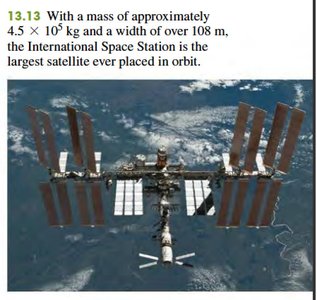
Example: The International Space Station orbits at a height of about 400 km above Earth’s surface, with a period of approximately 93 minutes.
Summary Table: Common Forces in Mechanics
Force | Symbol | Direction | Magnitude |
|---|---|---|---|
Weight | w | Downward | |
Normal | n | Perpendicular to surface | Varies |
Tension | T | Along string/rope | Varies |
Static Friction | Opposes potential motion | ||
Kinetic Friction | Opposes motion | ||
Gravitational | Toward mass center |
