 Back
BackNewton’s Laws of Motion and Applications: Study Notes for University Physics I
Study Guide - Smart Notes
 Tailored notes based on your materials, expanded with key definitions, examples, and context.
Newton’s Laws of Motion
Overview of Newton’s Laws
Newton’s Laws of Motion form the foundation of classical mechanics, describing the relationship between forces and the motion of objects. These laws are essential for understanding a wide range of physical phenomena, from everyday motion to planetary orbits.
Newton’s First Law (Law of Inertia): An object at rest remains at rest, and an object in motion continues in motion with constant velocity unless acted upon by a net external force.
Newton’s Second Law: The acceleration of an object is proportional to the net force acting on it and inversely proportional to its mass. The direction of acceleration is the same as the direction of the net force.
Newton’s Third Law: For every action, there is an equal and opposite reaction. If object A exerts a force on object B, then object B exerts a force of equal magnitude and opposite direction on object A.
Key Concepts and Definitions
Force (\(\vec{F}\)): A push or pull acting upon an object as a result of its interaction with another object.
Mass (m): A measure of an object’s inertia; its resistance to acceleration.
Acceleration (\(\vec{a}\)): The rate of change of velocity of an object.
Inertia: The tendency of an object to resist changes in its state of motion.
Net Force (\(\sum \vec{F}\)): The vector sum of all forces acting on an object.
Newton’s Second Law: Applications
Force, Mass, and Acceleration
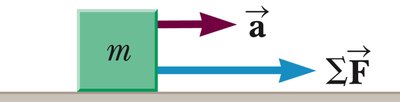
Newton’s Second Law quantitatively relates force, mass, and acceleration. A larger force produces a greater acceleration, while a larger mass results in a smaller acceleration for the same force.
Equation:
Units: Force is measured in newtons (N), mass in kilograms (kg), and acceleration in meters per second squared (m/s2).
Example: A lightweight motorcycle (small m) with a powerful engine (large F) accelerates rapidly.

Constant Net Force and Motion
When a constant net force acts on an object, it accelerates in the direction of the force. If the net force is zero, the object moves with constant velocity (or remains at rest).
Example: A car moving toward a wall will continue at constant velocity unless a force (such as brakes or collision) acts upon it.

Apparent Weight and Elevator Problems
Apparent Weight
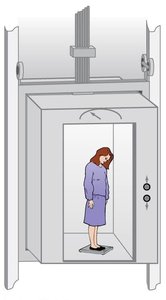
Apparent weight is the reading on a scale when you and the scale are accelerating together, such as in an elevator. It differs from actual weight when the elevator accelerates.
Actual Weight:
Apparent Weight: (if accelerating upward), (if accelerating downward)
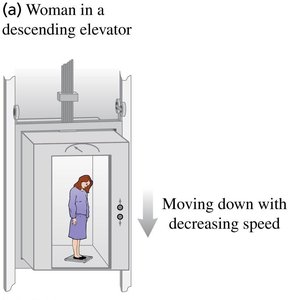
Example: In a descending elevator slowing down, the scale reads less than the actual weight.
Newton’s Third Law: Action-Reaction Force Pairs
Understanding Action-Reaction Pairs
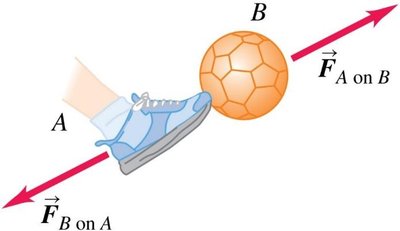
Newton’s Third Law states that forces always occur in pairs. These pairs act on different objects and are equal in magnitude but opposite in direction.
Example: When a snowball hits a child, the child exerts a force on the snowball, and the snowball exerts an equal and opposite force on the child.

Force Pairs in Static Situations
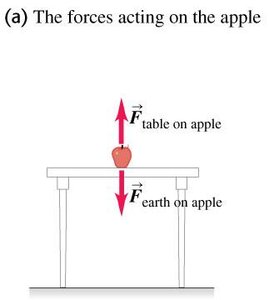
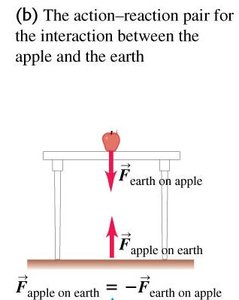
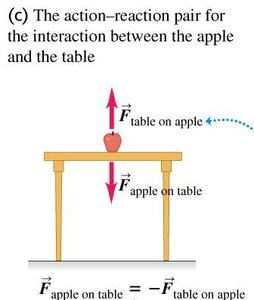
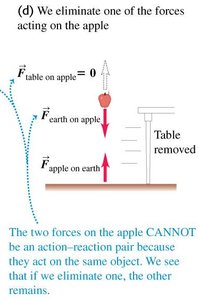
For an apple resting on a table, several forces act on it. It is important to distinguish between forces acting on the same object and action-reaction pairs acting between two objects.
Forces on the Apple: Gravity (Earth on apple) and normal force (table on apple).
Action-Reaction Pair (Apple and Table):
Action-Reaction Pair (Apple and Earth):
Applications of Newton’s Third Law
Pulling Objects and Tension
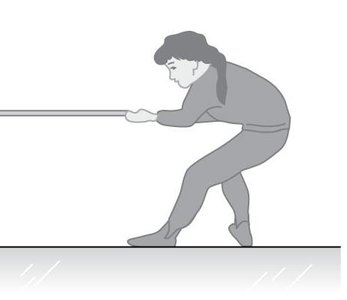
When pulling objects connected by ropes, the tension in each rope and the forces on each block can be analyzed using Newton’s laws and action-reaction pairs.
Example: Two blocks connected by ropes; the tension in the rope closer to the person pulling is greater because it must accelerate both blocks.
Gravitational Interactions and Orbits
Sun and Jupiter: Barycenter
When two massive bodies such as the Sun and Jupiter interact gravitationally, they both orbit a common center of mass called the barycenter. The forces they exert on each other are equal and opposite.
Action-Reaction Forces:
Barycenter: The point about which both bodies orbit, located closer to the more massive body.




Summary Table: Newton’s Laws and Key Equations
Law | Statement | Key Equation |
|---|---|---|
First Law | Object remains at rest or in uniform motion unless acted upon by net force | |
Second Law | Net force causes acceleration proportional to mass | |
Third Law | For every action, there is an equal and opposite reaction |
Additional info:
Inertial reference frames are non-accelerating frames in which Newton’s laws are valid.
Apparent weight changes in accelerating systems, such as elevators.
Action-reaction pairs always act on different objects, not on the same object.
