 Back
Newton's Laws of Motion and Applications: Forces, Friction, and Circular Motion
Study Guide - Smart Notes
 Tailored notes based on your materials, expanded with key definitions, examples, and context.
Force and Newton's Laws
Concept of Force
Force is a fundamental concept in physics, describing the interaction between objects that can cause a change in motion. It is a vector quantity, meaning it has both magnitude and direction. The net force on an object is the vector sum of all individual forces acting upon it, according to the superposition principle.
Force (\( \vec{F} \)): Measure of interaction between objects.
Net Force (\( \vec{F}_{\text{net}} \)): Vector sum of all forces:
Effect: The net force determines the change in an object's motion.
Newton's First Law (Law of Inertia)
Newton's first law states that an object at rest remains at rest, and an object in uniform motion remains in uniform motion unless acted upon by a nonzero net force. Uniform motion is motion at constant velocity.
Inertia: Property of matter to resist changes in motion.
Inertial Reference Frame: A frame in which Newton's first law holds true; typically, the ground is considered an inertial frame.
Key Point: In the absence of force, acceleration is zero.

Newton's Second Law
Newton's second law relates the net force acting on an object to the rate of change of its momentum. For constant mass, it simplifies to the product of mass and acceleration.
Momentum (\( \vec{p} \)):
Second Law:
Constant Mass:
SI Unit: Newton (N)
Direction: Acceleration is in the direction of the net force.
Mass and Inertia
Mass is a measure of an object's inertia, indicating its resistance to changes in motion. It is a scalar quantity and intrinsic to the object.
Acceleration:
Mass: Intrinsic, does not depend on force or acceleration.
Inertia: Resistance to change in motion, depends on mass.
Types of Forces
Contact and Action-at-a-Distance Forces
Forces can be classified as contact forces (arising from physical contact) or action-at-a-distance forces (acting without direct contact).
Contact Forces: Normal force, friction, tension, elastic force.
Action-at-a-Distance Forces: Gravitational, electrical, magnetic forces.
Fundamental Forces of Nature
All forces in nature can be categorized into four fundamental types:
Gravity: Interaction due to mass.
Electromagnetism: Interaction due to charge.
Weak Nuclear Force: Responsible for radioactive decay.
Strong Nuclear Force: Binds quarks together.
Gravitational Force and Weight
The gravitational force exerted by Earth on an object is called weight. Mass is independent of gravity, but weight depends on the local gravitational field.
Gravitational Force:
Gravity near Earth's surface:
Weight: Varies with location (different planets, Moon, etc.)

Normal Force
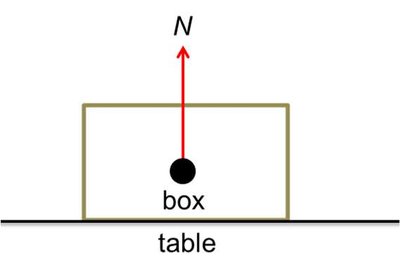
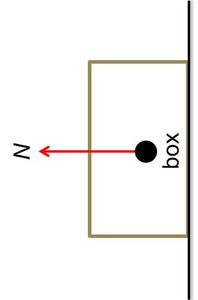
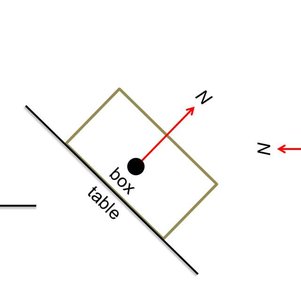
The normal force is a contact force exerted by a surface perpendicular to the object. It is equal to weight only in special cases.
Direction: Perpendicular to the surface.
Magnitude: Depends on the situation (not always equal to weight).
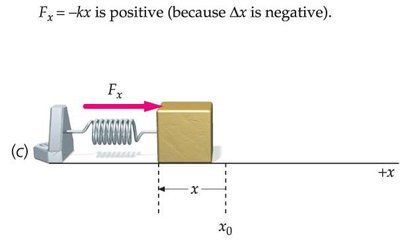
Spring Force (Hooke's Law)
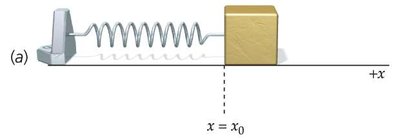
A spring exerts a force proportional to its displacement from equilibrium, described by Hooke's Law. The force is a restoring force, acting opposite to the direction of displacement.
Hooke's Law:
Spring Constant (k): Measures stiffness of the spring.
Restoring Force: Opposes stretch or compression.
Tension Force
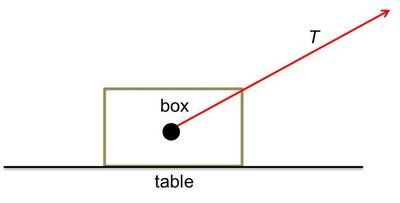
Tension is the force transmitted through a string, rope, cable, or wire. It acts along the length of the wire and is usually considered to have negligible mass.
Direction: Along the wire.
Magnitude: Same at both ends.

Free-Body Diagrams
Drawing Free-Body Diagrams
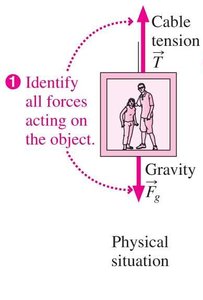
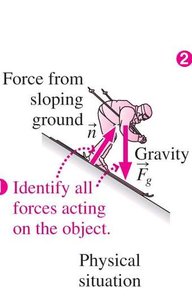
Free-body diagrams are essential tools for visualizing forces acting on an object. The object is represented as a dot, and all forces are drawn as vectors originating from the dot.
Steps: Identify object, draw dot, add vectors for each force.
Purpose: Helps in solving problems using Newton's laws.
Solving Newton's Second Law Problems
Problem-Solving Steps
To solve problems using Newton's second law, follow these steps:
Interpret the problem and identify the object of interest.
Draw a free-body diagram.
Choose a convenient coordinate system.
Resolve forces into components.
Apply Newton's second law to each coordinate direction.
Apparent Weight
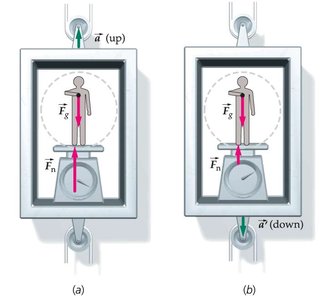
Apparent weight is the normal force or vertical pulling force applied to an object, which can differ from the real weight (mg) in accelerating systems.
Formula: (for upward acceleration)
Example: Scale reading in an accelerating elevator.
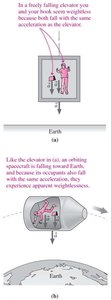
Newton's Third Law
Action-Reaction Pairs
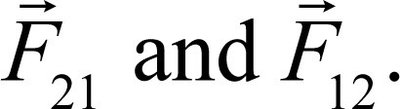
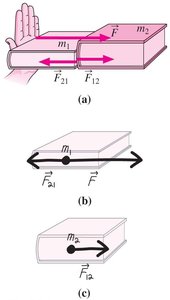
Newton's third law states that forces always come in pairs: if object A exerts a force on object B, then B exerts an equal and opposite force on A. These forces act on different objects and cannot cancel each other.
Action-Reaction:
Key Point: Forces act on different objects.

Friction
Static and Kinetic Friction
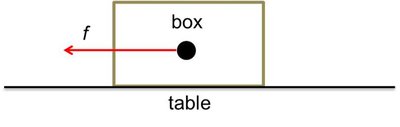
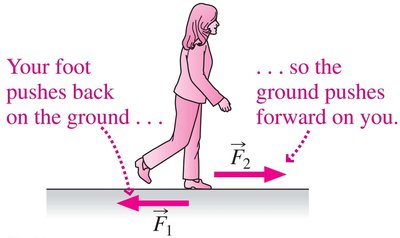
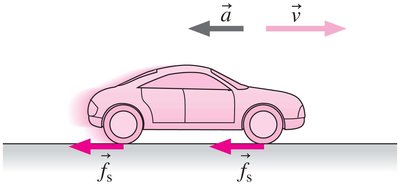
Friction is a contact force that opposes relative motion between surfaces. Static friction prevents motion, while kinetic friction acts during motion.
Static Friction:
Maximum Static Friction:
Kinetic Friction:
Coefficients: (static), (kinetic)
Angle of Repose
The angle of repose is the maximum angle at which an object remains at rest on an inclined surface before sliding. It is related to the coefficient of static friction.
Formula:

Multiple Objects and Constraints
Solving Multi-Object Problems
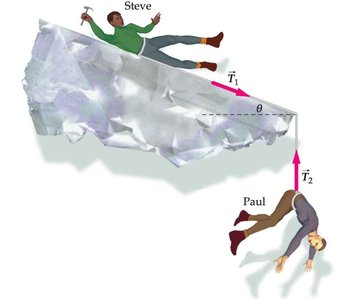
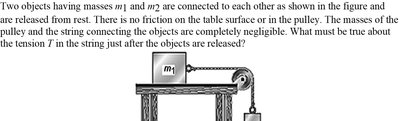
For systems with multiple objects, draw a free-body diagram for each, write Newton's law for each, and identify connections (such as tension in a rope) to solve the system.
Connections: Common terms in equations (e.g., tension).
Example: Two people connected by a rope on a glacier.
Circular Motion
Uniform Circular Motion and Centripetal Force
In uniform circular motion, the acceleration points toward the center of the circle (centripetal acceleration), and the force required is called centripetal force.
Centripetal Acceleration:
Centripetal Force:
Note: Centripetal force is not a new force, but a name for the net force causing circular motion.
Examples of Circular Motion
Vertical Circle: Forces at top and bottom differ due to gravity.
Loop-the-Loop: Minimum speed at top to stay on track.
Banked Curve: Angle for frictionless curve at given speed.
Summary Table: Types of Forces
Type of Force | Formula | Direction | Example |
|---|---|---|---|
Gravitational | Downward | Weight | |
Normal | Varies | Perpendicular to surface | Box on table |
Spring | Opposite to displacement | Stretched spring | |
Tension | Varies | Along string/rope | Hanging picture |
Friction (static) | Opposes motion | Box at rest | |
Friction (kinetic) | Opposes motion | Box sliding |
Additional info: Academic context and examples have been expanded for clarity and completeness. Only images directly relevant to the explanation have been included.
