 Back
BackNewton’s Laws of Motion and Applications: Forces, Friction, and Circular Motion
Study Guide - Smart Notes
 Tailored notes based on your materials, expanded with key definitions, examples, and context.
Newton’s Laws of Motion
Newton’s First Law: Equilibrium and Inertia
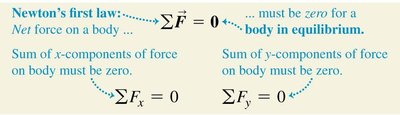
Newton’s First Law states that a body at rest remains at rest, and a body in motion continues in motion with constant velocity unless acted upon by a net external force. This principle is also known as the law of inertia. For a body to be in equilibrium, the vector sum of all forces acting on it must be zero.
Equilibrium Condition: The sum of the forces in each direction must be zero.
Mathematical Formulation:
Sum of x-components:
Sum of y-components:
Example: A book resting on a table is in equilibrium because the upward normal force balances the downward gravitational force.
Newton’s Second Law: Dynamics of Particles
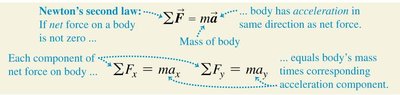
Newton’s Second Law relates the net force acting on a body to its acceleration. If the net force is not zero, the body accelerates in the direction of the net force. The acceleration is proportional to the net force and inversely proportional to the mass of the body.
Mathematical Formulation:
Component form: ,
Example: If a 2 kg object experiences a net force of 10 N to the right, its acceleration is to the right.
Newton’s Third Law: Action and Reaction
Newton’s Third Law states that for every action, there is an equal and opposite reaction. When one body exerts a force on a second body, the second body exerts a force of equal magnitude and opposite direction on the first body.
Action-Reaction Pairs: These forces always act on different objects.
Mathematical Formulation:
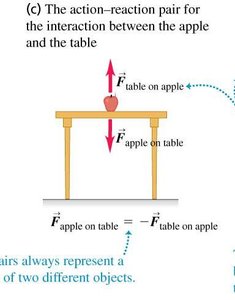
Example: When you push against a wall, the wall pushes back with an equal and opposite force.
Mass and Weight
Relationship Between Mass and Weight
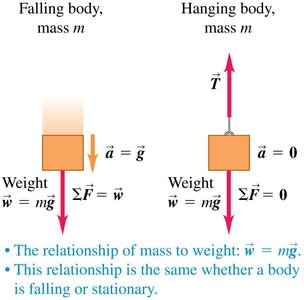
Mass is a measure of the amount of matter in an object, while weight is the gravitational force acting on that mass. The weight of an object is given by:
Falling Body: The only force is gravity, so and .
Hanging Body: The tension in the rope balances the weight, so and .
Example: A 5 kg mass has a weight of .
Free-Body Diagrams and Problem Solving
Constructing Free-Body Diagrams
Free-body diagrams are essential tools for analyzing forces acting on a body. They help visualize all the forces and set up equations for equilibrium or dynamics problems.
Draw the object as a simple shape (box, dot, etc.).
Represent all forces as arrows pointing in the direction they act.
Label each force (e.g., tension, weight, normal force, friction).
Choose coordinate axes and resolve forces into components if necessary.
Example: For a block on a table, draw arrows for gravity (down), normal force (up), and any applied or frictional forces (horizontal).
Applications of Newton’s Laws
Systems of Connected Bodies
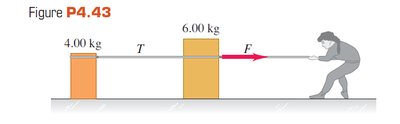
When analyzing systems with multiple connected bodies (e.g., blocks connected by ropes or pulleys), consider each body separately and apply Newton’s laws to each. The acceleration is often the same for all connected bodies.
Write equations for each body.
Identify relationships (e.g., tension, acceleration).
Solve the system of equations for unknowns.
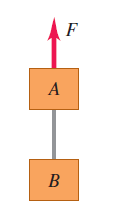
Example: Two blocks connected by a rope over a pulley: set up equations for each block and solve for acceleration and tension.
Friction Forces
Nature of Friction
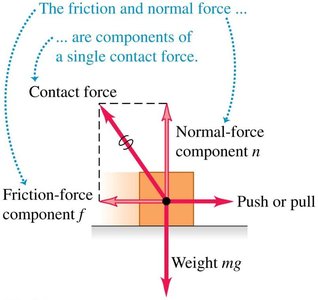
Friction is a force that opposes the relative motion of two surfaces in contact. It arises from microscopic interactions between the surfaces.
Static Friction (): Acts when there is no relative motion;
Kinetic Friction (): Acts when surfaces slide;
Normal Force (): Perpendicular contact force between surfaces.
Example: A crate on a floor requires a certain force to start moving (overcome static friction) and a smaller force to keep moving (kinetic friction).
Coefficients of Friction
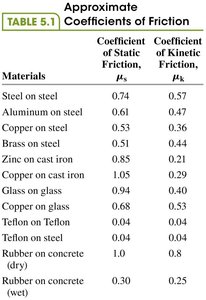
The coefficients of static and kinetic friction depend on the materials in contact. Typical values are given in tables for common material pairs.
Materials | Coefficient of Static Friction, | Coefficient of Kinetic Friction, |
|---|---|---|
Steel on steel | 0.74 | 0.57 |
Aluminum on steel | 0.61 | 0.47 |
Glass on glass | 0.68 | 0.53 |
Teflon on Teflon | 0.04 | 0.04 |
Rubber on concrete (dry) | 1.0 | 0.8 |
Rubber on concrete (wet) | 0.3 | 0.25 |
Friction in Horizontal Motion: Example
To move a 500-N crate across a level floor, a 230-N force is needed to start motion (static friction), and a 200-N force is needed to keep it moving (kinetic friction). The coefficients are:
Static:
Kinetic:
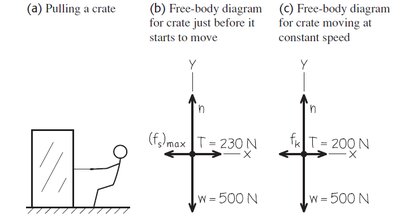
Fluid Resistance and Terminal Speed
Drag Force and Terminal Velocity
When an object moves through a fluid (like air), it experiences a resistive force (drag) that increases with speed. Eventually, the drag force balances the weight, and the object falls at a constant terminal speed.
Before Terminal Speed: , object accelerates downward.
At Terminal Speed: , acceleration is zero.
Terminal Speed Formula:
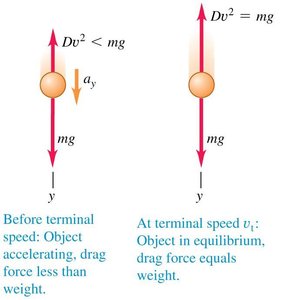
Example: For a 50-kg skydiver with kg/m, m/s.
Inclined Planes and Pulley Systems
Inclined Plane Analysis
When analyzing motion on an inclined plane, resolve the weight into components parallel and perpendicular to the surface. The normal force and acceleration can be found using Newton’s laws.
Parallel component:
Perpendicular component:
Normal force:
Acceleration (frictionless):
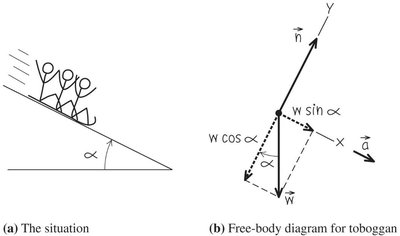
Pulley Systems (Atwood Machine)
In an Atwood machine, two masses are connected by a string over a pulley. The acceleration is determined by the difference in weights and the total mass:
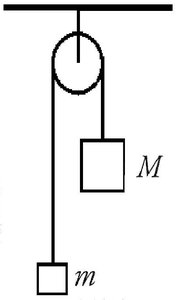
Example: For kg, kg, m/s2.
Summary Table: Key Equations
Concept | Equation |
|---|---|
Newton’s First Law (Equilibrium) | |
Newton’s Second Law (Dynamics) | |
Weight | |
Static Friction | |
Kinetic Friction | |
Terminal Speed | |
Inclined Plane Acceleration | |
Atwood Machine Acceleration |
Additional info: These notes cover the core applications of Newton’s Laws, including equilibrium, dynamics, friction, and systems involving pulleys and inclined planes, as well as the effects of fluid resistance and terminal speed. All equations are provided in LaTeX format for clarity and further study.
