 Back
BackNewton's Laws of Motion and Applications: Study Notes for University Physics I
Study Guide - Smart Notes
 Tailored notes based on your materials, expanded with key definitions, examples, and context.
Newton's Laws of Motion
Introduction to Newton's Laws
Newton's Laws of Motion are fundamental principles that describe the relationship between the motion of an object and the forces acting on it. These laws form the basis for classical mechanics and are essential for understanding a wide range of physical phenomena.
Units, Physical Quantities, and Vectors
Unit Conversions and Dimensional Analysis
Physics problems often require converting between different units and using dimensional analysis to ensure equations are consistent. For example, converting miles per gallon to kilometers per gallon or liters per 100 kilometers is a common exercise in applying unit analysis.
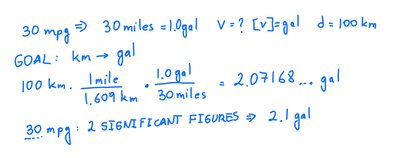
Example: If a car gets 30 miles per gallon (mpg), how many gallons are needed for a 100 km trip?
Conversion factors: 1 mile = 1.609 km, 1 gallon = 3.788 L, 1 L = 10-3 m3
Calculation: (rounded to two significant figures)
Vectors and Vector Operations
Vectors are quantities that have both magnitude and direction, such as displacement, velocity, and force. Vector operations include addition, subtraction, and scalar multiplication.
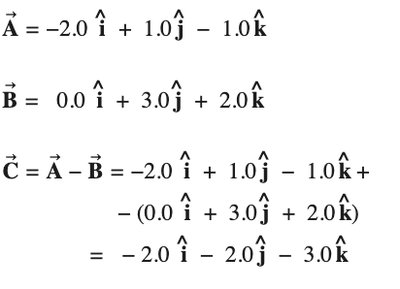
Example: Given and , find .
Solution:
Newton's First Law of Motion (Law of Inertia)
Statement and Explanation
Newton's First Law states that an object at rest remains at rest, and an object in motion continues in motion with constant velocity unless acted upon by a net external force. This law introduces the concept of inertia, the tendency of objects to resist changes in their state of motion.
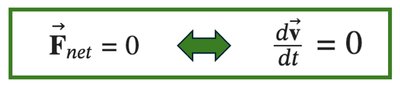
Key Point: If the net external force on an object is zero, its velocity remains constant (including the possibility of zero velocity).
Mathematical Form:


Example: Elevator at Constant Speed
When an elevator is lifted at constant speed, the upward force exerted by the cable equals the downward force of gravity. This is a direct application of Newton's First Law, as the net force is zero and the velocity is constant.
Key Point: Constant velocity implies balanced forces (equilibrium).
Inertial Frames of Reference
Newton's Laws are valid only in inertial frames of reference—coordinate systems that are not accelerating. In non-inertial (accelerating) frames, fictitious forces must be introduced to apply Newton's laws.
Definition: An inertial frame is one in which Newton's First Law holds true.
Newton's Second Law of Motion
Statement and Mathematical Formulation
Newton's Second Law quantifies the relationship between force, mass, and acceleration. It states that the net external force acting on an object is equal to the mass of the object multiplied by its acceleration.
Mathematical Form:
More generally, , where is momentum ()

Units of Force
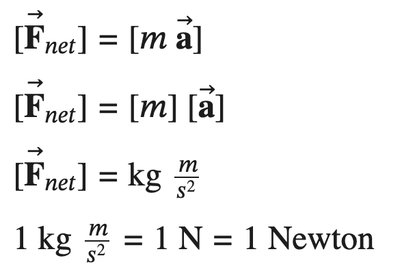
The SI unit of force is the newton (N), defined as the force required to accelerate a 1 kg mass by 1 m/s2.
Unit Definition:
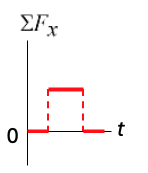
Force and Acceleration Graphs
Force versus time graphs can be used to analyze the net force acting on an object and predict its motion. For example, a constant nonzero force results in constant acceleration.
Newton's Third Law of Motion
Statement and Explanation
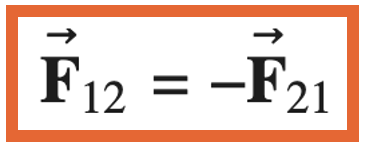
Newton's Third Law states that for every action, there is an equal and opposite reaction. If object A exerts a force on object B, then object B exerts a force of equal magnitude and opposite direction on object A. These forces act on different objects.
Mathematical Form:
Key Point: Action-reaction pairs never act on the same object.
Examples and Applications
Example 1: When a horse pulls a wagon, the force the horse exerts on the wagon is equal in magnitude and opposite in direction to the force the wagon exerts on the horse.
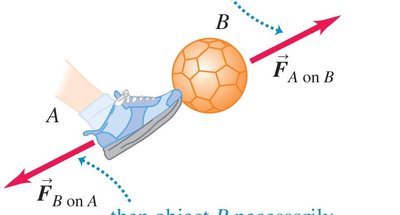
Example 2: When you kick a ball, your foot exerts a force on the ball, and the ball exerts an equal and opposite force on your foot.
Action-Reaction Pairs in Multiple Object Systems
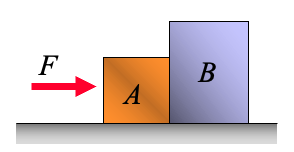
When analyzing systems with multiple objects, it is important to correctly identify action-reaction pairs. For example, if two crates are in contact and a force is applied to one, the force each crate exerts on the other is equal in magnitude and opposite in direction.
Summary Table: Newton's Laws of Motion
Law | Statement | Mathematical Form | Key Concept |
|---|---|---|---|
First Law | An object remains at rest or in uniform motion unless acted on by a net external force. | Inertia, equilibrium | |
Second Law | The net force on an object equals mass times acceleration. | Force causes acceleration | |
Third Law | For every action, there is an equal and opposite reaction. | Action-reaction pairs |
Practice and Application
Apply Newton's laws to solve problems involving forces, motion, and equilibrium.
Carefully identify all forces acting on each object and draw free-body diagrams.
Use vector addition to combine forces and determine net force and resulting acceleration.
Additional info: These notes are based on University Physics I (Classical Mechanics) and cover the core content of Chapter 4: Newton's Laws of Motion, including practical examples, vector operations, and the identification of action-reaction pairs in physical systems.
