 Back
BackNewton’s Laws of Motion and Applications: Study Notes for University Physics I
Study Guide - Smart Notes
 Tailored notes based on your materials, expanded with key definitions, examples, and context.
Newton’s Laws of Motion
Overview
Newton’s Laws of Motion are fundamental principles that describe the relationship between the motion of an object and the forces acting on it. These laws form the basis for classical mechanics and are essential for solving a wide range of physics problems involving forces and motion.
Newton’s First Law of Motion (Law of Inertia)
Statement and Mathematical Formulation
Newton’s First Law states that an object at rest remains at rest, and an object in motion continues in motion with constant velocity unless acted upon by a net external force. This property is known as inertia.
Mathematical Expression:
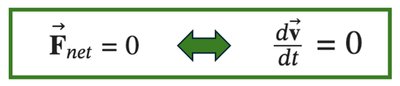
Equilibrium Condition: For an object to be in equilibrium, the sum of all forces acting on it must be zero.
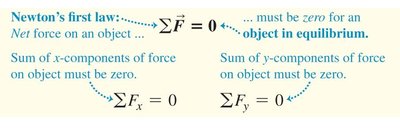
Component Form: The sum of the x- and y-components of the forces must each be zero:
Example: A book resting on a table remains at rest because the net force on it is zero (gravity is balanced by the normal force).
Newton’s Second Law of Motion
Statement and Mathematical Formulation
Newton’s Second Law states that the acceleration of an object is directly proportional to the net force acting on it and inversely proportional to its mass. The direction of the acceleration is the same as the direction of the net force.
Mathematical Expression:
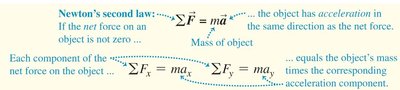
Component Form:
Example: If a 2 kg object experiences a net force of 10 N to the right, its acceleration is m/s2 to the right.
Newton’s Third Law of Motion
Statement and Mathematical Formulation
Newton’s Third Law states that for every action, there is an equal and opposite reaction. This means that forces always occur in pairs: if object 1 exerts a force on object 2, then object 2 exerts an equal and opposite force on object 1.
Mathematical Expression:
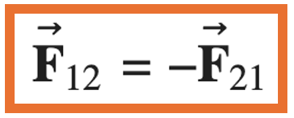
Example: When you push against a wall, the wall pushes back against you with an equal and opposite force.
Applications of Newton’s Laws
Equilibrium and Non-Equilibrium Problems
Newton’s Laws are used to analyze both equilibrium (no acceleration) and non-equilibrium (with acceleration) situations. The process involves drawing free-body diagrams, identifying all forces, and applying the laws to solve for unknowns.
Equilibrium: All forces balance, so and .
Non-Equilibrium: The net force is nonzero, so .
Example: Projectile Motion and Constant Velocity Components
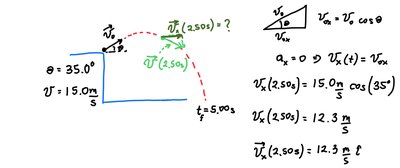
Consider a shell fired from a cliff with an initial velocity at an angle. The horizontal velocity remains constant if air resistance is negligible, as there is no horizontal force acting on the shell.
Given: m/s, , s
Find: at s
Solution: m/s
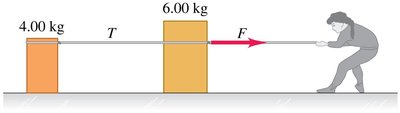
Example: Two Crates Connected by a Rope
When two objects are connected by a rope and pulled, both experience the same acceleration, but the net force on each may differ due to their masses.
Key Points:
The lighter crate experiences a smaller net force but the same acceleration as the heavier crate.
The tension in the rope transmits the force between the crates.
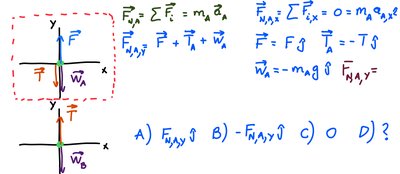
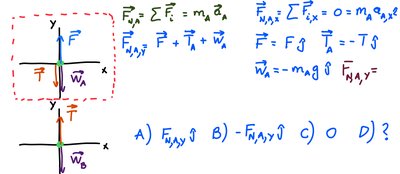
Example: Boxes Connected by a Vertical Rope (Problem 4.45)
Two boxes, A and B, are connected by a light vertical rope. A constant upward force is applied to box A, and box B descends a certain distance in a given time. The tension in the rope and the masses can be found using Newton’s laws and kinematic equations.
Step 1: Draw Free-Body Diagrams
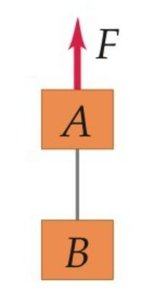
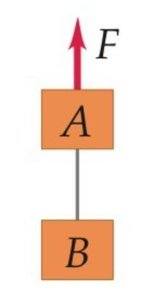
Step 2: Write Equations for Each Box
For box A:
For box B:
Step 3: Use Kinematics to Find Acceleration
Given the distance descended and time, use:
Step 4: Solve the System of Equations
Combine the force and kinematic equations to solve for the unknown mass.
Example Application: This type of problem is common in analyzing Atwood machines and elevator systems.
Summary Table: Newton’s Laws of Motion
Law | Statement | Mathematical Form | Key Application |
|---|---|---|---|
First Law | Object remains at rest or in uniform motion unless acted on by a net force | Equilibrium analysis | |
Second Law | Net force causes acceleration proportional to mass | Non-equilibrium motion | |
Third Law | For every action, equal and opposite reaction | Force pairs, interactions |
Key Problem-Solving Steps
Draw a clear free-body diagram for each object.
Identify all forces acting on each object (gravity, tension, normal, applied, friction, etc.).
Apply Newton’s laws to set up equations for each object.
Use kinematic equations as needed to relate motion variables.
Solve the system of equations for the unknowns.
Additional info: These notes are based on classical mechanics topics from University Physics I, focusing on Newton’s Laws and their applications to equilibrium and non-equilibrium systems, including multi-body problems and projectile motion.
