 Back
BackNewton’s Laws of Motion and Applications: Forces, Friction, and Fluid Resistance
Study Guide - Smart Notes
 Tailored notes based on your materials, expanded with key definitions, examples, and context.
Newton’s Laws of Motion
4.1 Force
In physics, a force is a vector quantity that causes an object to accelerate, change direction, or deform. Forces are measured in newtons (N) and can be contact (e.g., friction, tension) or non-contact (e.g., gravity).
4.2 Newton’s First Law (Law of Inertia)
Newton’s First Law states that an object at rest remains at rest, and an object in motion continues in motion with constant velocity unless acted upon by a net external force. This property is called inertia.
Example: A box on a frictionless surface will not move unless pushed.
4.3 Mass and Newton’s Second Law
Newton’s Second Law relates the net force acting on an object to its mass and acceleration:
Mass is a measure of an object’s inertia (resistance to acceleration).
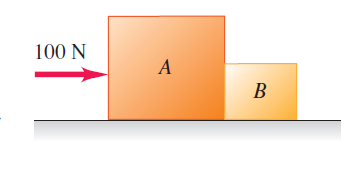
Example: If a 20 kg system is pushed with 100 N, .
4.4 Mass and Weight
Weight is the gravitational force acting on an object:
Weight depends on the local gravitational acceleration .
Mass is constant everywhere; weight varies with .
4.5 Newton’s Third Law
Newton’s Third Law states: For every action, there is an equal and opposite reaction. If object A exerts a force on object B, then B exerts an equal and opposite force on A.
Example: When pushing box A against box B, the force A exerts on B is equal in magnitude and opposite in direction to the force B exerts on A.
4.6 Free-Body Diagrams
A free-body diagram is a graphical illustration used to visualize the forces acting on an object. Each force is represented by an arrow pointing in the direction the force acts.
Identify all forces: applied, friction, normal, tension, weight, etc.
Applications of Newton’s Laws
Using Newton’s First Law: Particles in Equilibrium
When the net force on a particle is zero, the particle is in equilibrium and does not accelerate:
Using Newton’s Second Law: Dynamics of Particles
When the net force is not zero, the object accelerates according to .
Example: Two boxes in contact (A: 15 kg, B: 5 kg) are pushed with 100 N. Both accelerate together:
The force on B is .
Frictional Forces
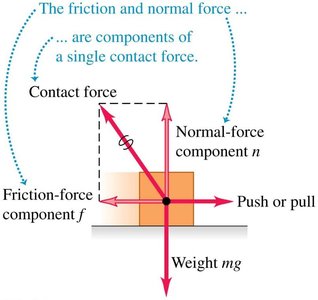
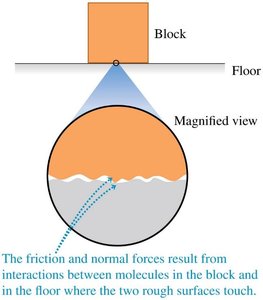
Friction is a force that opposes the relative motion of two surfaces in contact. There are two main types:
Static friction (): Prevents motion up to a maximum value
Kinetic friction (): Acts when objects are sliding,
Coefficients of Friction
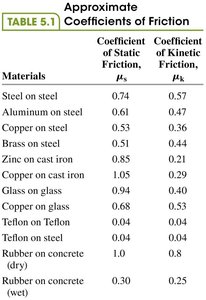
The coefficient of friction () is a dimensionless constant that depends on the materials in contact.
Materials | Coefficient of Static Friction, | Coefficient of Kinetic Friction, |
|---|---|---|
Steel on steel | 0.74 | 0.57 |
Aluminum on steel | 0.61 | 0.47 |
Copper on steel | 0.53 | 0.36 |
Brass on steel | 0.51 | 0.44 |
Zinc on cast iron | 1.05 | 0.21 |
Glass on glass | 0.68 | 0.53 |
Teflon on Teflon | 0.04 | 0.04 |
Rubber on concrete (dry) | 1.0 | 0.8 |
Rubber on concrete (wet) | 0.3 | 0.25 |
Friction Example
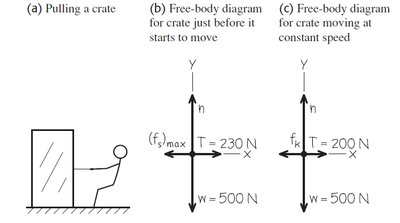
To move a 500-N crate, a 230-N force is needed to start motion (static friction), and 200 N to keep it moving at constant velocity (kinetic friction):
Inclined Planes and Pulleys
Inclined Plane (Frictionless)
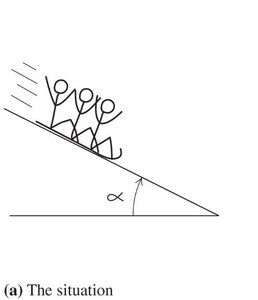
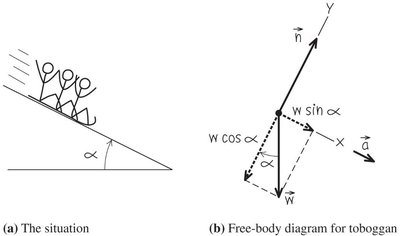
When an object slides down a frictionless incline at angle :
Acceleration:
Normal force:
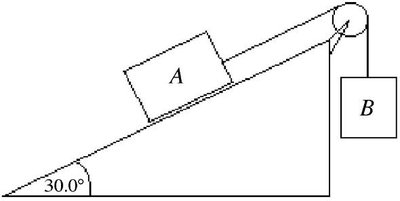
Two-Block Pulley System (Inclined Plane)
Two blocks connected by a string over a pulley, with one on a frictionless incline ():
Acceleration:
Tension: or
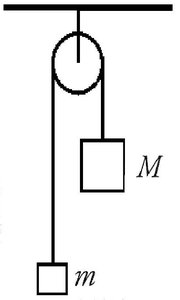
Atwood Machine
An Atwood machine consists of two masses connected by a string over a frictionless pulley:
Acceleration:
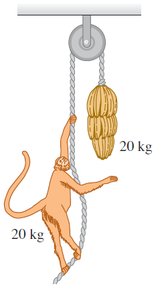
Monkey and Banana Problem
If a monkey and bananas have equal mass and are connected by a rope over a pulley:
Both experience the same tension and acceleration.
Relative distance between monkey and bananas remains constant, regardless of climbing or falling.
Friction Forces in Multi-Block Systems
Friction in Stacked Blocks
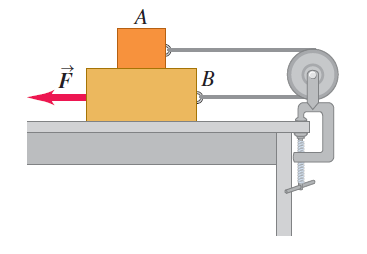
When blocks are stacked, friction acts at each interface. The normal force at each contact determines the frictional force:
Friction between A and B:
Friction between B and table:
Fluid Resistance and Terminal Speed
Fluid Resistance (Drag)
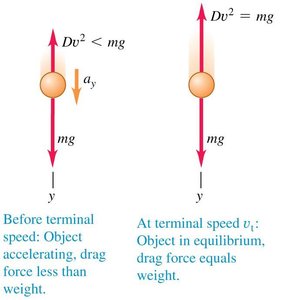
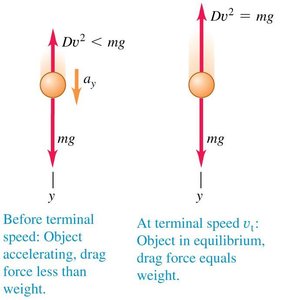
When an object moves through a fluid (like air), it experiences a resistive force (drag) that increases with speed. For high speeds, drag force is proportional to :
At terminal speed, drag force equals weight:
Terminal speed:
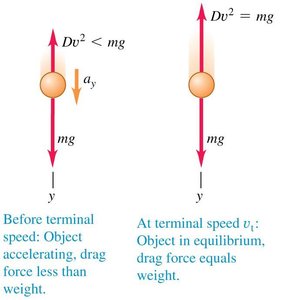
Example: Terminal Speed of a Skydiver
For a 50-kg skydiver with kg/m:
Additional info: These notes cover the core applications of Newton's Laws, including friction, inclined planes, pulleys, and fluid resistance, as relevant to introductory college physics.
