 Back
Newton's Laws of Motion and Forces: Study Notes
Study Guide - Smart Notes
 Tailored notes based on your materials, expanded with key definitions, examples, and context.
Newton's Laws of Motion and Forces
Introduction
Newton's Laws of Motion form the foundation of classical mechanics, describing the relationship between the motion of an object and the forces acting upon it. This chapter explores the concepts of force, friction, mass, weight, and the three fundamental laws formulated by Isaac Newton. Understanding these principles is essential for analyzing and predicting the motion of objects in various physical situations.
Force and Acceleration
Force Causes Acceleration
Force is any interaction that, when unopposed, will change the motion of an object.
Acceleration is directly proportional to the net force acting on an object.
To increase an object's acceleration, increase the net force applied to it.
Equation:
where is the net force, is mass, and is acceleration.
Friction
The Force of Friction
Friction is a force that opposes the relative motion or tendency of such motion of two surfaces in contact.
It depends on the types of materials in contact and how much they are pressed together.
Friction arises from microscopic surface irregularities and the stickiness of atoms at the contact points.
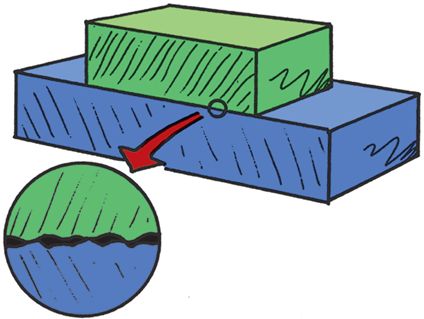
Friction can occur with sliding objects, in water, and in air (air resistance).
When an object moves at constant speed across a surface, the force of friction equals and opposes the applied force.
If the object accelerates, the applied force exceeds the force of friction.
Mass and Weight
Definitions and Distinctions
Mass is the quantity of matter in an object and a measure of its inertia (resistance to changes in motion).
Mass is independent of gravity and is measured in kilograms (kg).
Weight is the force of gravity acting on an object, measured in newtons (N) or pounds (lb).
Weight depends on the local gravitational field: where is the acceleration due to gravity.
Conversions:
On Earth: weighs
(on Earth)
Mass remains constant regardless of location, but weight changes with gravity (e.g., less on the Moon than on Earth).
Mass Resists Acceleration
For a given force, increasing mass decreases acceleration:
Doubling the mass halves the acceleration; tripling the mass gives one-third the acceleration.
Newton's First Law of Motion (Law of Inertia)
Statement and Implications
An object at rest remains at rest, and an object in motion continues in motion with constant velocity unless acted upon by a net external force.
This property of objects to resist changes in motion is called inertia.
More mass means more inertia.

Example: A book on a table remains at rest until a force (push or pull) acts on it.
Newton's Second Law of Motion
Statement and Mathematical Formulation
The acceleration of an object is directly proportional to the net force acting on it and inversely proportional to its mass.
The direction of acceleration is the same as the direction of the net force.
Equation:
Units:
Examples:
If the net force on an object is doubled, its acceleration doubles.
If the mass is doubled, acceleration is halved for the same force.
Practice Problems
Example 1: A force pushes a object. Acceleration:
Example 2: What force is needed to accelerate a object at ?
Example 3: Two forces ( and ) act rightward on a object. Net force: , so
Newton's Third Law of Motion
Action and Reaction
For every action, there is an equal and opposite reaction.
Forces always occur in pairs: if object A exerts a force on object B, object B exerts an equal and opposite force on object A.
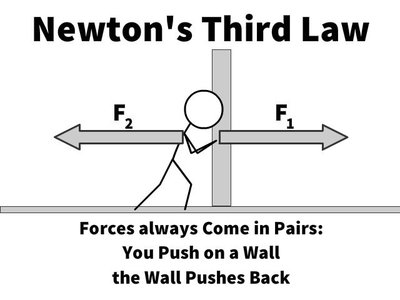
Example: When you push against a wall, the wall pushes back with equal force in the opposite direction.
Net Force and Friction in Practice
Calculating Net Force
The net force () is the vector sum of all forces acting on an object.
If forces act in the same direction, add them; if in opposite directions, subtract them.
Friction always acts opposite to the direction of motion.
Equation:
Example 1: A force pulls a sled right; friction is . ,
Example 2: A car accelerates at ; friction is .
Mass, Weight, and Normal Force
Normal Force
The normal force is the perpendicular support force exerted by a surface on an object resting on it.
For objects at rest on a horizontal surface, the normal force equals the object's weight.
Examples:
A girl standing on a scale: Normal force =
A girl weighing : Normal force =
A boy holding a box: Normal force =
Summary Table: Mass vs. Weight
Property | Mass | Weight |
|---|---|---|
Definition | Amount of matter | Force due to gravity |
Unit | kg | N (or lb) |
Depends on location? | No | Yes |
Measured by | Balance | Scale |
Key Equations
Additional Info
Newton's laws are valid only in inertial reference frames (non-accelerating frames).
Friction can be static (prevents motion) or kinetic (opposes ongoing motion).
Normal force can change in non-horizontal or accelerating situations (e.g., elevators).
