 Back
BackNewton's Laws of Motion and Friction Forces: Study Notes
Study Guide - Smart Notes
 Tailored notes based on your materials, expanded with key definitions, examples, and context.
Newton's Laws of Motion
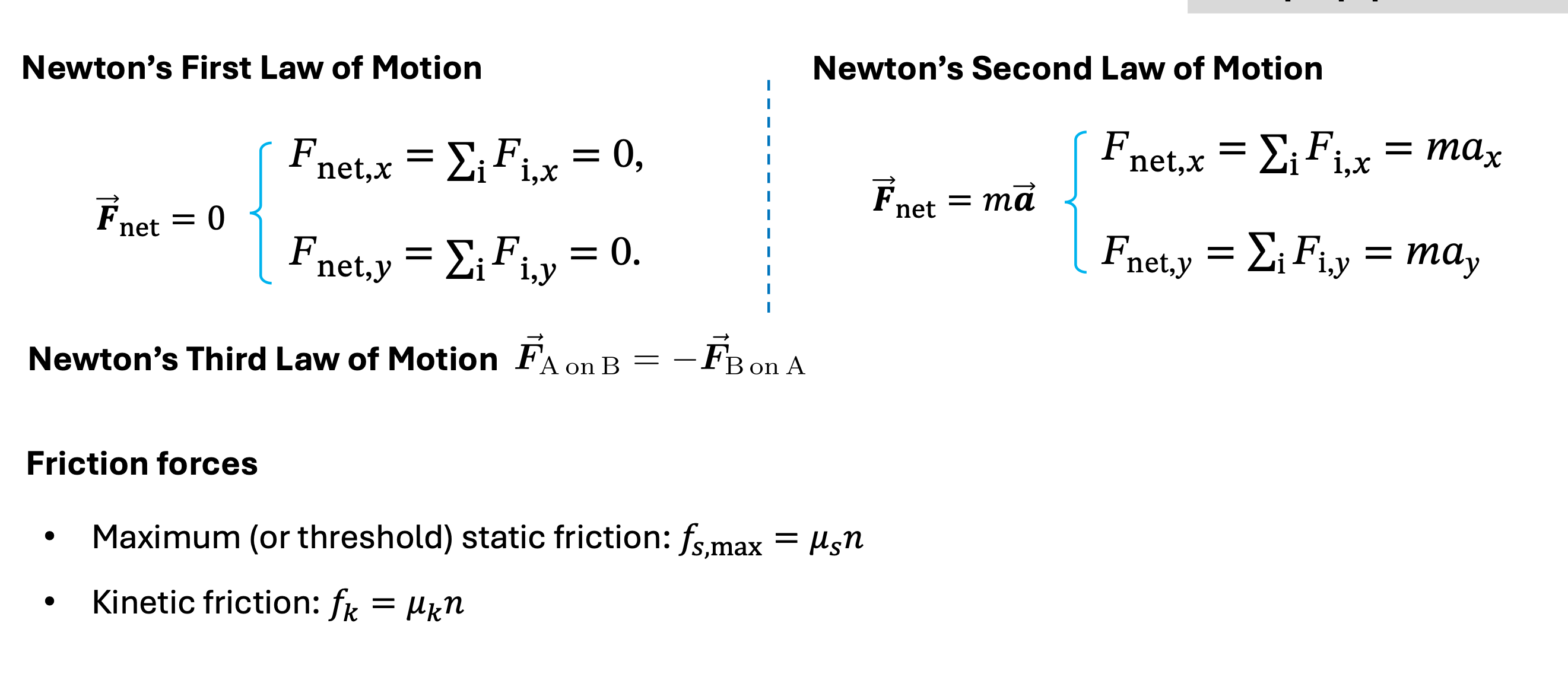
Newton's First Law of Motion
Newton's First Law, also known as the law of inertia, states that an object at rest remains at rest and an object in motion continues in motion with constant velocity unless acted upon by a net external force. This law establishes the concept of inertia and the necessity of a net force to change an object's state of motion.
Definition: If the net force on an object is zero, its velocity remains constant.
Mathematical Formulation:
Example: A book resting on a table remains stationary unless pushed.
Newton's Second Law of Motion
Newton's Second Law quantifies the relationship between force, mass, and acceleration. It states that the net force acting on an object is equal to the product of its mass and acceleration. This law is fundamental for analyzing dynamics and predicting motion under various forces.
Definition: The acceleration of an object is directly proportional to the net force and inversely proportional to its mass.
Mathematical Formulation:
Example: If a 2 kg object experiences a net force of 10 N, its acceleration is m/s2.
Newton's Third Law of Motion
Newton's Third Law states that for every action, there is an equal and opposite reaction. This means that forces always occur in pairs, and when one object exerts a force on another, the second object exerts an equal and opposite force back.
Definition: Forces between two objects are equal in magnitude and opposite in direction.
Mathematical Formulation:
Example: When you push against a wall, the wall pushes back with an equal force.
Friction Forces
Static and Kinetic Friction
Friction is a force that opposes the relative motion of two surfaces in contact. It is classified into static friction (which prevents motion) and kinetic friction (which opposes ongoing motion). The maximum static friction is the threshold before motion begins, while kinetic friction acts during movement.
Maximum Static Friction: The greatest force that can be applied before an object starts moving. where is the coefficient of static friction and is the normal force.
Kinetic Friction: The force opposing motion once an object is sliding. where is the coefficient of kinetic friction and is the normal force.
Example: A box on the floor requires a certain minimum force to start moving (static friction), and a lesser force to keep it moving (kinetic friction).
Additional info: The coefficients of friction ( and ) depend on the materials in contact and are typically determined experimentally. Static friction is usually greater than kinetic friction for the same pair of surfaces.
