 Back
BackNewton’s Laws of Motion: Applications and Problem Solving
Study Guide - Smart Notes
 Tailored notes based on your materials, expanded with key definitions, examples, and context.
Newton’s Laws of Motion
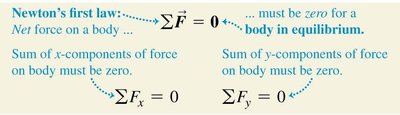
Newton’s First Law: Equilibrium and Force Balance
Newton’s First Law states that a body remains at rest or moves with constant velocity unless acted upon by a net external force. This principle is fundamental for analyzing equilibrium situations in physics.
Equilibrium Condition: The net force on a body in equilibrium is zero.
Component Form: The sum of the x- and y-components of all forces must each be zero.
Equations:
Newton’s Second Law: Dynamics of Particles
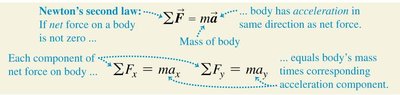
Newton’s Second Law describes how the motion of an object changes when a net force acts upon it. The acceleration of the object is proportional to the net force and inversely proportional to its mass.
General Form: The net force equals mass times acceleration.
Component Form: Each force component equals mass times the corresponding acceleration component.
Equations:
Mass and Weight
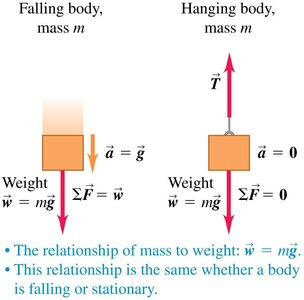
Weight is the gravitational force acting on a body of mass m. The relationship between mass and weight is given by:
Weight Formula: , where is the acceleration due to gravity.
This relationship holds whether the body is stationary or in free fall.
Free-Body Diagrams and Problem Solving Steps
Free-body diagrams are essential tools for visualizing forces acting on a body. They help in systematically applying Newton’s laws to solve problems.
Draw a sketch of the physical situation.
Draw a free-body diagram for each body, showing all forces acting on it.
Label each force and choose coordinate axes.
Write equations for each force component and solve for unknowns.
Applications of Newton’s Laws
Equilibrium and Dynamics Examples
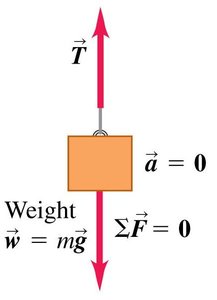
Consider a body being pulled vertically by a string:
If the body moves at constant speed, the tension equals the weight: .
If the body accelerates upward: .
If the body accelerates downward: .
Multiple-Body Systems and Tension
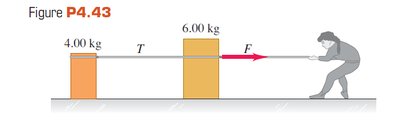
When analyzing systems with multiple connected bodies (e.g., blocks connected by strings), it is important to consider the forces on each body and the relationships between their accelerations.
For two blocks connected by a string, the tension and acceleration can be found by applying Newton’s second law to each block and solving the resulting equations.
Inclined Plane Problems
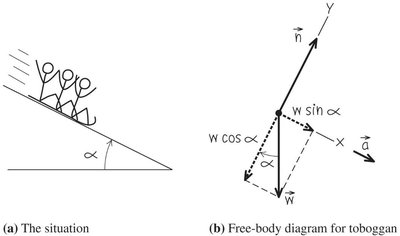
When a body slides down a frictionless incline, the acceleration and normal force can be determined by resolving the weight into components parallel and perpendicular to the incline.
Parallel component: causes acceleration down the slope.
Perpendicular component: is balanced by the normal force.
Acceleration:
Normal force:
Atwood Machine
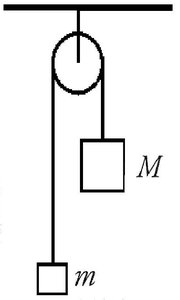
An Atwood machine consists of two masses connected by a string over a pulley. The acceleration of the system is found by applying Newton’s second law to each mass and solving for the acceleration.
Let and be the masses ():
Newton’s Third Law: Action-Reaction Pairs
Principle of Action and Reaction
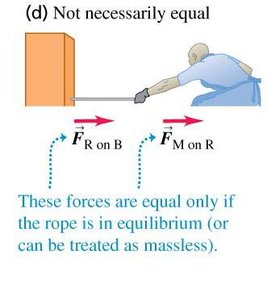
Newton’s Third Law states that for every action, there is an equal and opposite reaction. Forces always occur in pairs, acting on different bodies.
If body A exerts a force on body B, then body B exerts an equal and opposite force on body A.
These forces are equal in magnitude and opposite in direction.
Identifying Action-Reaction Pairs
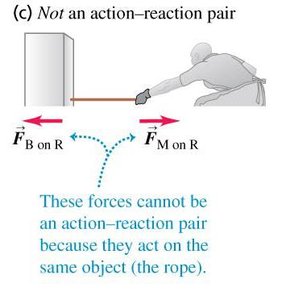
It is important to distinguish between forces acting on the same object (not action-reaction pairs) and forces acting on different objects (action-reaction pairs).
Forces in an action-reaction pair never act on the same object.
Examples include the force of the ground on a foot and the force of the foot on the ground.
Worked Example: Boxes in Contact
Force Transmission in Connected Objects
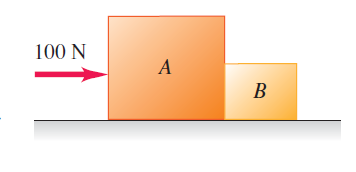
When two boxes are in contact and a force is applied to one, both boxes accelerate together. The force on the second box can be found by considering the combined acceleration and the mass of the second box.
Total mass:
Applied force:
Acceleration:
Force on box B:
Summary Table: Newton’s Laws of Motion
Law | Statement | Key Equation | Application |
|---|---|---|---|
First Law | Body remains at rest or in uniform motion unless acted on by a net force | Equilibrium analysis | |
Second Law | Net force causes acceleration proportional to mass | Dynamics, finding acceleration | |
Third Law | For every action, equal and opposite reaction | Identifying force pairs |
Additional info: These notes include expanded academic context and examples to ensure completeness and clarity for exam preparation.
