 Back
Newton’s Laws of Motion: Concepts, Applications, and Problem Solving
Study Guide - Smart Notes
 Tailored notes based on your materials, expanded with key definitions, examples, and context.
Newton’s Laws of Motion
Introduction to Newton’s Laws
Newton’s laws of motion are fundamental principles that describe the relationship between the motion of an object and the forces acting upon it. These laws form the foundation for classical mechanics and are essential for understanding how objects move in response to applied forces.
Newton’s First Law of Motion (Law of Inertia)
Definition and Concept
Newton’s First Law states that an object at rest remains at rest, and an object in motion continues in motion with constant velocity unless acted upon by a net external force. This property is known as inertia.
Inertia: The tendency of an object to resist changes in its state of motion.
Friction: A force that opposes motion between two surfaces in contact. The amount of friction affects how easily an object’s motion changes.
Example: A hockey puck sliding on ice will continue moving in a straight line at constant speed unless friction or another force acts on it.
Experimental Demonstration
By varying the amount of friction (e.g., using different surfaces), one can observe how objects maintain their velocity more easily on surfaces with less friction.
On very low friction surfaces, objects continue moving with little change in velocity, illustrating inertia.
Newton’s Second Law of Motion
Definition and Mathematical Formulation
Newton’s Second Law quantifies the relationship between force, mass, and acceleration. It states that the acceleration of an object is directly proportional to the net force acting on it and inversely proportional to its mass.
Mathematical Expression:
\(\vec{F}_{\text{net}}\): Net force acting on the object (in newtons, N)
\(m\): Mass of the object (in kilograms, kg)
\(\vec{a}\): Acceleration of the object (in meters per second squared, m/s2)
Applications and Examples
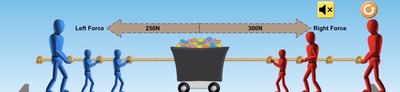
Example 1: A golf ball dropped from rest experiences a downward gravitational force (0.450 N) and an upward drag force (0.050 N). The net force is the vector sum of these forces.
Example 2: Pulling a sled with a dog (mass = 30 kg) on snow with 10 N friction. If you pull with 70 N horizontally, the net force is 60 N, and the acceleration is m/s2.
Experimental Investigations
By varying the net force while keeping mass constant, acceleration changes proportionally.
By varying the mass while keeping net force constant, acceleration changes inversely.
Free Body Diagrams
A free body diagram is a graphical illustration used to visualize the forces acting on an object. It helps in analyzing the net force and predicting the resulting acceleration.
Types of Forces and the Four Fundamental Interactions
Overview of Fundamental Forces
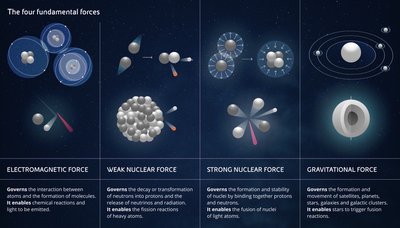
All forces in nature can be categorized into four fundamental interactions:
Force | Description | Examples |
|---|---|---|
Electromagnetic | Governs interactions between charged particles | Electricity, magnetism, light |
Weak Nuclear | Responsible for radioactive decay and neutrino interactions | Beta decay, fusion in stars |
Strong Nuclear | Binds protons and neutrons in the nucleus | Nuclear stability, fusion |
Gravitational | Attraction between masses | Planetary orbits, falling objects |
Problem Solving with Newton’s Laws
Sample Problems and Solutions
Golf Ball Example: Net force = gravity (0.450 N down) + drag (0.050 N up) = 0.400 N down.
Sled Example: If friction is 10 N and pulling force is 70 N, net force is 60 N. For a 30 kg dog, m/s2.
Constant Velocity Case: If a sled moves at constant velocity, the pulling force equals the frictional force (net force = 0).
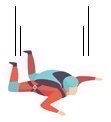
Skydiver Example: For a 50 kg skydiver with 100 N upward drag, weight is N down. Net force is N down. Acceleration is m/s2 downward.
Newton’s Third Law of Motion
Definition and Concept
Newton’s Third Law states that for every action, there is an equal and opposite reaction. This means that forces always occur in pairs, and each force in a pair acts on a different object.
Action-Reaction Pairs: If object A exerts a force on object B, then object B exerts an equal and opposite force on object A.
Example: When you jump off the ground, you push down on the Earth, and the Earth pushes you up with an equal force.
Important Note: In all force pairs, each force acts on a different object.
Weight and the Force of Gravity
Definition and Calculation
The weight of an object is the gravitational force exerted on it by a planet (usually Earth). It is calculated as:
w: Weight (in newtons, N)
m: Mass (in kilograms, kg)
g: Acceleration due to gravity (on Earth, m/s2)
Example: A 75 kg professor jumps upward with an acceleration of 1.0 m/s2. The force applied to the Earth is N.
Summary Table: Newton’s Laws of Motion
Law | Statement | Key Concept |
|---|---|---|
First Law | An object remains at rest or in uniform motion unless acted on by a net force. | Inertia |
Second Law | Net force equals mass times acceleration. | |
Third Law | For every action, there is an equal and opposite reaction. | Force pairs act on different objects |
