 Back
BackNewton’s Laws of Motion: Forces and Applications
Study Guide - Smart Notes
 Tailored notes based on your materials, expanded with key definitions, examples, and context.
Newton’s Laws of Motion
Introduction to Forces
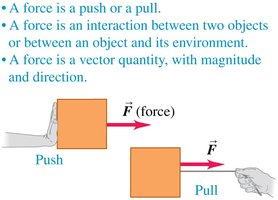
Forces are fundamental to understanding motion in physics. A force is a push or pull that arises from the interaction between two objects or between an object and its environment. Forces are vector quantities, meaning they have both magnitude and direction.
Definition: A force is an interaction that can cause an object to accelerate.
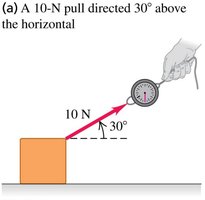
Vector Nature: Forces are represented by arrows (vectors) whose length indicates magnitude and whose direction shows the direction of the force.
Examples: Pushing or pulling a box.
Types of Forces
There are several common types of forces encountered in physics problems:
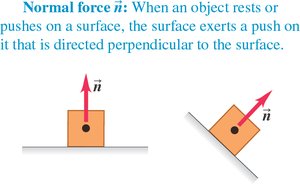
Normal Force (\( \vec{n} \)): The perpendicular contact force exerted by a surface on an object resting on it.
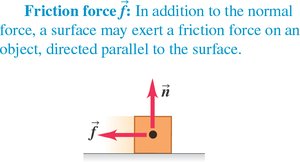
Friction Force (\( \vec{f} \)): The force exerted by a surface parallel to itself, opposing the motion or attempted motion of an object.
Tension: The pulling force transmitted through a string, rope, or cable when it is pulled tight by forces acting from opposite ends.
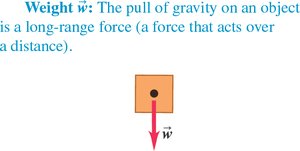
Weight (\( \vec{w} \)): The gravitational force exerted by the Earth on an object, always directed downward.
Drawing Force Vectors
Force vectors are drawn to represent both the magnitude and direction of the force. The length of the arrow corresponds to the magnitude, and the arrow points in the direction of the force.
Superposition and Components of Forces
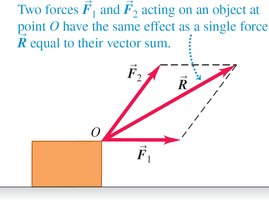
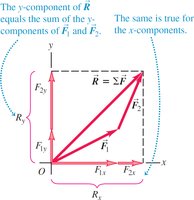
When multiple forces act on an object, their effects combine according to the principle of superposition. The net force is the vector sum of all individual forces.
Superposition Principle: Several forces acting at a point have the same effect as their vector sum acting at that point.
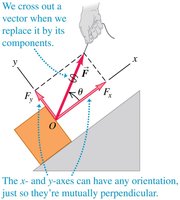
Decomposing Forces: Any force can be resolved into perpendicular components, typically along the x- and y-axes, using trigonometry.
Vector Sum Notation: The net force is denoted as \( \sum \vec{F} \) or \( \vec{R} \).
Worked Example: Net Force Components
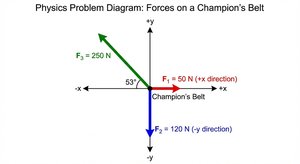
Consider three wrestlers applying forces to a belt. To find the net force, resolve each force into x and y components, sum them, and calculate the resultant magnitude and direction.

Newton’s First Law of Motion (Law of Inertia)
Statement and Equilibrium
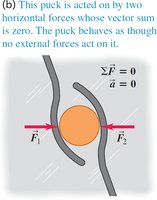
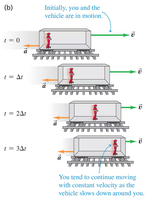
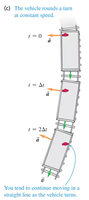
Newton’s First Law states that an object remains at rest or in uniform motion unless acted upon by a net external force. This is the principle of equilibrium.
Equilibrium Condition: \( \sum \vec{F} = 0 \)
Implication: If the net force is zero, the object does not accelerate.

Net Force and Acceleration
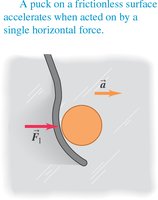
If a net force acts on an object, it will accelerate in the direction of the net force.
If the net force is zero, the object remains in equilibrium (no acceleration).
Inertial Frames of Reference
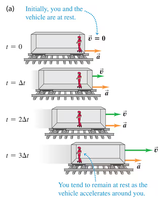
Newton’s First Law is valid only in inertial frames—frames of reference that are not accelerating. In non-inertial (accelerating) frames, apparent forces (fictitious forces) may seem to act on objects.
Newton’s Second Law of Motion
Force and Acceleration
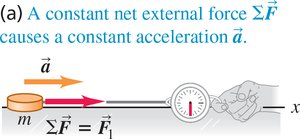
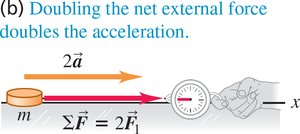
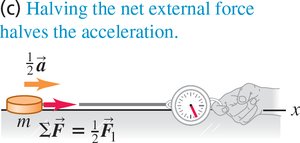
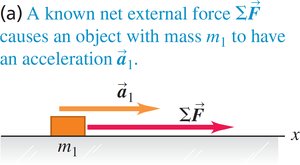
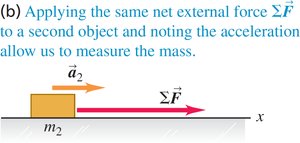
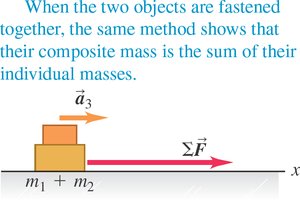
Newton’s Second Law quantifies the relationship between force, mass, and acceleration. The acceleration of an object is directly proportional to the net external force and inversely proportional to its mass.
Mathematical Form: \( \sum \vec{F} = m \vec{a} \)
SI Unit: The unit of force is the newton (N), where 1 N = 1 kg·m/s².
Mass and Acceleration
For a fixed net force, increasing the mass decreases the acceleration, and vice versa.

Uniform Circular Motion
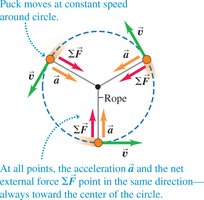
For objects in uniform circular motion, the net force (centripetal force) always points toward the center of the circle, causing centripetal acceleration.
Mass and Weight
Relationship Between Mass and Weight
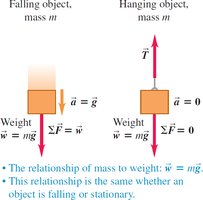
Weight is the gravitational force exerted on an object by the Earth. It is proportional to the object's mass and the local acceleration due to gravity (g).
Formula: \( w = mg \)
Note: The value of g varies with altitude and location.
Newton’s Third Law of Motion
Action and Reaction
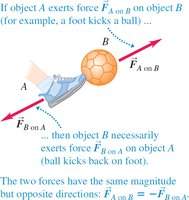
Newton’s Third Law states that for every action, there is an equal and opposite reaction. If object A exerts a force on object B, then object B exerts an equal and opposite force on object A.
Mathematical Form: \( \vec{F}_{A \text{ on } B} = -\vec{F}_{B \text{ on } A} \)
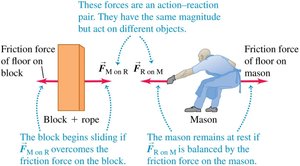
Action-Reaction Pairs: These forces act on different objects and never cancel each other.
Applications of Newton’s Third Law
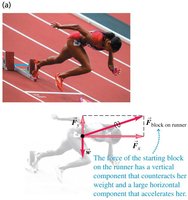
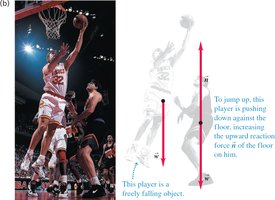
Everyday activities such as walking or running rely on Newton’s Third Law. For example, when you push backward on the ground, the ground pushes you forward with an equal force, allowing you to accelerate.

Free-Body Diagrams
Drawing and Using Free-Body Diagrams
A free-body diagram is a graphical representation used to visualize the forces acting on a single object. Each force is represented by a vector arrow pointing in the direction the force acts.
Steps:
Isolate the object of interest.
Draw all forces acting on the object (gravity, normal, friction, tension, applied forces, etc.).
Label each force clearly.
Purpose: Free-body diagrams help in setting up equations using Newton’s laws to solve for unknowns.
Worked Example: Boxes in Contact
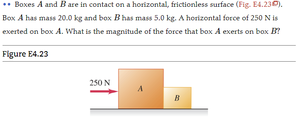
Consider two boxes, A and B, in contact on a frictionless surface. If a force is applied to box A, the force that A exerts on B can be found using Newton’s laws and free-body diagrams.
Worked Example: Chair on a Floor
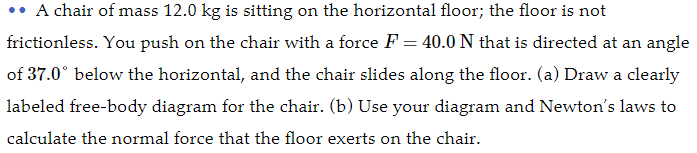
A chair of mass 12.0 kg is pushed with a force of 40.0 N at an angle of 37.0° below the horizontal. To find the normal force, draw a free-body diagram and apply Newton’s laws in the vertical direction.
Additional info: In all problems, always start by drawing a free-body diagram, resolve forces into components, and apply Newton’s laws to each direction independently. This systematic approach is essential for solving mechanics problems involving forces and motion.
