 Back
BackNewton’s Laws of Motion: Forces, Equilibrium, and Dynamics
Study Guide - Smart Notes
 Tailored notes based on your materials, expanded with key definitions, examples, and context.
Chapter 4: Newton’s Laws of Motion
Kinematics and Dynamics
Newton’s laws form the foundation of classical mechanics, describing how forces affect the motion of objects. While these laws are simple to state, they often challenge our 'common sense' ideas about motion, which may not always align with experimental evidence. Understanding Newton’s laws helps us adjust our intuition to match the physical reality.
4.1 Force and Interactions
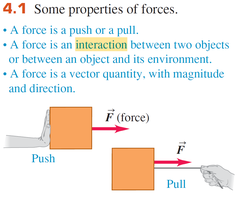
Forces are fundamental to understanding motion. A force is an interaction that can cause an object to accelerate, and it is always exerted by one body on another. Forces can be classified as contact forces (requiring physical contact) or long-range forces (acting at a distance).
Definition of Force: A force is a push or a pull, and it is a vector quantity, meaning it has both magnitude and direction.
Interaction: Forces always involve interactions between two objects or between an object and its environment.
Types of Forces
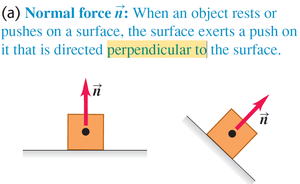
Normal Force (\(\vec{n}\)): The force exerted by a surface perpendicular to the object resting on it.
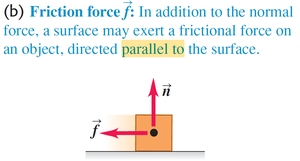
Friction Force (\(\vec{f}\)): The force exerted by a surface parallel to the object, opposing relative motion.
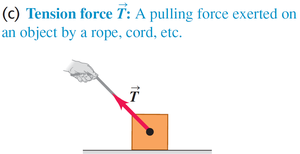
Tension Force (\(\vec{T}\)): The pulling force transmitted by a rope, cord, or similar object.
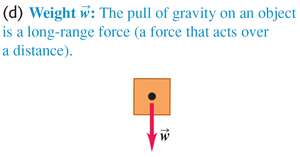
Weight (\(\vec{w}\)): The gravitational force acting on an object, a long-range force directed toward the center of the Earth.
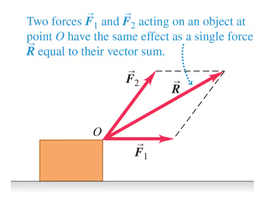
Superposition of Forces
When multiple forces act on a body at a point, their combined effect is the same as a single force equal to the vector sum of all the forces. This is known as the superposition principle.
Net Force: The vector sum of all forces acting on a body.
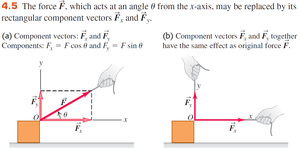
Any force can be replaced by its component vectors, typically along perpendicular axes (e.g., x and y components).
SI Unit of Force
Newton (N): The SI unit of force. One newton is the force required to accelerate a 1 kg mass by 1 m/s².
Vector Addition and Components
The resultant force \(\vec{R}\) is the vector sum of all individual forces:

Forces can be resolved into components along chosen axes, and the resultant’s components are the sums of the individual components:
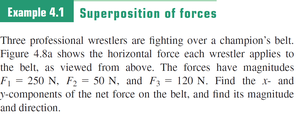
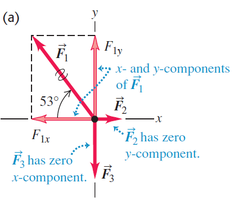
Example: Superposition of Forces
Three wrestlers apply forces of 250 N, 50 N, and 120 N to a belt. To find the net force, resolve each force into x and y components, sum them, and calculate the magnitude and direction of the resultant.

4.2 Newton’s First Law
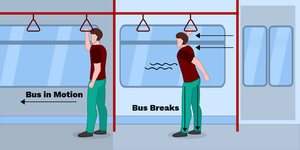
Newton’s First Law (Law of Inertia) states that a body at rest remains at rest, and a body in motion continues in motion with constant velocity unless acted upon by a net external force. This law defines the concept of equilibrium.
Equilibrium: A body is in equilibrium if the net force acting on it is zero.
(body in equilibrium)

Equilibrant: A single force that balances other forces, bringing the system into equilibrium.
Inertia
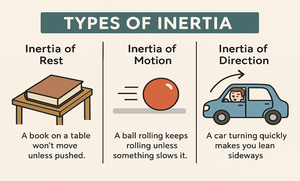
Inertia is the property of a body to resist changes in its state of motion. It explains why objects remain at rest or in uniform motion unless acted upon by a force.
Types of Inertia: Inertia of rest, inertia of motion, and inertia of direction.
4.3 Newton’s Second Law
Newton’s Second Law quantifies the relationship between force, mass, and acceleration. It states that the net force acting on a body is equal to the mass of the body multiplied by its acceleration.

Direction: The acceleration is in the same direction as the net force.
Units: Force is measured in newtons (N), mass in kilograms (kg), and acceleration in meters per second squared (m/s²).
Summary Table: Types of Forces
Type of Force | Symbol | Description |
|---|---|---|
Normal Force | \(\vec{n}\) | Perpendicular to surface |
Friction Force | \(\vec{f}\) | Parallel to surface, opposes motion |
Tension Force | \(\vec{T}\) | Pulling force by rope/cord |
Weight | \(\vec{w}\) | Gravitational pull |
Friction Forces
Kinetic Friction (\(f_k\)): Acts when two surfaces are moving relative to each other.
Static Friction (\(f_s\)): Acts when there is no relative motion.
Direction: Always opposes the relative motion of the surfaces.
Example Problems
Blocks on Inclined Plane: Two blocks connected by a string slide down an incline with different coefficients of friction. To solve, draw free-body diagrams, resolve forces, and apply Newton’s second law to each block.
Maximum Mass for Sliding Together: For a system of blocks and pulleys, use static friction and Newton’s laws to find the largest mass that allows blocks to move together.
Additional info: The above notes expand on the provided content with definitions, formulas, and examples to ensure a self-contained study guide suitable for college-level physics students.
