 Back
Newton's Laws of Motion: Forces, Free-Body Diagrams, and Applications
Study Guide - Smart Notes
 Tailored notes based on your materials, expanded with key definitions, examples, and context.
Newton's Laws of Motion and Force Analysis
Introduction to Forces and Free-Body Diagrams
Understanding the interaction of forces is fundamental in Physics with Calculus. Free-body diagrams (FBDs) are essential tools for visualizing and analyzing the forces acting on an object. These diagrams help in applying Newton's Laws to solve problems involving equilibrium and motion.
Types of Forces
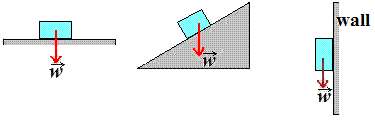
Weight (w): The gravitational force acting on an object, always directed downward toward the center of the Earth. where is mass and is the acceleration due to gravity.
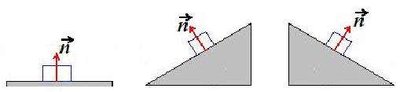
Normal Force (n): The perpendicular contact force exerted by a surface on an object resting on it.
Friction (f): The force that opposes the relative motion or tendency of such motion of two surfaces in contact.
Tension (T): The pulling force transmitted through a string, rope, cable, or chain.
Applied Force (F_{push}, F_{pull}): Any external force applied to an object.
Free-Body Diagrams: Examples and Construction
Free-body diagrams isolate a single object and represent all the forces acting on it with arrows. The length and direction of each arrow correspond to the magnitude and direction of the force.
Normal Force in Various Situations
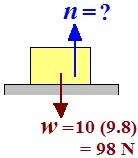
Object at Rest on a Horizontal Surface: The normal force balances the weight of the object. .
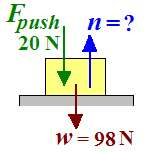
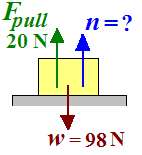
Object with Additional Vertical Forces: If an extra downward force is applied, . If an upward force is applied, .
Friction and Tension Forces
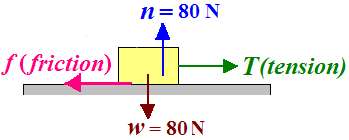
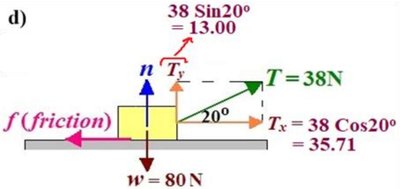
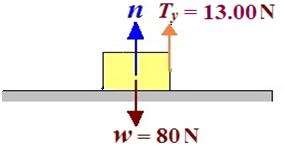
When an object is pulled or pushed horizontally, friction opposes the motion, and tension may act if a rope or cable is involved. The normal force may change if there are vertical components to the applied force.
Newton's Third Law: Action-Reaction Pairs
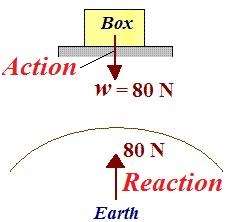
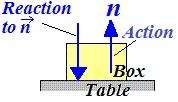
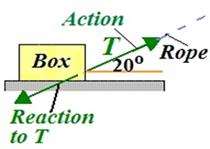
For every action, there is an equal and opposite reaction. This law explains the mutual forces between two objects in contact or interaction.
Weight: The Earth pulls on the box, and the box pulls on the Earth with equal magnitude but opposite direction.
Normal Force: The table pushes up on the box, and the box pushes down on the table.
Tension: The rope pulls on the box, and the box pulls back on the rope.
Applications: Atwood Machine and Connected Objects
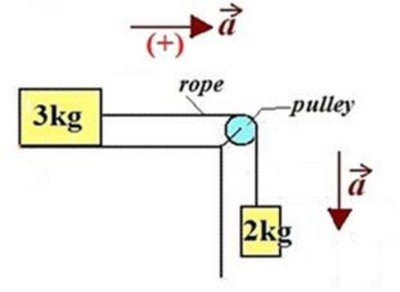
Systems involving pulleys and multiple objects require careful force analysis for each object. The tension is the same throughout a massless, frictionless rope, and the acceleration is common to all connected objects.
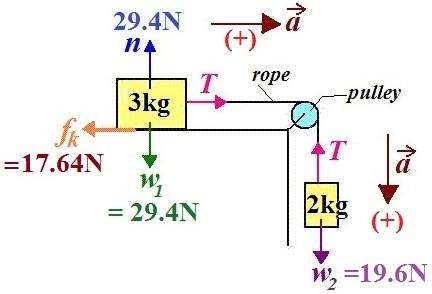
Force Analysis in Multiple Object Systems
When two or more objects interact (e.g., stacked crates), each object experiences forces from the other, and Newton's Third Law applies to these contact forces.
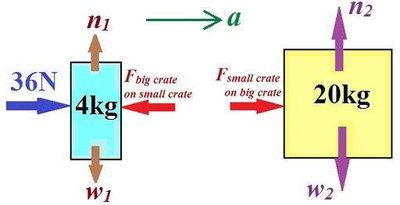
Force Components on Inclined Planes
On an inclined plane, the weight of the object is resolved into two components: parallel () and perpendicular () to the surface. The normal force balances the perpendicular component, and friction (if present) opposes the parallel component.
(parallel to the incline)
(perpendicular to the incline)
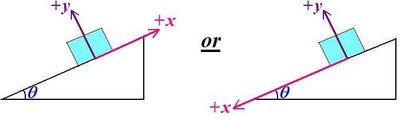
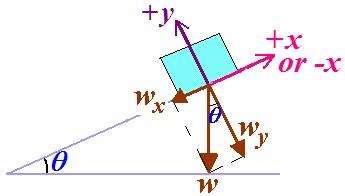
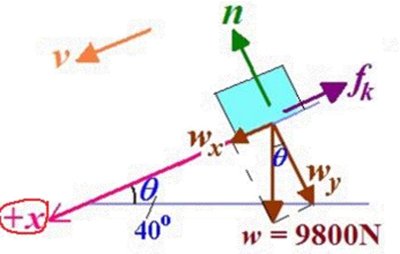
Example: Forces on an Inclined Plane
Consider a box of weight on a incline. The forces acting are the normal force, friction, and the components of weight. The net force along the incline determines the acceleration.
Normal force:
Friction force: (if kinetic friction is present)
Net force:
Force Equilibrium and Acceleration
When the sum of all forces on an object is zero, the object is in equilibrium (no acceleration). If the net force is nonzero, the object accelerates according to Newton's Second Law:
Summary Table: Common Forces in Free-Body Diagrams
Force | Symbol | Direction | Formula |
|---|---|---|---|
Weight | w | Downward | |
Normal | n | Perpendicular to surface | Varies (see above) |
Friction | f | Opposes motion | |
Tension | T | Along rope/cable | Varies (see above) |
Applied | F_{push}, F_{pull} | Direction of push/pull | Given |
Additional info: The notes above expand on the visual content by providing definitions, equations, and context for each force and scenario. The images are included only where they directly clarify the force analysis or free-body diagram construction.
