Back
Newton’s Laws of Motion – Physics with Calculus Study Notes
Study Guide - Smart Notes
 Tailored notes based on your materials, expanded with key definitions, examples, and context.
Newton’s Laws of Motion
Introduction
Newton’s Laws of Motion form the foundation of classical mechanics, describing the relationship between the motion of an object and the forces acting upon it. These laws are essential for understanding how objects move and interact in our universe.
Force and Mass
Definition of Force
Force is a push or pull exerted on an object, capable of changing the object’s state of motion.
Force is a vector quantity, meaning it has both magnitude and direction.
Definition of Mass
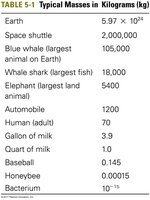
Mass measures an object’s resistance to changes in velocity (inertia).
It is also a measure of the quantity of matter in an object.
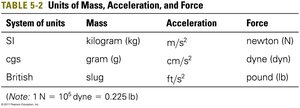
Units of Force, Mass, and Acceleration
System of Units | Mass | Acceleration | Force |
|---|---|---|---|
SI | kilogram (kg) | m/s2 | newton (N) |
cgs | gram (g) | cm/s2 | dyne (dyn) |
British | slug | ft/s2 | pound (lb) |
Newton’s First Law of Motion (Law of Inertia)
Statement and Explanation
An object at rest remains at rest, and an object in motion continues in motion with constant velocity unless acted upon by a net external force.
This law defines the concept of inertia.
An inertial reference frame is one in which Newton’s first law holds true (e.g., the surface of the Earth is a good approximation).
Newton’s Second Law of Motion
Statement and Mathematical Formulation
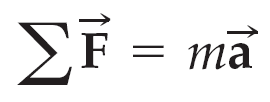
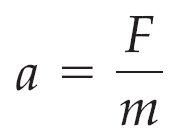
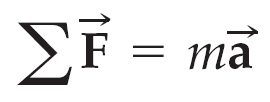
The acceleration of an object is directly proportional to the net force acting on it and inversely proportional to its mass.
Mathematically, this is expressed as:
Or, in vector form:
Experimental Evidence
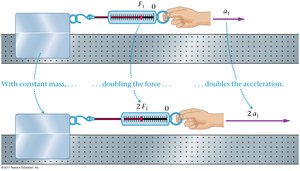
Doubling the force on an object doubles its acceleration (with constant mass).
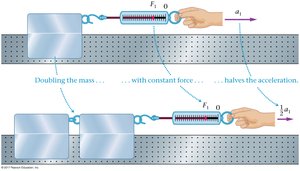
Doubling the mass halves the acceleration (with constant force).
Free-Body Diagrams
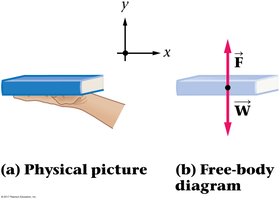
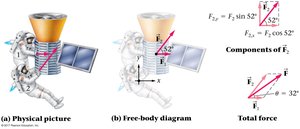
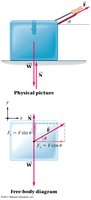
A free-body diagram is a sketch showing all the forces acting on an object.
Steps to draw a free-body diagram:
Sketch the forces acting on the object.
Isolate the object of interest.
Choose a convenient coordinate system.
Resolve the forces into components.
Apply Newton’s second law to each coordinate direction.
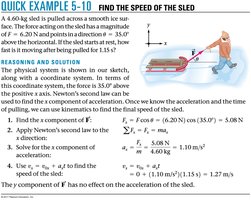
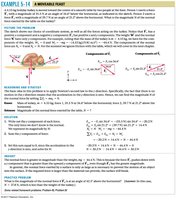
Worked Example: Finding the Speed of a Sled
Given a force acting at an angle, resolve the force into components and apply Newton’s second law to find acceleration and speed.
Newton’s Third Law of Motion
Statement and Explanation
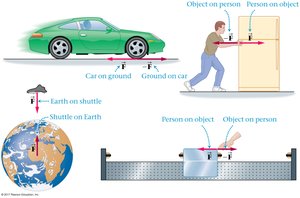
For every action, there is an equal and opposite reaction.
If object 1 exerts a force on object 2, then object 2 exerts a force of equal magnitude and opposite direction on object 1.
These are called action-reaction pairs.
Contact Forces
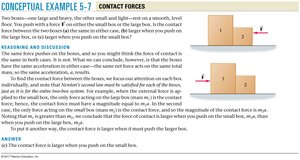
Contact forces are action-reaction pairs produced by two objects in physical contact.
The force exerted by one object on another depends on which object is being pushed or pulled.
The Vector Nature of Forces: Forces in Two Dimensions
Resolving Forces
Forces in two dimensions can be resolved into components along each axis (usually x and y).
Newton’s laws can be applied independently to each component.
Weight
Definition and Calculation
The weight of an object is the gravitational force exerted on it by the Earth.
Weight is calculated as:

Apparent Weight
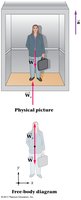
Your apparent weight is the contact force between your body and your surroundings (e.g., a scale or the floor).
If your surroundings are accelerating, your apparent weight may differ from your actual weight.
Normal Forces
Definition and Properties
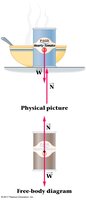
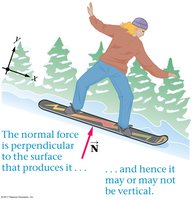
The normal force is the force exerted by a surface perpendicular to the object resting on it.
The normal force may be equal to, greater than, or less than the object’s weight, depending on the situation.
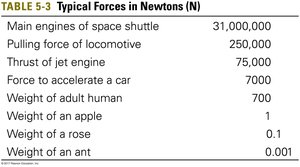
Summary Table: Typical Forces in Newtons (N)
Situation | Force (N) |
|---|---|
Main engines of space shuttle | 31,000,000 |
Pulling force of locomotive | 250,000 |
Thrust of jet engine | 75,000 |
Force to accelerate a car | 7,000 |
Weight of adult human | 700 |
Weight of an apple | 1 |
Weight of a rose | 0.1 |
Weight of an ant | 0.001 |
Summary of Key Concepts
Force: A push or pull; vector quantity.
Mass: Measures resistance to acceleration (inertia).
Newton’s First Law: Velocity remains constant if net force is zero.
Newton’s Second Law:
Newton’s Third Law: Forces come in equal and opposite pairs.
Free-body diagram: Diagram showing all forces on an object.
Weight:
Normal force: Perpendicular contact force from a surface.
Forces can be resolved into components and analyzed independently.