 Back
BackNewton’s Laws of Motion: Statics and Dynamics
Study Guide - Smart Notes
 Tailored notes based on your materials, expanded with key definitions, examples, and context.
Newton’s Laws of Motion: Statics and Dynamics
4-1 Force
In physics, a force is defined as a push or pull resulting from the interaction between two objects or between an object and its environment. Forces are responsible for changes in an object's motion and are vector quantities, meaning they have both magnitude and direction. The SI unit of force is the Newton (N), where 1 N = 1 kg·m/s2.
Contact forces: Forces that arise from physical contact (e.g., push, pull).
Action-at-a-distance forces: Forces that act without physical contact (e.g., gravity).
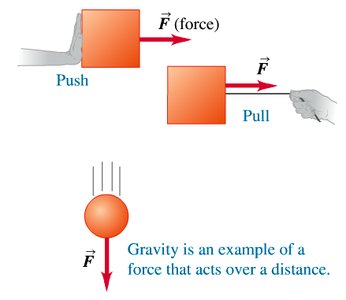
Example: Gravity is a force that acts over a distance, pulling objects toward the Earth.
4-2 Newton’s First Law of Motion (Law of Inertia)
Newton’s First Law states: "Every object continues in its state of rest, or of uniform velocity in a straight line, as long as no net force acts on it." This property is called inertia, which is the resistance of an object to changes in its motion. The more massive an object, the greater its inertia.
Inertia: The tendency of an object to resist changes in its state of motion.
Mass: A measure of an object's inertia (SI unit: kilogram, kg).
Inertial reference frame: A frame of reference in which Newton’s first law holds (i.e., not accelerating).
Important distinction: Mass is not the same as weight. Mass is a scalar quantity (kg), while weight is a force (N) due to gravity: $w = F_g = m g$, where $g = 9.80\ \mathrm{m/s^2}$ on Earth.
4-3 Mass and Weight
Mass is a scalar quantity representing the amount of matter in an object. Weight is the gravitational force acting on that mass. The relationship is:
$w = m g$
Mass (m): Measured in kilograms (kg).
Weight (w): Measured in Newtons (N), a vector directed toward the center of the Earth.
Example: A scale reports mass in kg by dividing the measured force by $g$.
4-4 Newton’s Second Law of Motion
Newton’s Second Law quantifies the relationship between force, mass, and acceleration: "The acceleration of an object is directly proportional to the net force acting on it, and inversely proportional to its mass." The law is mathematically expressed as:
$\Sigma \vec{F} = m \vec{a}$
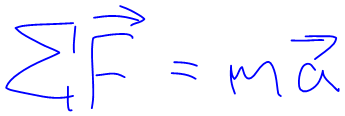
Net force ($\Sigma \vec{F}$): The vector sum of all forces acting on an object.
Acceleration ($\vec{a}$): Always in the direction of the net force.
Non-inertial reference frame: A frame that is accelerating, where fictitious forces may appear.
Example: If a 68.5 kg skater slows from 2.40 m/s to rest in 3.52 s due to friction, the frictional force can be found using Newton’s second law.
4-5 Newton’s Third Law of Motion (Action-Reaction)
Newton’s Third Law states: "Whenever one object exerts a force on a second object, the second object exerts an equal force in the opposite direction on the first object." These forces are called action-reaction pairs.
Third law pairs are equal in magnitude, opposite in direction, of the same type, and act on different objects.
Example: When you push on a door, the door pushes back on your hand with an equal and opposite force.
4-6 Types of Forces
Applied force: A force applied to an object by a person or another object.
Gravitational force: The force of gravity acting on an object (weight).
Normal force: The perpendicular contact force exerted by a surface.
Tension force: The pulling force transmitted by a string, rope, or cable.
Friction force: The force that opposes the motion of an object.
4-7 Free-Body Diagrams (FBDs)
A free-body diagram is a graphical illustration used to visualize the forces acting on a single object. The steps to draw an FBD are:
Draw a sketch of the situation.
Isolate the object of interest.
Identify and draw all forces acting on the object (with correct direction and labeling).
Apply Newton’s laws to solve for unknowns.
Types of forces to consider: Applied, gravitational, normal, tension, and friction forces.
4-8 Problems Involving Friction and Inclines
Friction is a force that opposes the relative motion of two surfaces in contact. On a microscopic scale, surfaces are rough, and friction arises from these irregularities.
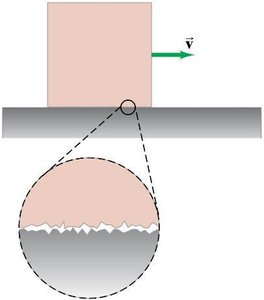
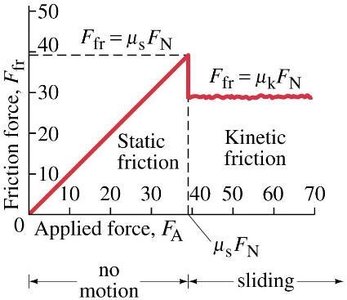
Static friction ($f_s$): The force that prevents the start of sliding motion between two surfaces. It adjusts up to a maximum value: $f_s \leq \mu_s F_N$.
Kinetic friction ($f_k$): The force that opposes motion once sliding has begun. It is constant: $f_k = \mu_k F_N$.
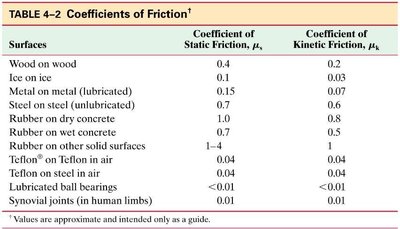
Here, $\mu_s$ and $\mu_k$ are the coefficients of static and kinetic friction, respectively, and $F_N$ is the normal force.
Surfaces | Coefficient of Static Friction, $\mu_s$ | Coefficient of Kinetic Friction, $\mu_k$ |
|---|---|---|
Wood on wood | 0.4 | 0.2 |
Ice on ice | 0.1 | 0.03 |
Metal on metal (lubricated) | 0.15 | 0.07 |
Steel on steel (unlubricated) | 0.7 | 0.6 |
Rubber on dry concrete | 1.0 | 0.8 |
Rubber on wet concrete | 0.7 | 0.5 |
Teflon on Teflon in air | 0.04 | 0.04 |
Frictional force behavior: The static frictional force increases with applied force up to its maximum value, after which kinetic friction takes over and remains constant.
4-8 Inclined Planes
When an object is on an inclined plane, three forces act on it: the normal force (perpendicular to the surface), the frictional force (parallel to the surface), and gravity (downward). The weight can be resolved into components parallel and perpendicular to the incline.
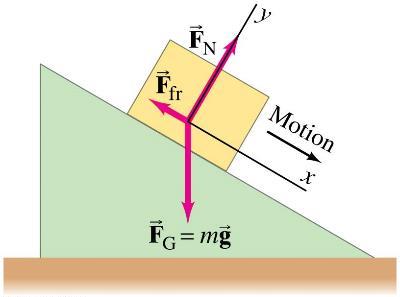
Parallel component: $mg \sin \theta$ (down the incline)
Perpendicular component: $mg \cos \theta$ (normal to the incline)
The net force along the incline determines the acceleration:
$F_{\text{net}} = m a = mg \sin \theta - f$
where $f$ is the frictional force (static or kinetic, as appropriate).
4-8 Example Problems
Finding acceleration on a frictionless incline: $a = g \sin \theta$
Finding the coefficient of static friction to keep a box stationary: $\mu_s = \tan \theta$ (when the box just begins to slide)
Two-mass pulley systems: Analyze forces on each mass, resolve components, and apply Newton’s laws to solve for acceleration and tension.
4-8 Measuring Coefficients of Friction
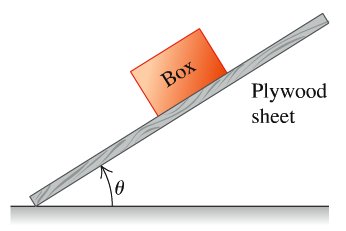
One method to measure the coefficients of friction is to gradually increase the angle of an inclined plane until the box just begins to slide (static friction), and then lower it until the box slides at constant speed (kinetic friction). Applying Newton’s second law allows calculation of $\mu_s$ and $\mu_k$:
Static friction: $\mu_s = \tan \theta_1$ (angle where sliding begins)
Kinetic friction: $\mu_k = \tan \theta_2$ (angle where constant speed is observed)
Additional info: These notes cover the core concepts of Newton’s Laws, types of forces, free-body diagrams, friction, and inclined planes, as outlined in a typical introductory college physics course.
