 Back
BackNewton's Laws of Motion: Study Notes and Applications
Study Guide - Smart Notes
 Tailored notes based on your materials, expanded with key definitions, examples, and context.
Newton's Laws of Motion
Introduction to Newton's Laws
Newton's Laws of Motion are fundamental principles that describe the relationship between the motion of an object and the forces acting upon it. These laws form the basis for classical mechanics and are essential for understanding how objects move and interact.
Force and Acceleration: Newton's Second Law
Newton's Second Law states that the acceleration of an object is directly proportional to the net force acting on it and inversely proportional to its mass. This law is mathematically expressed as:
Formula:
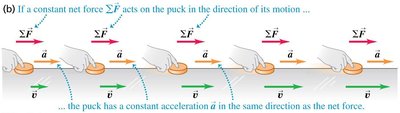
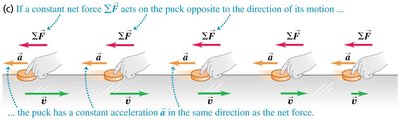
Key Point: The direction of the acceleration is the same as the direction of the net force.
Example: If a constant force is applied to a puck, its acceleration will be constant and in the direction of the force.

Proportionality of Force and Acceleration
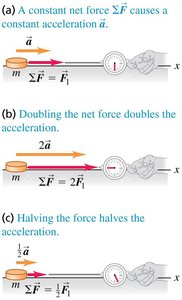
The relationship between force and acceleration can be further explored:
Doubling the net force doubles the acceleration.
Halving the net force halves the acceleration.
Formula:
Mass and Acceleration
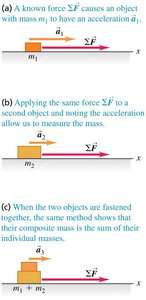
The mass of an object affects its acceleration for a given force:
Key Point: For a fixed force, increasing the mass decreases the acceleration.
Composite Mass: When two objects are fastened together, their combined mass is the sum of their individual masses.
Formula:
Free-Body Diagrams
Free-body diagrams are essential tools for visualizing and analyzing the forces acting on a single object. They help identify all relevant forces and ensure correct application of Newton's Laws.
Key Point: Only include forces acting on the object, not forces the object exerts on others.
Action-Reaction Pairs: These pairs never appear together in the same free-body diagram.
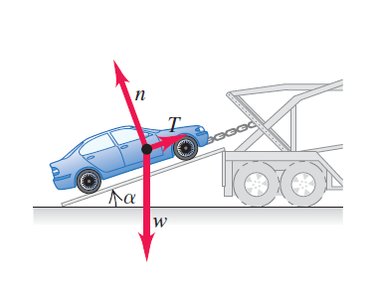
Strategy for Force and Motion Problems
Solving force and motion problems involves a systematic approach:
Prepare a pictorial representation of the problem.
Analyze the motion using a motion diagram to determine the acceleration vector.
Identify all forces acting on the object and show them on a free-body diagram.
Apply Newton's Second Law.
Determine the vector sum of the forces from the free-body diagram.
Solve for the subsequent motion using kinematic equations.
Assess the results for physical consistency.
Application Example: Horizontal Force on a Box
A worker pulls a box of mass 40 kg with a constant horizontal force of 20 N on a frictionless surface. The vertical forces are in equilibrium, so there is no vertical motion, but there is a net force along the horizontal direction, resulting in acceleration.
Formula:
Calculation:
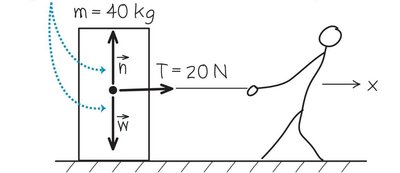
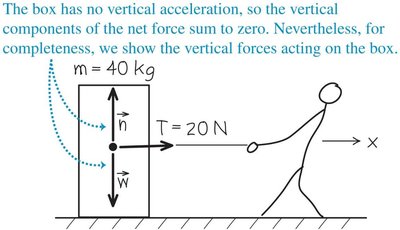
Application Example: Friction Force on a Ketchup Bottle
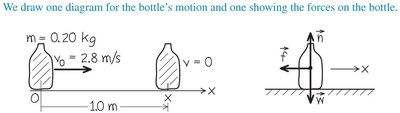
A ketchup bottle with mass 0.20 kg is pushed along a smooth counter with an initial velocity of 2.8 m/s. It slows down due to friction and comes to rest after sliding 1.0 m. The net horizontal force opposes the motion, causing deceleration.
Key Point: The friction force acts opposite to the direction of motion.
Formula for friction force: (where is the deceleration calculated from kinematics)
Summary Table: Newton's Second Law Applications
Scenario | Net Force () | Acceleration () | Direction |
|---|---|---|---|
Zero net force | $0$ | $0$ | None (constant velocity) |
Net force in direction of motion | Same as force | ||
Net force opposite to motion | Opposite to motion |
Additional info: Academic context and formulas have been expanded for clarity and completeness. Examples and diagrams are directly relevant to Newton's Laws and their applications in force and motion problems.
