 Back
BackNewton's Laws: Practice Problems with Step-by-Step Guidance
Study Guide - Smart Notes
 Tailored notes based on your materials, expanded with key definitions, examples, and context.
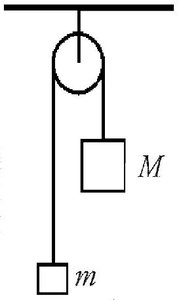
Q1. Two objects are connected by a very light flexible string as shown in the figure, where M = 0.60 kg and m = 0.40 kg. You can ignore friction and the mass of the pulley.
Background
Topic: Newton's Second Law, Atwood Machine
This question tests your understanding of Newton's laws applied to a system of two masses connected by a string over a pulley. You need to analyze forces, draw free-body diagrams, and calculate acceleration and tension.
Key Terms and Formulas:
Newton's Second Law:
Free-body diagram: A visual representation of all forces acting on an object
Acceleration constraint: Both masses accelerate together
For Atwood machine:
Tension in the string: or (depending on which mass you analyze)
Step-by-Step Guidance
Draw free-body diagrams for each mass. For mass M, show gravity () downward and tension () upward. For mass m, show gravity () downward and tension ($T$) upward.
Write Newton's second law for each mass. For M: (if M moves upward). For m: (if m moves downward).
Add the two equations to eliminate T and solve for acceleration .
Set up the formula for acceleration: (be careful with sign conventions).
Try solving on your own before revealing the answer!
Final Answer:
Acceleration:
Tension:
We used Newton's second law for both masses and solved the system of equations to find acceleration and tension.
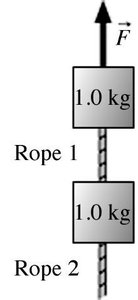
Q3. The figure shows two 1.0 kg-blocks connected by a rope. A second rope hangs beneath the lower block. Both ropes have a mass of 250 g. The entire assembly is accelerated upward at 2.3 m/s2 by force F. What is the tension at the top end of rope 1?
Background
Topic: Newton's Second Law, Tension in Ropes
This question tests your ability to analyze forces in a multi-object system, including the effect of rope mass and acceleration.
Key Terms and Formulas:
Newton's Second Law:
Tension: The force transmitted through a rope or string
System mass: Add up all masses being supported by the rope
For tension at the top of rope 1:
Step-by-Step Guidance
Identify all masses supported by the top of rope 1: both blocks and both ropes.
Calculate the total mass: .
Write the equation for tension: , where is gravity and is the upward acceleration.
Plug in the values for each mass and acceleration, but stop before calculating the final tension value.
Try solving on your own before revealing the answer!
Final Answer:
Tension at the top of rope 1:
We summed all masses and multiplied by the total acceleration (gravity plus upward acceleration).
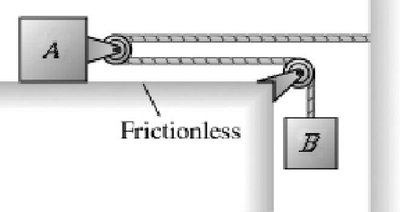
Q4. A wooden block A of mass 4.0 kg slides on a frictionless table when pulled using a massless string and pulley array by a hanging box B of mass 5.0 kg, as shown in the figure. What is the acceleration of block A as it slides on the frictionless table?
Background
Topic: Newton's Second Law, Pulley Systems
This question tests your understanding of how to analyze a system with pulleys and massless strings, focusing on acceleration constraints.
Key Terms and Formulas:
Newton's Second Law:
Acceleration constraint: Both blocks move together, but the pulley arrangement may affect the acceleration relationship.
For a frictionless system: (if both masses move together)
Step-by-Step Guidance
Draw free-body diagrams for both blocks. Block A has tension pulling horizontally; block B has gravity pulling downward and tension upward.
Write Newton's second law for each block. For A: . For B: .
Add the equations to eliminate T and solve for acceleration .
Set up the formula for acceleration, but stop before plugging in the numbers.
Try solving on your own before revealing the answer!
Final Answer:
Acceleration of block A:
We used Newton's second law for both blocks and solved for the acceleration using the constraint that both blocks move together.
