 Back
BackNewton’s Second Law of Motion and Related Concepts
Study Guide - Smart Notes
 Tailored notes based on your materials, expanded with key definitions, examples, and context.
Newton’s Laws of Motion
Newton’s First Law of Motion (Law of Inertia)
Newton’s First Law states that every object continues in a state of rest or of uniform speed in a straight line unless acted on by a nonzero net force. This property is called inertia, which is the tendency of objects to resist changes in their motion.
Inertia: The resistance of any physical object to a change in its state of motion or rest.
Example: Dishes remain at rest on a table when a tablecloth is quickly pulled out from underneath them, demonstrating inertia.
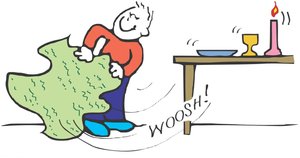
Additional info: Inertia is not a force but a property of matter. The greater the mass, the greater the inertia.
States of Motion Implied by the First Law
An object can be in one of three states: at rest, moving at constant velocity, or changing velocity (accelerating). Only a net force can change the state of motion.
Friction
The Force of Friction
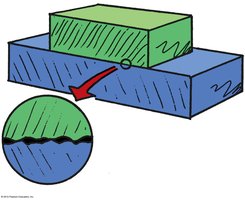
Friction is a resistive force that acts opposite to the direction of motion or intended motion when two surfaces interact. It always acts to decrease the net force and thus the acceleration of the object(s).
Depends on the types of materials in contact and how much they are pressed together.
Caused by microscopic surface irregularities and atomic-level stickiness.
Example: Friction between a crate and a smooth wooden floor is less than that on a rough floor.
Types of Friction
Static Friction: The frictional force that prevents two surfaces from sliding past each other.
Sliding (Kinetic) Friction: The frictional force acting when objects are sliding over each other.
Both static and sliding friction do not depend on speed or area of contact.
Fluid Friction (Drag): The resistive force experienced by objects moving through fluids (liquids or gases). It does depend on speed and area of contact.
Newton’s Second Law of Motion
Statement and Equation
Newton’s Second Law relates the net force acting on an object to its mass and the resulting acceleration. The acceleration produced by a net force is directly proportional to the net force, in the same direction as the net force, and inversely proportional to the mass of the object.
Equation:
Key Points:
To increase acceleration, increase the net force or decrease the mass.
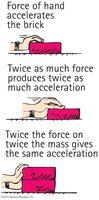
If the net force doubles, acceleration doubles (if mass is constant).
If the mass doubles, acceleration halves (if force is constant).
Mass Resists Acceleration
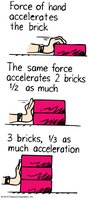
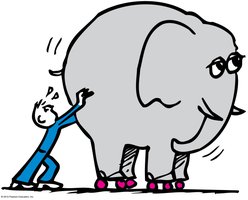
Mass is a measure of an object’s inertia. The greater the mass, the less acceleration produced by a given force.
Twice the mass produces half the acceleration for the same force.
Three times the mass produces one-third the acceleration.
Free Fall and Non-Free Fall
Free Fall
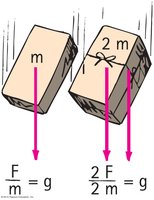
When an object falls under the influence of gravity alone (no air resistance), it is in free fall. All objects in free fall near Earth’s surface accelerate at the same rate, regardless of mass, because the force of gravity is proportional to mass, and so is inertia.
Acceleration due to gravity: (often approximated as )
Key Point: Heavier objects experience a greater gravitational force, but also have greater inertia, resulting in the same acceleration as lighter objects.
Non-Free Fall (Air Resistance)
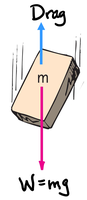
When objects fall through air, they experience an upward force called air resistance (drag). The net force is then the difference between the weight and the drag force, resulting in an acceleration less than .
Air resistance increases with speed and frontal surface area.
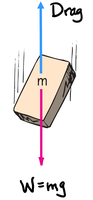
When air resistance equals the weight, the net force is zero and the object stops accelerating—this is called terminal speed (or terminal velocity if direction is specified).
Terminal Velocity
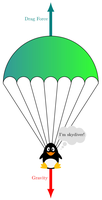
Terminal velocity is reached when the force of air resistance (drag) equals the force of gravity (weight), resulting in zero net force and constant velocity.
Objects with larger surface areas (like feathers or parachutes) reach terminal velocity quickly and fall slowly.
Heavier objects with the same surface area reach a higher terminal velocity.
Example: Skydiver
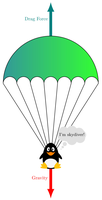
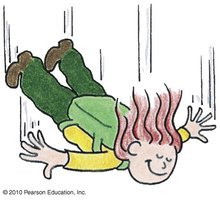
When a skydiver jumps from a plane, only gravity acts at first. As speed increases, air resistance builds up, reducing net force and acceleration. When air resistance equals weight, the skydiver reaches terminal velocity and continues falling at constant speed.
Free Fall vs. Non-Free Fall: Coin and Feather
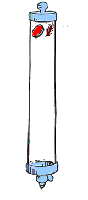
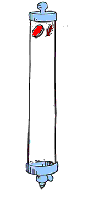
In air, a feather reaches terminal velocity quickly and falls slowly, while a coin falls much faster because air resistance is negligible for it over short distances. In a vacuum (no air), both fall together at the same rate.
Summary Table: Free Fall vs. Non-Free Fall
Condition | Forces Acting | Acceleration | Terminal Velocity? |
|---|---|---|---|
Free Fall (Vacuum) | Gravity only | No | |
Non-Free Fall (Air) | Gravity, Air Resistance | < | Yes, when drag = weight |
