 Back
Newton's Second Law of Motion: Force, Mass, and Acceleration
Study Guide - Smart Notes
 Tailored notes based on your materials, expanded with key definitions, examples, and context.
Newton's Second Law of Motion
Introduction
Newton's Second Law of Motion is a foundational principle in classical mechanics, describing the relationship between force, mass, and acceleration. This chapter explores how forces cause acceleration, the nature of friction, the distinction between mass and weight, and the behavior of objects in free fall and nonfree fall conditions.
Force Causes Acceleration
Relationship Between Force and Acceleration
Acceleration is directly proportional to the net force acting on an object.
To increase an object's acceleration, increase the net force applied to it.
Mathematically, this relationship is expressed as:
Key Point: The direction of acceleration is the same as the direction of the net force.
The Force of Friction
Nature and Effects of Friction
Friction is a force that opposes the relative motion of two surfaces in contact.
It depends on the types of materials and how tightly they are pressed together.
Friction arises from microscopic surface irregularities and the 'stickiness' of atoms at the interface.
Friction can occur with sliding objects, in water, and in air (air resistance).
Friction acts even when objects are at rest, opposing any applied force that does not cause motion.
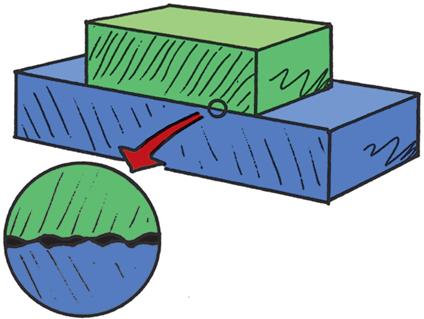
Example: Friction between a crate and a smooth wooden floor is less than that on a rough floor.
Friction in Motion
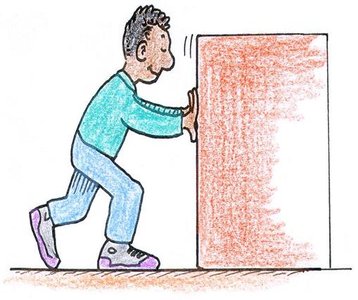
When an object moves at constant speed across a surface, the force of friction is equal and opposite to the applied force.
If the object accelerates, the applied force exceeds the force of friction.
Mass and Weight
Definitions and Distinctions
Mass is the quantity of matter in an object and a measure of its inertia (resistance to changes in motion).
Weight is the force of gravity acting on an object, calculated as .
Mass is measured in kilograms (kg), while weight is measured in newtons (N) or pounds (lb).
Mass is independent of location, but weight depends on the local gravitational field.
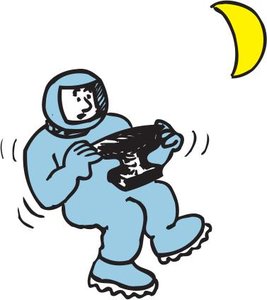
Example: An object has the same mass on Earth and the Moon, but its weight is less on the Moon due to lower gravity.
Relationship Between Mass and Weight
Weight is directly proportional to mass: .
On Earth's surface, 1 kg weighs approximately 9.8 N or 2.2 lb.
1 lb = 4.45 N.
Mass and Inertia
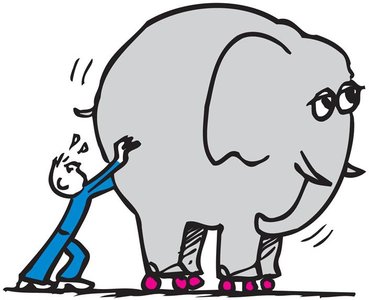
Mass is a measure of an object's inertia—its resistance to acceleration.
The greater the mass, the less acceleration produced by a given force.
Examples: Tension and Inertia
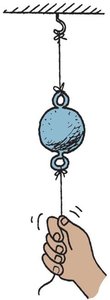
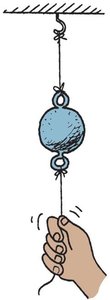
If a string holding a weight is pulled slowly, the top string breaks, illustrating the weight (force of gravity).
If the string is pulled quickly, the bottom string breaks, illustrating the mass (inertia) of the object.
Newton's Second Law of Motion
Statement and Equation
Newton's Second Law states: The acceleration of an object is directly proportional to the net force acting on it, is in the direction of the net force, and is inversely proportional to its mass.
Mathematically:
or equivalently,
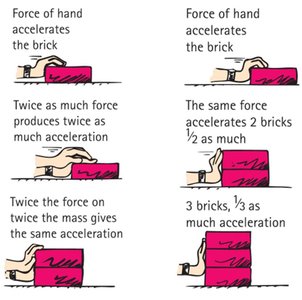
If the net force is doubled, acceleration doubles.
If the mass is doubled, acceleration is halved.
Free Fall
Acceleration Due to Gravity
In the absence of air resistance, all objects near Earth's surface accelerate downward at .
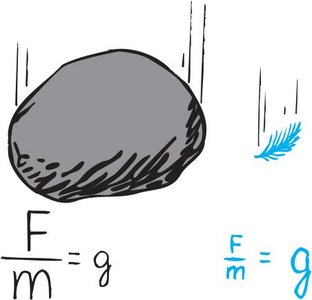
The force of gravity is proportional to mass, but so is inertia, so all objects fall with the same acceleration.
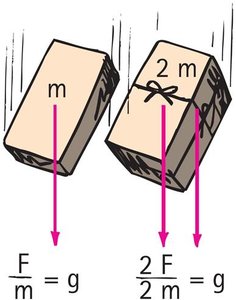
Example: A 5-kg and a 10-kg iron ball dropped from rest accelerate at the same rate and reach the same speed at the same time (neglecting air resistance).
Nonfree Fall
Air Resistance and Terminal Velocity
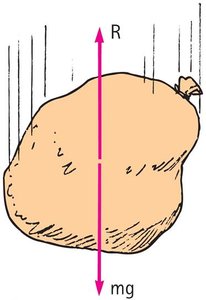
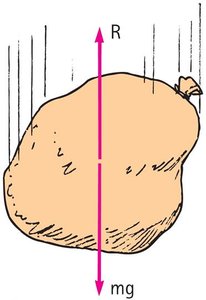
When objects fall through air, they experience both gravity (downward) and air resistance (upward).
As speed increases, air resistance increases until it balances the force of gravity.
At this point, the object stops accelerating and falls at a constant speed called terminal velocity.
Factors Affecting Air Resistance
Air resistance depends on the object's speed and frontal surface area.
Larger surface area or higher speed increases air resistance.
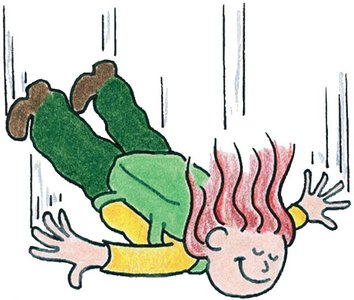
Skydiver Example
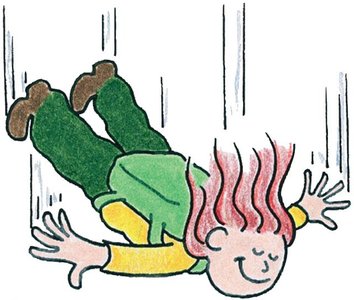
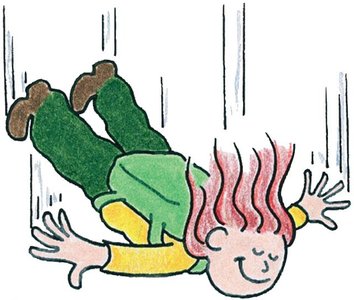
As a skydiver accelerates, air resistance increases, reducing net force and acceleration.
When air resistance equals weight, the skydiver reaches terminal velocity and continues falling at constant speed.
Comparing Free Fall and Nonfree Fall
In air, a feather quickly reaches terminal velocity and falls slowly, while a rock takes longer to reach terminal velocity and falls faster.
In a vacuum (no air), both fall together with the same acceleration.
Summary Table: Free Fall vs. Nonfree Fall
Condition | Forces Acting | Acceleration | Terminal Velocity? |
|---|---|---|---|
Free Fall (Vacuum) | Gravity only | (constant) | No |
Nonfree Fall (Air) | Gravity and air resistance | < (decreases as speed increases) | Yes, when forces balance |
Key Equations
Newton's Second Law:
Weight:
Acceleration in nonfree fall:
