 Back
BackNewton’s Third Law and Interacting Objects: Systems, Forces, and Applications
Study Guide - Smart Notes
 Tailored notes based on your materials, expanded with key definitions, examples, and context.
Newton’s Third Law and Interacting Objects
Introduction to Interacting Objects
Understanding how objects interact is fundamental to analyzing physical systems. Newton’s Third Law provides the framework for describing these interactions, emphasizing that forces always occur in pairs. This chapter explores the identification of systems, the distinction between internal and external forces, and the application of Newton’s Third Law to various scenarios.
Newton’s Third Law of Motion
Action-Reaction Pairs
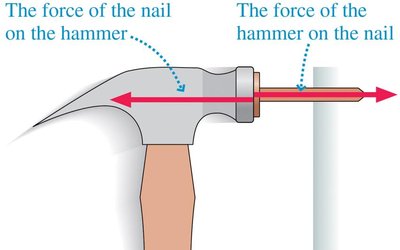
Newton’s Third Law states: For every action, there is an equal and opposite reaction. This means that forces always come in pairs, known as action/reaction pairs. When one object exerts a force on a second object, the second object exerts an equal and opposite force on the first.
Key Point: The two forces in an action/reaction pair act on different objects.
Key Point: The forces are equal in magnitude but opposite in direction.
Example: When a hammer strikes a nail, the hammer exerts a force on the nail, and the nail exerts an equal and opposite force on the hammer.

Simultaneity and Indistinguishability
It is not meaningful to distinguish which object acts and which reacts; both forces occur simultaneously.
Example: Your weight pushes down on a chair, and the chair pushes up on you with an equal force.
Objects, Systems, and the Environment
Defining Systems and Environments
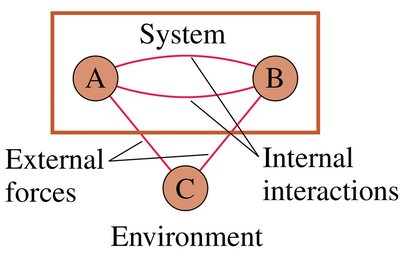
When analyzing physical problems, it is essential to distinguish between the system (the set of objects whose motion is being studied) and the environment (objects outside the system that exert forces on it).
Internal interactions: Forces between objects within the system.
External forces: Forces exerted by the environment on the system.
Interaction Diagrams
An interaction diagram visually represents all objects and the forces between them, distinguishing between internal and external interactions.
Objects in the system are enclosed in a box.
Lines represent interactions (forces) between objects.
Tactics: Analyzing Interactions
Steps for Analyzing Interacting Objects
Represent each object as a circle with a name and label, placed relative to other objects.
Identify interactions: Draw lines between circles to represent forces. Each line connects only two objects.
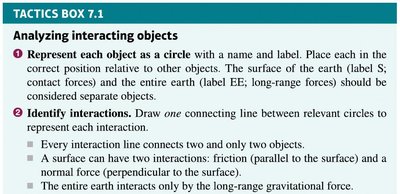
Identify the system: Draw a box around the objects of interest.
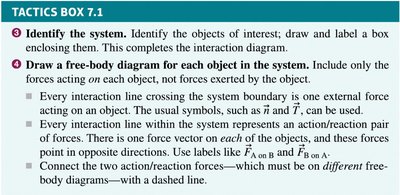
Draw free-body diagrams (FBDs): For each object in the system, include only the forces acting on it, not those it exerts.
Propulsion and Static Friction
Static Friction as a Propulsion Force
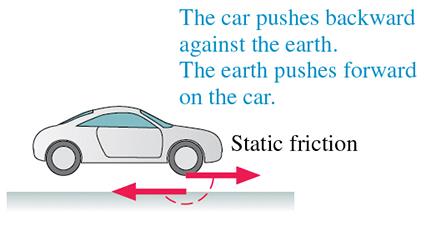
Static friction enables objects to move without slipping. It acts in the direction that prevents relative motion between surfaces in contact.
Example: When walking, static friction points forward, propelling you ahead.
On ice, static friction is reduced, leading to slipping.
Examples of Propulsion
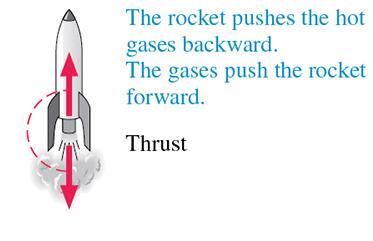
Rocket Launch: The rocket pushes hot gases downward; the gases push the rocket upward (thrust).
Driving a Car: The tires push backward on the road; the road pushes forward on the tires via static friction.
Free-Body Diagrams and Interaction Diagrams
Drawing Free-Body Diagrams (FBDs)
FBDs are essential for visualizing the forces acting on each object in a system. Each force is represented as an arrow pointing in the direction of the force.
Include only forces acting on the object, not those it exerts.
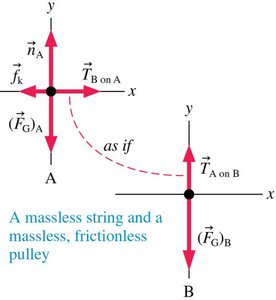
Action/reaction pairs are shown on different FBDs and connected with dashed lines.
Reasoning with Newton’s Third Law
Unequal Accelerations Despite Equal Forces
Although action/reaction forces are equal in magnitude, the resulting accelerations depend on the masses of the objects involved.
Example: When a bowling ball hits a ping-pong ball, both experience equal forces, but the ping-pong ball accelerates much more due to its smaller mass.
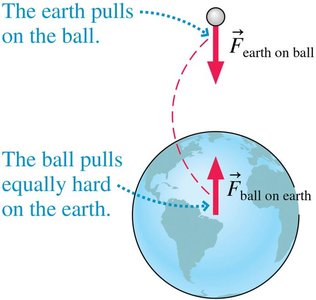
Earth and Ball: When a ball falls, the Earth pulls the ball downward, and the ball pulls the Earth upward with an equal force. However, the Earth's acceleration is negligible due to its large mass.
Acceleration Constraints in Interacting Systems
Acceleration Constraints
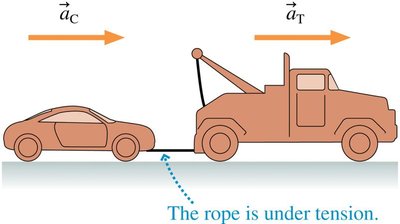
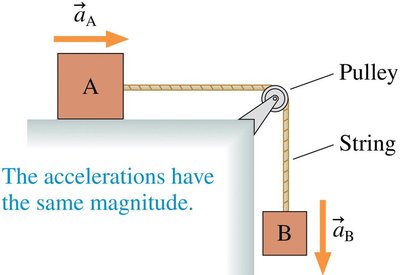
When two objects are connected (e.g., by a rope or string), their accelerations may be constrained to have the same magnitude, though possibly in different directions.
Example 1: A car towed by a truck—both accelerate together.
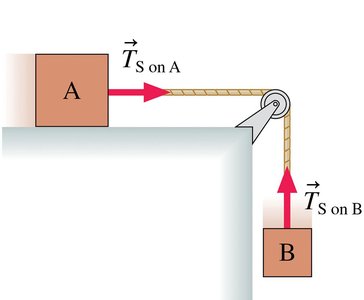
Example 2: Two boxes connected by a string over a pulley—one moves right, the other moves down, but the magnitudes of their accelerations are equal.
Problem-Solving Strategy: Interacting-Objects Problems
Systematic Approach
Solving problems involving interacting objects requires a structured approach:
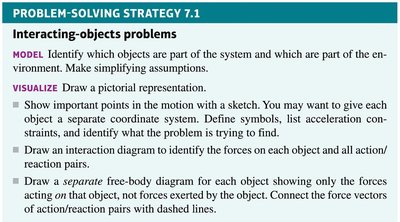
Model: Identify the system and environment; make simplifying assumptions.
Visualize: Draw a pictorial representation, interaction diagram, and FBDs for each object.
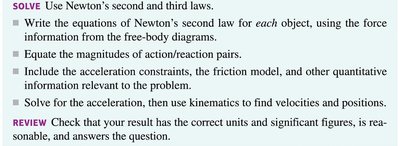
Solve: Apply Newton’s second and third laws, write equations for each object, include acceleration constraints and friction, and solve for unknowns.
Review: Check units, significant figures, and the reasonableness of the answer.
Tension and the Massless String Approximation
Tension in Ropes and Strings
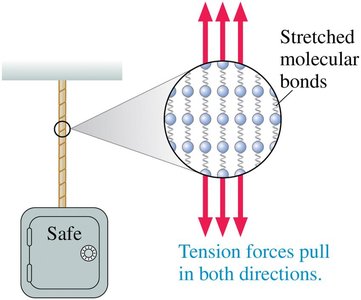
Tension is the pulling force transmitted by a rope, string, or cable. It acts equally in both directions along the rope.
Tension arises from molecular bonds modeled as tiny springs.
Cutting the rope removes the tension, causing the object to fall.
Massless String Approximation
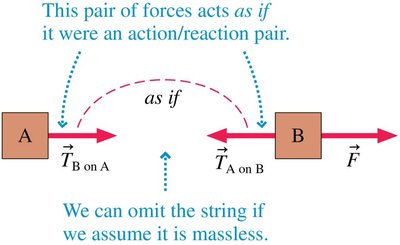
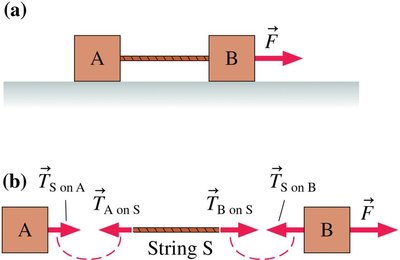
When the mass of the string is negligible compared to the objects it connects, we can assume the tension is the same throughout the string. The string transmits force but does not exert a force itself.
Action/reaction pairs can be considered between the connected objects, omitting the string.
Pulleys and Tension
Pulleys in Interacting Systems
Pulleys change the direction of the tension force in a string or rope. For massless, frictionless pulleys and strings, the tension is the same on both sides of the pulley.
Action/reaction pairs exist between the objects connected by the string.
Free-body diagrams help visualize the forces on each object.
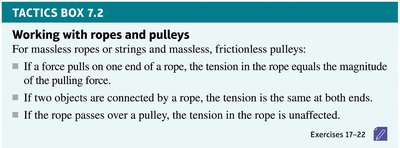
Tactics: Working with Ropes and Pulleys
Principle | Description |
|---|---|
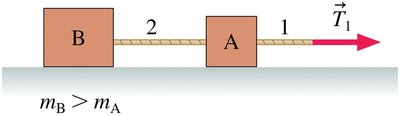
Tension at ends | If a force pulls on one end of a rope, the tension equals the magnitude of the pulling force. |
Connected objects | If two objects are connected by a rope, the tension is the same at both ends. |
Pulleys | If the rope passes over a pulley, the tension in the rope is unaffected (for massless, frictionless pulleys). |
Summary Table: Key Concepts in Interacting Objects
Concept | Description | Example |
|---|---|---|
Action/Reaction Pairs | Forces always come in pairs, equal in magnitude and opposite in direction | Hammer and nail, Earth and ball |
System/Environment | System: objects of interest; Environment: objects exerting external forces | Hammer and nail (system), Earth (environment) |
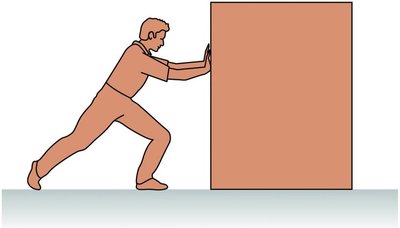
Free-Body Diagram | Diagram showing all forces acting on a single object | Person pushing a crate |
Static Friction | Friction that prevents slipping, acts as propulsion | Walking, car driving |
Tension | Puling force in a rope or string, acts equally in both directions | Safe hanging from a rope |
Massless String Approximation | Assume string mass is negligible, tension is uniform | Two boxes connected by a string |
Pulleys | Change direction of tension, tension remains constant | Blocks connected over a pulley |
Additional info:
When solving interacting-objects problems, always start by clearly defining the system and drawing accurate free-body diagrams for each object.
Acceleration constraints are crucial in systems with ropes and pulleys, as they determine the relationship between the motions of connected objects.
Newton’s Third Law is foundational for understanding momentum conservation and the behavior of forces in all mechanical systems.
