 Back
Newton's Third Law of Motion and Vector Analysis
Study Guide - Smart Notes
 Tailored notes based on your materials, expanded with key definitions, examples, and context.
Newton's Third Law of Motion
Forces and Interactions
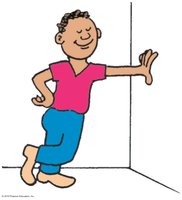
In physics, an interaction occurs between two objects, resulting in a pair of forces acting on each object. These forces are always equal in magnitude and opposite in direction, forming what is known as a force pair. For example, when a person pushes against a wall, the wall pushes back with an equal and opposite force.
Interaction: Always involves two objects and two forces.
Force Pair: Each object exerts a force on the other.
Example: Hand pushing on a wall; wall pushes back on hand.
Statement of Newton's Third Law
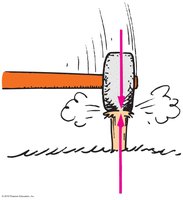
Newton's Third Law of Motion states: "Whenever one object exerts a force on a second object, the second object exerts an equal and opposite force on the first." This law is fundamental to understanding interactions in mechanics.
Action Force: The force exerted by the first object.
Reaction Force: The force exerted by the second object, equal in magnitude and opposite in direction.
Formula:
Examples of Action and Reaction Forces
Action and reaction forces are always present in interactions, and they act on different objects. For instance, when a car's tires push backward against the road, the road pushes the tires forward, propelling the car.
Action: Tire pushes on road.
Reaction: Road pushes on tire.
Application: Essential for vehicle motion.

Another example is a rocket: the rocket pushes exhaust gases backward, and the gases push the rocket forward.
Action: Rocket pushes gas backward.
Reaction: Gas pushes rocket forward.
Application: Principle behind rocket propulsion.

Action and Reaction on Different Masses
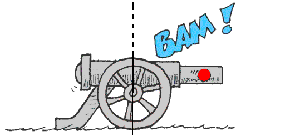
When the same force acts on objects of different masses, their accelerations differ according to Newton's second law. For example, when a cannon fires a cannonball, both experience equal and opposite forces, but the lighter cannonball accelerates much more than the heavy cannon.
Formula:
Small mass: Large acceleration.
Large mass: Small acceleration.
Defining the System: Internal and External Forces
When analyzing forces, it is important to define the system. If only external forces act on the system, they cause acceleration. Internal force pairs within the system cancel each other and do not cause acceleration.
External Force: Causes acceleration of the system.
Internal Force: Action-reaction pairs within the system cancel.
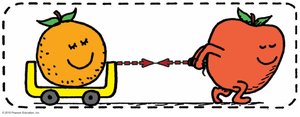
Example: An orange in a cart accelerated by an external force.
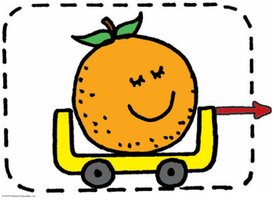
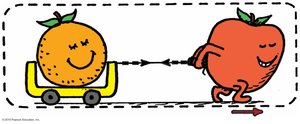
When an apple pulls an orange, the force exerted by the apple accelerates the orange. The action and reaction forces do not cancel because they act on different objects.

If the system includes both the apple and the orange, the force pair is internal and cancels, resulting in no acceleration unless an external force (such as friction) acts.
When friction acts as an external force, it can accelerate the system.
Applications: Lift and Flight
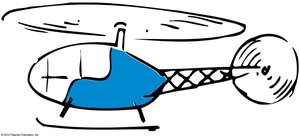
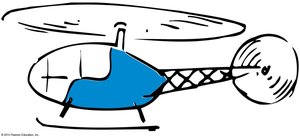
Newton's third law explains how lift is generated in helicopters and airplanes. When the lift force is greater than the weight, the helicopter moves upward. Birds and airplanes generate lift by pushing air downward, which results in an upward reaction force.
Lift: Upward force generated by wings or rotors.
Weight: Downward force due to gravity.
Flight: Achieved when lift exceeds weight.
Vectors and Newton's Third Law
Vector Components
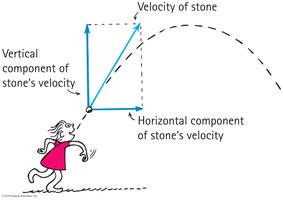
Vectors can be resolved into perpendicular components, typically vertical and horizontal. This resolution is essential for analyzing forces and motion in two dimensions.
Vertical Component: Perpendicular to the horizontal.
Horizontal Component: Perpendicular to the vertical.
Resolution: Process of breaking a vector into components.
Formula: ,
Force Components in Practice
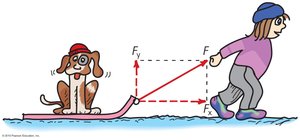
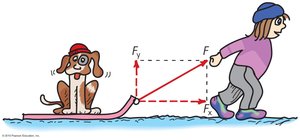
When a force is applied at an angle, its horizontal and vertical components can be analyzed separately. For example, when pulling a sled, the horizontal component is typically greater and responsible for motion, while the vertical component affects the normal force.
Horizontal Component: Responsible for forward motion.
Vertical Component: Affects contact force with the ground.
Other Forces: Weight () and normal force () also act on the sled.
Forces on an Inclined Plane
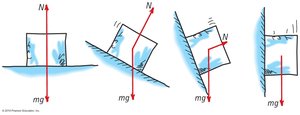
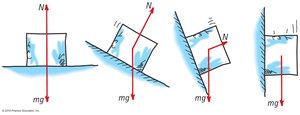
When a block is placed on a ramp, two forces act on it: gravity () and the normal force (). As the ramp angle increases, the normal force decreases, and at 90 degrees (vertical), the net force is equal to gravity.
Gravity (): Remains constant.
Normal Force (): Decreases as ramp angle increases.
Net Force: At vertical, net force is .
Summary of Newton's Three Laws of Motion
Newton's First Law (Law of Inertia)
An object at rest remains at rest, and an object in motion remains in motion at constant speed along a straight-line path unless acted upon by a net external force.
Formula:
Newton's Second Law (Law of Acceleration)
When a net force acts on an object, it accelerates. The acceleration is directly proportional to the net force and inversely proportional to the object's mass.
Formula:
Newton's Third Law (Law of Action and Reaction)
Whenever one object exerts a force on a second object, the second object exerts an equal and opposite force on the first.
Formula:
