 Back
BackChapter 5 newtons third law
Study Guide - Smart Notes
 Tailored notes based on your materials, expanded with key definitions, examples, and context.
Newton's Third Law of Motion
Fundamental Principle
Newton's third law of motion states that every force is part of an interaction between two objects. No force occurs alone; forces always come in pairs called action and reaction forces. The law is formally stated as:
Whenever one object exerts a force on a second object, the second object exerts an equal and opposite force on the first.
Action and reaction forces are co-pairs of a single interaction.
Neither force exists without the other.
They are equal in magnitude and opposite in direction.
They always act on different objects.
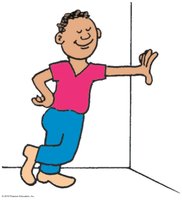
Examples of Newton's Third Law
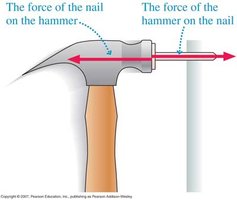
Hammer and Nail: When a hammer strikes a nail, the hammer exerts a force on the nail, and the nail exerts an equal and opposite force on the hammer.
Rocket Propulsion: The rocket pushes exhaust gases backward (action), and the gases push the rocket forward (reaction).

Man and Spring: When a man pulls on a spring, the spring pulls back on the man with equal force.

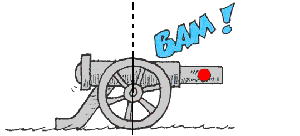
Cannon and Cannonball: When a cannon fires a cannonball, the cannonball moves forward, and the cannon recoils backward.
Action and Reaction on Different Masses
When you step off a curb, Earth pulls you downward (action), and you pull Earth upward (reaction). However, due to Earth's much larger mass, its acceleration is negligible and not sensed.
Common Questions and Misconceptions
Do action and reaction forces cancel? No, because they act on different objects. For example, when two people push off each other on ice, both move in opposite directions, but the forces do not cancel since each acts on a different person.
Force on Bug vs. Bus: When a bus collides with a bug, the force exerted by the bus on the bug is equal and opposite to the force exerted by the bug on the bus.
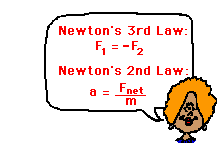
Vector Components
Resolution of Vectors
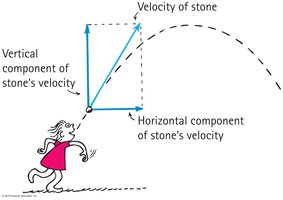
Any vector can be resolved into vertical and horizontal components. This process is called resolution. The components are always perpendicular to each other and are useful for analyzing motion and forces in two dimensions.
Vertical Component: Represents the part of the vector acting upward or downward.
Horizontal Component: Represents the part of the vector acting sideways.
Mathematical Resolution: If a vector V makes an angle θ with the horizontal, its components are:
Application: Tossed Stone
The velocity of a tossed stone can be broken into vertical and horizontal components, which together determine its trajectory.
Application: Pulling a Sled
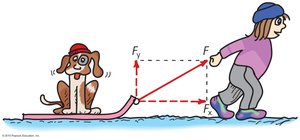
When Nellie Newton pulls a sled, her force can be resolved into horizontal and vertical components. The horizontal component propels the sled forward, while the vertical component may lift it slightly.
Application: Skiing Down a Hill
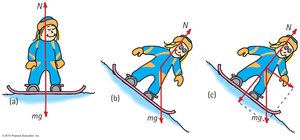
When skiing down a slope, the weight of the skier can be resolved into components parallel and perpendicular to the slope. The parallel component propels the skier down the hill, while the perpendicular component is balanced by the normal force.
Application: Block on a Ramp
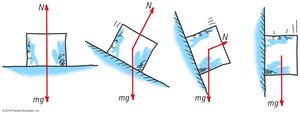
As the slope of a ramp increases, the normal force decreases and the parallel component of weight increases, causing greater acceleration down the ramp. When the ramp is vertical, the net force equals the weight.
Summary of Newton's Three Laws of Motion
Newton's First Law (Law of Inertia)
Every object continues in a state of rest or uniform speed in a straight line unless acted on by a nonzero net force.
Newton's Second Law (Law of Acceleration)
The acceleration of an object is directly proportional to the net force and inversely proportional to its mass.
Newton's Third Law (Law of Action and Reaction)
Whenever one object exerts a force on a second object, the second object exerts an equal and opposite force on the first.
Key Takeaways:
Forces always come in pairs.
Action and reaction forces act on different objects.
Vector resolution is essential for analyzing forces and motion in two dimensions.
