 Back
Newton’s Third Law of Motion and Vectors: Study Notes
Study Guide - Smart Notes
 Tailored notes based on your materials, expanded with key definitions, examples, and context.
Newton’s Third Law of Motion
Forces and Interactions
In physics, an interaction always involves a pair of forces acting on two different objects. These forces are equal in magnitude and opposite in direction, and they arise from the mutual influence of the objects on each other.
Interaction: Occurs between two objects, requiring a pair of forces.
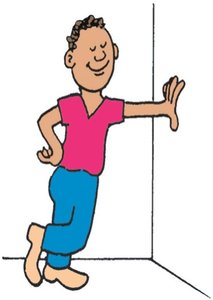
Example: When you push on a wall, the wall pushes back on you with an equal and opposite force.
Statement of Newton’s Third Law
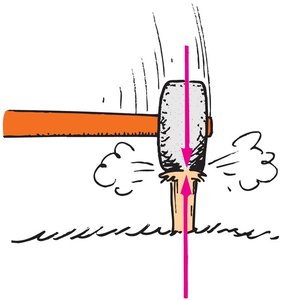
Newton’s Third Law of Motion states: Whenever one object exerts a force on a second object, the second object exerts an equal and opposite force on the first object.
These forces are called action and reaction forces.
They are always equal in magnitude and opposite in direction.
They always act on different objects.
Examples of Action-Reaction Pairs
Soccer Kick: If a player kicks a ball with 1500 N, the ball exerts a 1500 N force back on the player's foot.
Car Tires and Road: The tires push the road backward (action), and the road pushes the tires forward (reaction), propelling the car.

Jet Propulsion: A jet engine pushes exhaust gases backward (action), and the gases push the jet forward (reaction).

Action and Reaction on Different Masses
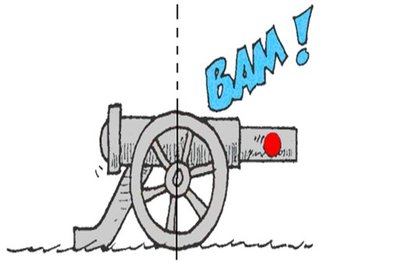
When the same force acts on objects of different masses, the resulting accelerations differ according to Newton's Second Law ().
Cannon and Cannonball: The force on the cannonball (small mass) produces a large acceleration; the same force on the cannon (large mass) produces a small acceleration.
Defining the System and Internal vs. External Forces
When analyzing forces, it is important to define the system. Internal forces (forces between objects within the system) cancel each other and do not cause acceleration of the system as a whole. Only external forces can change the motion of the system.
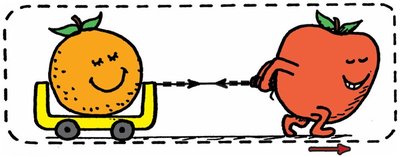
Example: An orange on a cart is pulled by an apple. The force the apple exerts on the orange is external to the orange, but if both are considered as one system, the force is internal and cancels out.
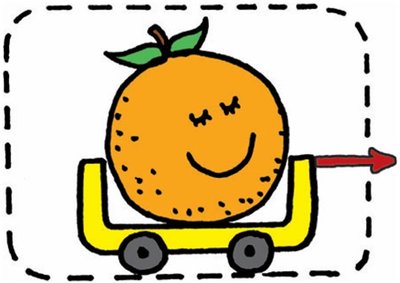
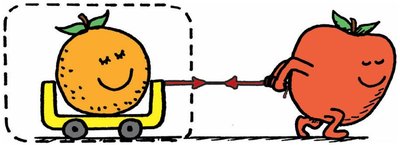
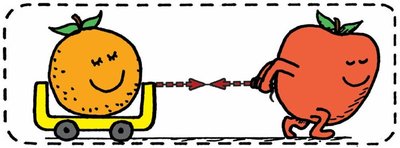
External Forces: For the system to accelerate, an external force (such as friction from the floor) must act on it.
Applications of Newton’s Third Law
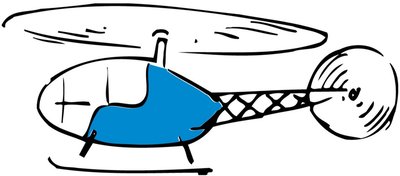
Helicopter Lift: The rotor blades push air downward (action), and the air pushes the helicopter upward (reaction). If lift exceeds weight, the helicopter rises.
Bird Flight: Birds push air downward with their wings; the air pushes them upward.
Airplane Wings: Slightly tilted wings deflect air downward, producing lift as the air pushes back upward on the wings.
Gliders: Heavier gliders must push air downward with greater force to maintain altitude.
Vectors and Forces
Vector Components
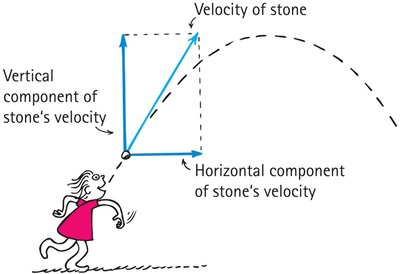
A vector is a quantity with both magnitude and direction. Any vector can be resolved into perpendicular components, typically horizontal and vertical.
Resolution: The process of breaking a vector into its components.
Example: The velocity of a thrown stone can be split into vertical and horizontal components.
Forces on an Inclined Plane
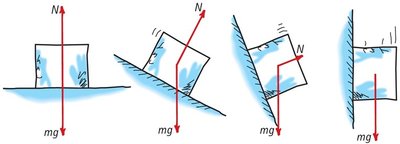
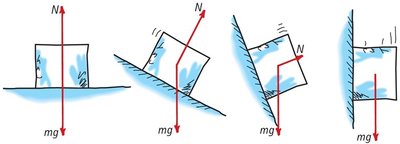
When an object rests on an inclined plane, two main forces act on it: the gravitational force () and the normal force () from the surface.
As the ramp angle increases: The gravitational force () remains constant, but the normal force () decreases.
At 90 degrees (vertical): The normal force is zero, and the net force on the object is downward.
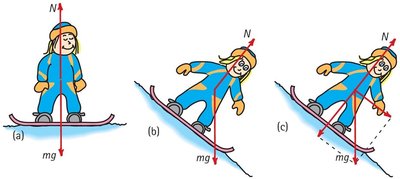
Resultant Forces and Motion on an Incline
The resultant of the normal force and gravity is the force that propels an object down the incline. The component of gravity parallel to the incline causes the motion.
Summary of Newton’s Three Laws of Motion
First Law (Law of Inertia): An object at rest remains at rest, and an object in motion remains in motion at constant velocity unless acted upon by a net external force.
Second Law (Law of Acceleration): The acceleration of an object is directly proportional to the net force acting on it and inversely proportional to its mass:
Third Law (Law of Action and Reaction): For every action, there is an equal and opposite reaction.
