 Back
BackNewton’s Third Law of Motion: Forces and Interactions
Study Guide - Smart Notes
 Tailored notes based on your materials, expanded with key definitions, examples, and context.
Newton’s Third Law of Motion
Forces and Interactions
In physics, a force is an interaction between two objects that can cause a change in motion. Forces always occur in pairs, meaning that whenever one object exerts a force on another, the second object exerts a force back on the first. This mutual interaction is fundamental to understanding motion and is described by Newton’s Third Law of Motion.
Interaction: Always involves two objects and a pair of forces acting on them.
Force Pair: For every action, there is a reaction force of equal magnitude but opposite direction.
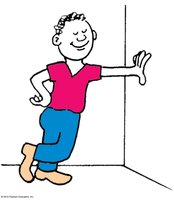
Examples: Pushing against a wall, hammering a nail, a book resting on a table, a rocket launching, etc.
Newton’s Third Law of Motion: Statement and Meaning
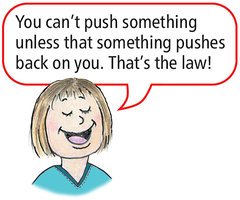
Newton’s Third Law of Motion states: Whenever one object exerts a force on a second object, the second object exerts an equal and opposite force on the first. This means that forces always come in pairs, known as action and reaction forces. The distinction between action and reaction is arbitrary; what matters is that both forces are equal in magnitude and opposite in direction, and they act on different objects.
Action and Reaction: Neither force exists without the other.
Co-pairs: Both forces are part of a single interaction.
Direction: The forces are always in opposite directions.
Objects: Action and reaction forces always act on different objects.
Identifying Action and Reaction Forces
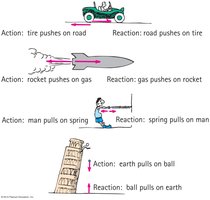
To identify action and reaction forces, first recognize the interaction between two objects. The action force is the force exerted by object A on object B, and the reaction force is the force exerted by object B on object A. Common examples include:
Car tires and road: Tires push back on the road (action); road pushes forward on tires (reaction).
Rocket and exhaust gases: Rocket pushes gases backward (action); gases push rocket forward (reaction).
Earth and falling object: Earth pulls object downward (action); object pulls Earth upward (reaction).
Consequences of Newton’s Third Law
Newton’s Third Law explains many everyday phenomena and is essential for understanding motion:
Equal Forces: The forces two objects exert on each other are always equal in magnitude and opposite in direction, regardless of the masses involved.
Different Effects: The effect of the forces depends on the masses of the objects. For example, when you step off a curb, you pull the Earth upward with the same force that the Earth pulls you downward, but the Earth's much larger mass means its acceleration is negligible.
Formula: Newton’s Second Law relates force, mass, and acceleration: For two interacting objects:
Applications and Examples
Collisions: In a collision between a large object (like a bus) and a small object (like a bug), the force exerted on each is equal, but the resulting accelerations are very different due to their masses.
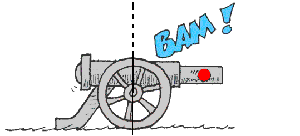
Pushing Off in Space: An astronaut can return to her ship by throwing tools in the opposite direction, using the reaction force to propel herself back.
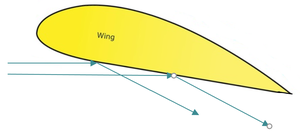
Birds and Airplanes: Birds fly by pushing air downward with their wings; the air pushes them upward. Airplane wings are tilted to deflect air downward, generating lift as the reaction force.
Summary of Newton’s Three Laws of Motion
Law | Description |
|---|---|
First Law (Inertia) | An object at rest remains at rest, and an object in motion remains in motion at constant speed in a straight line unless acted upon by a net force. |
Second Law (Acceleration) | The acceleration of an object is directly proportional to the net force acting on it and inversely proportional to its mass: |
Third Law (Action-Reaction) | For every action, there is an equal and opposite reaction. |
