 Back
Backlec 25
Study Guide - Smart Notes
 Tailored notes based on your materials, expanded with key definitions, examples, and context.
Chapter 30: Nuclear Physics and Radioactivity
The Mass Deficit of the Nucleus and Nuclear Binding Energy
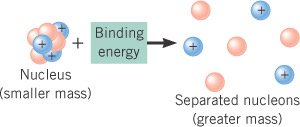
The mass of a nucleus is always less than the total mass of its individual protons and neutrons. This difference, known as the mass deficit, is a direct measure of the nuclear binding energy—the energy required to disassemble the nucleus into its constituent nucleons. The binding energy is a key concept in understanding nuclear stability and reactions.
Mass Deficit (Δm): The difference between the sum of the masses of the separated nucleons and the actual mass of the nucleus.
Binding Energy (E): The energy equivalent of the mass deficit, calculated using Einstein’s equation:
Formula for Mass Deficit:
Binding Energy per Nucleon: For nuclei with mass number , the binding energy per nucleon is typically about 8 MeV/nucleon.
Example: The Binding Energy of the Helium Nucleus
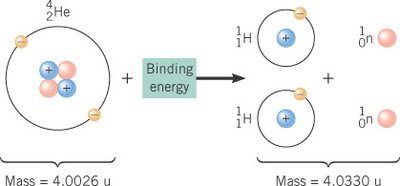
To calculate the binding energy of a helium-4 nucleus, compare the mass of the nucleus to the sum of the masses of its constituent protons and neutrons. The difference is converted to energy using the conversion factor .
Given: Mass of , Mass of , Mass of
Calculation: Binding energy per nucleon:
Radioactivity
Types of Radioactive Decay
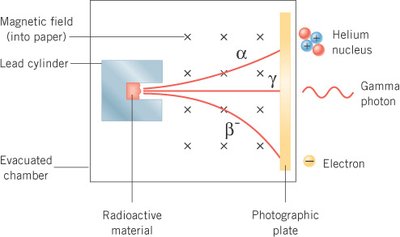
Radioactive decay is the spontaneous transformation of an unstable atomic nucleus into a more stable one, accompanied by the emission of particles or electromagnetic radiation. The three main types of decay are alpha (), beta (), and gamma () decay.
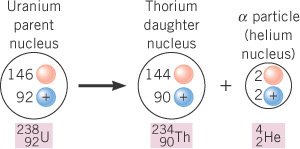
Alpha Decay (): Emission of a helium nucleus (), reducing atomic number by 2 and mass number by 4.
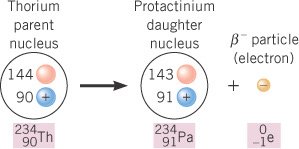
Beta Decay ( and ): Emission of an electron () or positron (), changing a neutron to a proton or vice versa.
Gamma Decay (): Emission of a high-energy photon, usually following another decay process, with no change in atomic or mass number.
Radiation Detectors
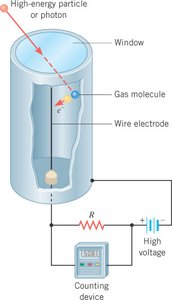
Devices such as the Geiger counter are used to detect and measure ionizing radiation. When a charged particle or photon enters the detector, it ionizes the gas inside, producing a current pulse that is registered as a count.
Geiger Counter: Consists of a gas-filled chamber, a wire electrode, and a counting device. Ionization events trigger measurable electrical pulses.
Alpha Decay ( Decay)
In alpha decay, a nucleus emits an alpha particle, resulting in a daughter nucleus with atomic number reduced by 2 and mass number reduced by 4. The energy released (Q-value) is shared as kinetic energy among the products.
General Equation:
Example:
Q-value Calculation:
Applications: Smoke Detectors
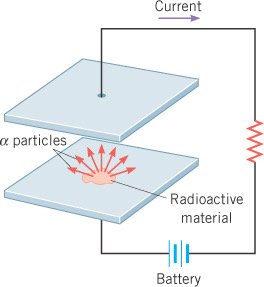
Alpha particles from a radioactive source ionize air between two plates, allowing a small current to flow. The presence of smoke disrupts this current, triggering the alarm. Americium-241 is commonly used as the alpha emitter.
Beta Decay ( Decay)
Beta decay involves the transformation of a neutron into a proton (beta-minus) or a proton into a neutron (beta-plus), accompanied by the emission of an electron or positron and a neutrino or antineutrino.
Beta-minus () Decay:
Beta-plus () Decay:
Neutrino: A nearly massless, neutral particle that carries away missing energy and momentum.
Gamma Decay ( Decay)
Gamma decay occurs when an excited nucleus releases excess energy by emitting a gamma photon. This process does not change the atomic or mass number of the nucleus.
General Equation:
Example:
The Neutrino in Beta Decay
During beta decay, the observed energy of emitted electrons is less than expected. The missing energy is carried away by the neutrino (or antineutrino), a neutral, nearly massless particle.
Neutrino (): Emitted in beta-minus decay.
Antineutrino (): Emitted in beta-plus decay.
Radioactive Decay and Activity
Decay Law and Half-Life
The number of radioactive nuclei decreases exponentially over time. The half-life () is the time required for half of the radioactive nuclei to decay. The decay constant () characterizes the probability of decay per unit time.
Decay Law:
Half-Life:
Activity (A): (measured in becquerels, Bq)
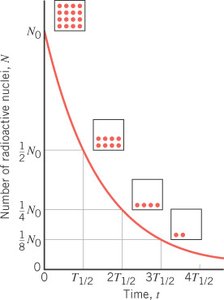
Chart of Nuclides and Nuclear Stability
The stability of a nucleus depends on the balance between the number of protons (Z) and neutrons (N). The chart of nuclides visually represents stable and unstable isotopes, with half-lives indicated by color coding.
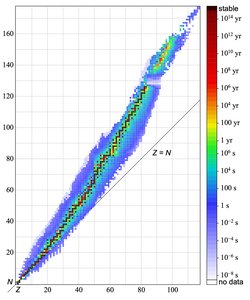
Example: Calculating Half-Life from Activity
Given the activity and number of atoms in a sample, the half-life can be determined using the decay law and the relationship between activity, decay constant, and number of nuclei.
Decay Constant:
Half-Life:
Example: For , years
Radioactive Dating
Radioactive dating uses the known half-life of isotopes such as carbon-14 to determine the age of ancient biological materials. The ratio of remaining radioactive atoms to the original amount allows calculation of elapsed time since death.
Dating Equation: or
Example: The “Ice Man” found in the Alps was dated using the activity of in his remains.

Radioactive Decay Series
Decay Chains
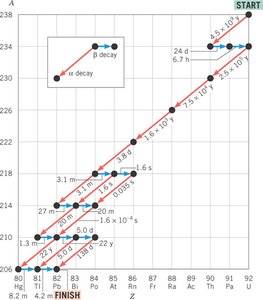
Some heavy nuclei undergo a series of sequential decays, known as a radioactive decay series, until a stable nucleus is formed. Each step involves alpha or beta decay, producing a chain of daughter nuclei.
Example: The uranium-238 decay series ends with stable lead-206 after multiple alpha and beta decays.
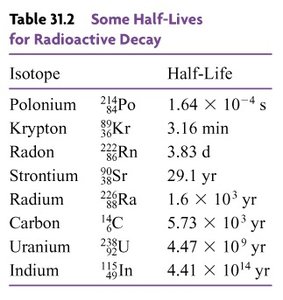
Isotope | Half-Life |
|---|---|
Polonium-214 | s |
Krypton-89 | 3.16 min |
Radon-222 | 3.83 d |
Strontium-90 | 29.1 yr |
Radium-226 | yr |
Carbon-14 | yr |
Uranium-238 | yr |
Indium-115 | yr |
Additional info: The table above summarizes the half-lives of several important radioactive isotopes, illustrating the wide range of decay rates found in nature.
