 Back
BackLecture 17
Study Guide - Smart Notes
 Tailored notes based on your materials, expanded with key definitions, examples, and context.
Optical Instruments and the Eye
Cameras: Image Formation and Depth-of-Field
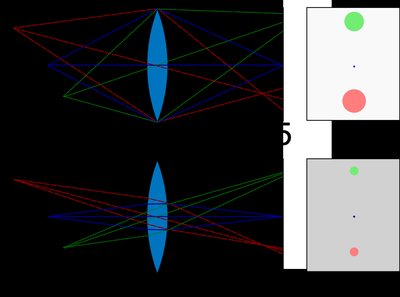
Cameras use converging lenses to form real, inverted images on a sensor or film. The position and size of the image depend on the object distance and the focal length of the lens. The depth-of-field (DOF) is the range over which the image appears acceptably sharp, controlled by the aperture size (f-stop).
Image Formation: When the object is placed farther than twice the focal length from the lens, the image is real, inverted, and smaller than the object.
Depth-of-Field:
Large aperture (small f-stop, e.g., f/1.8): shallow DOF, only a small range in focus.
Small aperture (large f-stop, e.g., f/22): deep DOF, larger range in focus.
f-stop Formula: , where f is the focal length and D is the diameter of the lens opening.
Exposure Control: To avoid overexposure when changing shutter speed, adjust the f-stop accordingly.
Example: A flower vase photographed with a CCD camera: calculations for image distance, image height, f-stop, and exposure adjustment.


The Human Eye
Anatomy and Optics
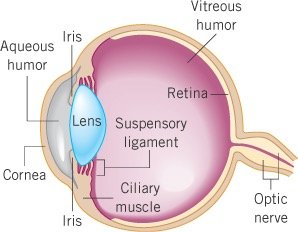
The human eye is a complex optical instrument. Most refraction occurs at the cornea, while the lens fine-tunes focus. The near point is the closest distance for comfortable focus (typically 25 cm), and the far point is the farthest (ideally infinity).
Cornea: Provides most of the eye's refractive power.
Lens: Adjusts shape for focusing on near or distant objects.
Retina: Receives the image formed by the lens system.
Vision Defects and Correction
Common vision defects include nearsightedness (myopia) and farsightedness (hyperopia). Correctional lenses are used to adjust the focal point for clear vision.
Nearsightedness: The far point is closer than normal. A diverging lens is used to create a virtual image at the far point.
Farsightedness: The near point is farther than normal. A converging lens is used to create a virtual image at the near point.
Refractive Power (Diopter): (in meters). Optometrists use diopters to specify lens power.
Example: Calculating the focal length and refractive power for eyeglasses for nearsighted and farsighted individuals.
Angular Magnification and the Magnifying Glass
Principle of Angular Magnification
The apparent size of an object depends on the angle it subtends at the eye. A magnifying glass increases this angle, making objects appear larger.
Angular Size: , where h_o is object height and d_o is object distance.
Angular Magnification:
Magnifying Glass:
Relaxed eye:
Focus at near point:
Example: Calculating magnification for a magnifying glass with a focal length of 9.5 cm.
The Compound Microscope
Structure and Magnification
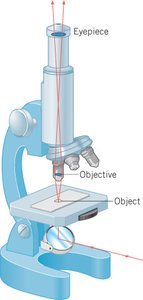
A compound microscope uses two converging lenses: the objective and the eyepiece. The objective forms a real, magnified image, which the eyepiece further magnifies.
Angular Magnification: , where L is the tube length, f_o is the objective focal length, f_e is the eyepiece focal length, and N is the near point.
Comparison: The compound microscope provides much greater magnification than a single magnifying glass.
Example: Calculating the angular magnification for a microscope with given focal lengths and tube length.
The Telescope
Principle and Magnification
An astronomical telescope uses two lenses: the objective (large focal length) and the eyepiece (small focal length). The objective forms an image near its focal plane, which the eyepiece magnifies for viewing with a relaxed eye.
Angular Magnification:
Length of Telescope:
Example: Calculating the angular magnification and length for a telescope with specified focal lengths.
Summary Table: Optical Instruments
Instrument | Main Function | Key Formula |
|---|---|---|
Camera | Forms real, inverted image | |
Eye | Focuses image on retina | (diopters) |
Magnifying Glass | Increases angular size | |
Microscope | High magnification of small objects | |
Telescope | Magnifies distant objects |
Additional info: All formulas use standard sign conventions for lenses. The notes include expanded explanations and examples for clarity.
