 Back
BackOptical Waves: Duality, Reflection, Refraction, and Dispersion
Study Guide - Smart Notes
 Tailored notes based on your materials, expanded with key definitions, examples, and context.
Introduction to Optical Waves
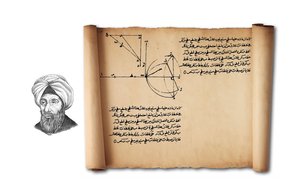
Optical waves, or light waves, are a fundamental topic in physics, exhibiting both wave-like and particle-like properties. The study of light's interaction with matter has evolved through history, with significant contributions from early scientists such as Ibn Sahl. Understanding optical waves is essential for explaining phenomena such as reflection, refraction, dispersion, and polarization.
The Duality of Electromagnetic (EM) Waves
Wave-Particle Duality
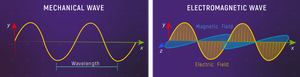
Light can be described using three main models: the wave model, the ray model, and the photon model. Each model provides unique insights into the behavior of light under different circumstances.
Wave Model: Describes light as a wave, characterized by properties such as wavelength (λ), frequency (f), and amplitude (A).
Ray Model: Treats light as straight lines (rays), useful for explaining reflection and refraction.
Photon Model: Considers light as discrete packets of energy called photons, essential for explaining phenomena like the photoelectric effect.
Key Equations:
Wavelength and frequency relation:
Frequency and wavelength:
Speed of light in vacuum:
Example: The photoelectric effect demonstrates the particle nature of light, where photons transfer energy to electrons in a metal, causing their emission.

Reflection of Light
Specular and Diffuse Reflection
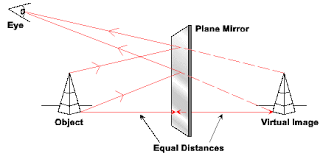
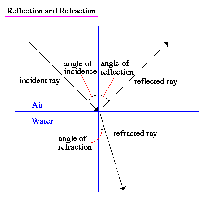
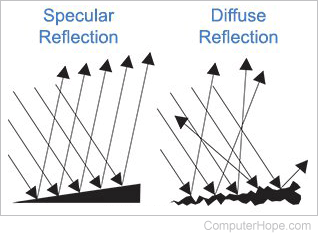
Reflection occurs when light bounces off a surface. If the surface is smooth, specular reflection creates clear images, as seen in mirrors. If the surface is rough, diffuse reflection scatters light in many directions, allowing us to see non-mirrored objects.
Law of Reflection: The angle of incidence equals the angle of reflection ().
Example: A calm lake acts as a mirror, producing a clear reflection due to specular reflection.
Refraction of Light
Snell's Law and Index of Refraction
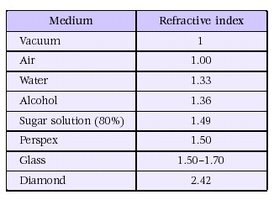
Refraction is the bending of light as it passes from one medium to another with a different refractive index. The refractive index (n) is a unitless number that describes how much the speed of light is reduced in a material compared to a vacuum.
Snell's Law:
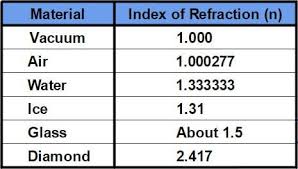
Index of Refraction Table:
Material | Index of Refraction (n) |
|---|---|
Vacuum | 1.000 |
Air | 1.000277 |
Water | 1.333333 |
Ice | 1.31 |
Glass | About 1.5 |
Diamond | 2.417 |
Example: A straw appears bent when placed in a glass of water due to the change in light speed and direction at the water-air interface.
Dispersion and Rainbows
Dispersion of Light
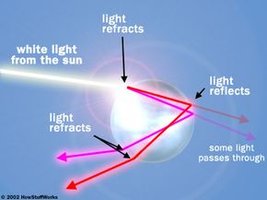
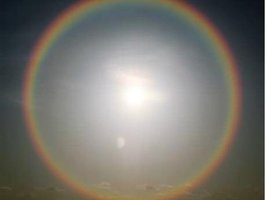
Dispersion occurs when different wavelengths of light are refracted by different amounts, causing white light to separate into its constituent colors. This is the principle behind the formation of rainbows.
Dispersion: The dependence of wave speed and refractive index on wavelength.
Rainbow Formation: Involves refraction, reflection, and dispersion within water droplets.
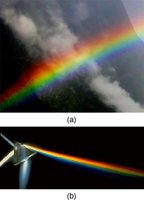

Example: Sunlight passing through raindrops creates a spectrum of colors, forming a rainbow. The order of colors is Red, Orange, Yellow, Green, Blue, Indigo, Violet (ROYGBIV).
Polarization of Light
Nature and Applications
Polarization is a property of transverse waves, such as electromagnetic waves, where the oscillations occur in a particular direction. Polarizers are materials that allow only waves oscillating in a specific direction to pass through.
Malus's Law:
Brewster's Angle: The angle at which reflected light is perfectly polarized.
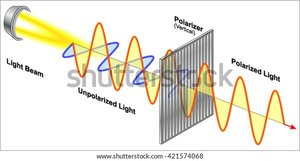
Example: Polarized sunglasses reduce glare by blocking horizontally polarized light reflected from surfaces like water or roads.
Special Phenomena: Total Internal Reflection and Fiber Optics
Total Internal Reflection
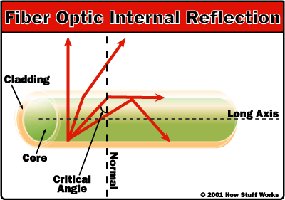
Total internal reflection occurs when light attempts to move from a medium with a higher refractive index to one with a lower refractive index at an angle greater than the critical angle. All the light is reflected back into the original medium.
Critical Angle Equation:
Example: Fiber optic cables use total internal reflection to transmit light signals over long distances with minimal loss.
Summary Table: Key Concepts in Optical Waves
Concept | Description | Key Equation |
|---|---|---|
Reflection | Bouncing of light from a surface | |
Refraction | Bending of light at an interface | |
Dispersion | Separation of light into colors | Depends on |
Polarization | Restriction of wave oscillations to one plane | |
Total Internal Reflection | Complete reflection at a boundary |
Conclusion
The study of optical waves encompasses a wide range of phenomena, from the basic laws of reflection and refraction to advanced concepts like polarization and total internal reflection. These principles are foundational for understanding natural phenomena such as rainbows and for technological applications like fiber optics and polarized lenses.
