 Back
BackOscillations About Equilibrium: Examples and Applications
Study Guide - Smart Notes
 Tailored notes based on your materials, expanded with key definitions, examples, and context.
Oscillations About Equilibrium
Simple Harmonic Motion (SHM) and Periodic Systems
Oscillatory motion occurs when an object moves back and forth about an equilibrium position due to a restoring force. The most common type is simple harmonic motion (SHM), where the restoring force is proportional to displacement and directed toward equilibrium.
Period (T): The time required for one complete cycle of motion.
Frequency (f): The number of cycles per second, .
Amplitude (A): The maximum displacement from equilibrium.
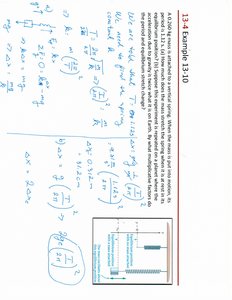
Example 13.10: Mass-Spring System and Period Calculation
This example demonstrates how to calculate the period of oscillation for a mass attached to a spring, using the formula for the period of a mass-spring system:
Period of a mass-spring system:
Variables: m is the mass, k is the spring constant.
Application: Used to determine how changing mass or spring stiffness affects oscillation period.
Example Calculation: For a given mass and spring constant, substitute values to find T.
Example 13.12: Energy in SHM and Velocity at Equilibrium
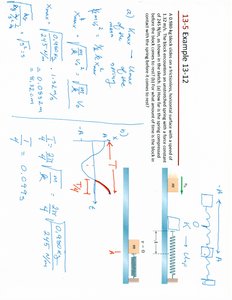
This example explores the relationship between potential and kinetic energy in a mass-spring system, and how to calculate the velocity of the mass as it passes through equilibrium.
Conservation of Energy in SHM: Total mechanical energy is conserved and is the sum of kinetic and potential energies.
Maximum velocity at equilibrium:
Angular frequency:
Potential energy at maximum displacement:
Kinetic energy at equilibrium:
Application: Used to find the speed of the mass as it passes through the center position.
Example 13.14: Pendulum Period and Design
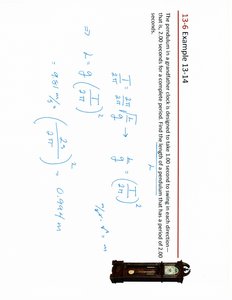
This example shows how to design a pendulum clock to achieve a specific period, using the formula for the period of a simple pendulum:
Period of a simple pendulum:
Variables: L is the length of the pendulum, g is the acceleration due to gravity.
Application: Used to determine the required length for a pendulum to keep accurate time (e.g., 2-second period for a clock).
Example Calculation: Rearranging the formula to solve for L given T and g.
Summary Table: Key Formulas for Oscillatory Systems
System | Period Formula | Key Variables |
|---|---|---|
Mass-Spring | m = mass, k = spring constant | |
Pendulum | L = length, g = gravity |
Additional info: These examples reinforce the importance of understanding how physical parameters affect oscillatory motion, and how energy conservation principles apply to SHM systems.
