 Back
Oscillations and Simple Harmonic Motion: Foundations for Physics with Calculus
Study Guide - Smart Notes
 Tailored notes based on your materials, expanded with key definitions, examples, and context.
Geometry Review for Physics
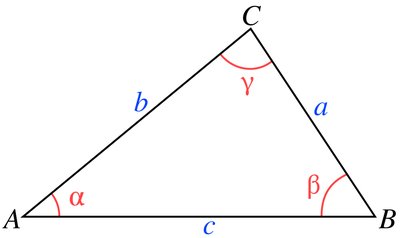
The Laws of Sines and Cosines
Understanding the geometry of triangles is essential for solving problems in geometric optics and oscillatory motion. The Law of Sines and Law of Cosines relate the sides and angles of any triangle, providing tools for analyzing vector components and wave directions.
Law of Sines: \( \frac{a}{\sin \alpha} = \frac{b}{\sin \beta} = \frac{c}{\sin \gamma} \)
Law of Cosines: \( c^2 = a^2 + b^2 - 2ab \cos \gamma \)
These laws are used to resolve forces, analyze wave propagation, and solve for unknowns in optics and mechanics.
Example: In a triangle with sides a, b, c and opposite angles α, β, γ, use the laws to find unknown sides or angles given sufficient information.
Oscillations and Simple Harmonic Motion (SHM)
Introduction to Oscillatory Motion
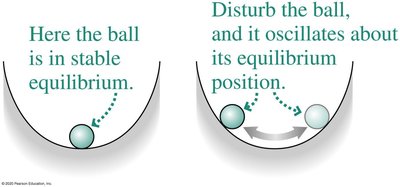
Oscillatory motion is a type of periodic motion where an object moves back and forth about an equilibrium position. This motion is fundamental in physics, describing systems from springs to pendulums and even molecular vibrations.
Periodic motion: Motion that repeats at regular intervals.
Simple Harmonic Motion (SHM): A special case of periodic motion where the restoring force is proportional to displacement and directed toward equilibrium.
Examples: Mass on a spring, torsional pendulum, vibrating bars.
Characteristics of SHM
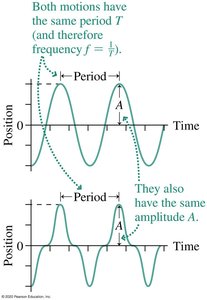
SHM is characterized by several measurable quantities:
Amplitude (A): Maximum displacement from equilibrium.
Period (T): Time to complete one full cycle.
Frequency (f): Number of cycles per second, \( f = \frac{1}{T} \), measured in Hz.
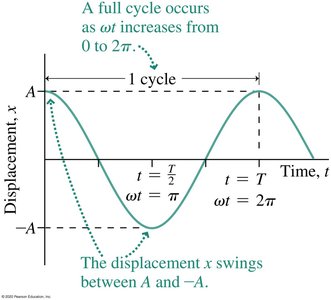
Angular Frequency (\( \omega \)): \( \omega = 2\pi f \), measured in radians per second.
Mathematical Description of SHM
The position of an object in SHM as a function of time is given by:
\( x(t) = A \cos(\omega t + \phi) \)
\( v(t) = -\omega A \sin(\omega t + \phi) \)
\( a(t) = -\omega^2 A \cos(\omega t + \phi) = -\omega^2 x(t) \)
Where \( \phi \) is the phase constant, determined by initial conditions.
Mass-Spring System
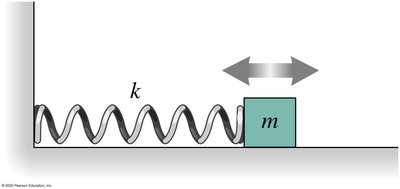
The mass-spring system is the prototypical example of SHM. The restoring force is given by Hooke's Law:
\( F_s = -kx \)
Newton's Second Law: \( m \frac{d^2x}{dt^2} = -kx \)
General solution: \( x(t) = A \cos(\omega t + \phi) \), where \( \omega = \sqrt{\frac{k}{m}} \)
Energy in SHM
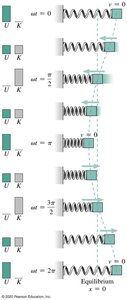
Energy in SHM oscillates between kinetic and potential forms, but the total mechanical energy remains constant (in the absence of damping):
Potential Energy: \( U = \frac{1}{2}kx^2 \)
Kinetic Energy: \( K = \frac{1}{2}mv^2 \)
Total Energy: \( E = U + K = \frac{1}{2}kA^2 \)
Damped and Driven Oscillations
Real systems experience non-conservative forces (like friction or air resistance), leading to damped oscillations. If an external periodic force is applied, the system undergoes forced oscillations and can exhibit resonance when the driving frequency matches the natural frequency.
Damped SHM: Amplitude decreases over time due to energy loss.
Driven SHM: Amplitude depends on the relationship between driving and natural frequencies.
Resonance: Maximum amplitude occurs when driving frequency equals natural frequency.

Pendulums and Rotational Analogs
Simple Pendulum
A simple pendulum consists of a mass suspended from a pivot, swinging under the influence of gravity. For small angles, the motion approximates SHM:
Equation of motion: \( \frac{d^2\theta}{dt^2} = -\frac{g}{L}\theta \)
Period: \( T = 2\pi \sqrt{\frac{L}{g}} \)
Where \( L \) is the length and \( g \) is the acceleration due to gravity.

Torsional and Physical Pendulums
Rotational analogs of SHM include torsional pendulums (twisting about an axis) and physical pendulums (extended bodies swinging about a pivot):
Torsional Pendulum: \( \tau = -\kappa \theta \), \( I \frac{d^2\theta}{dt^2} = -\kappa \theta \), \( \omega = \sqrt{\frac{\kappa}{I}} \)
Physical Pendulum: \( T = 2\pi \sqrt{\frac{I}{mgd}} \), where \( I \) is the moment of inertia and \( d \) is the distance from pivot to center of mass.

Summary Table: Key Equations in SHM
System | Restoring Force/Torque | Angular Frequency (\( \omega \)) | Period (T) |
|---|---|---|---|
Mass-Spring | \( F = -kx \) | \( \omega = \sqrt{\frac{k}{m}} \) | \( T = 2\pi \sqrt{\frac{m}{k}} \) |
Simple Pendulum | \( \tau = -mgL\theta \) | \( \omega = \sqrt{\frac{g}{L}} \) | \( T = 2\pi \sqrt{\frac{L}{g}} \) |
Torsional Pendulum | \( \tau = -\kappa \theta \) | \( \omega = \sqrt{\frac{\kappa}{I}} \) | \( T = 2\pi \sqrt{\frac{I}{\kappa}} \) |
Conclusion
Oscillatory motion, especially SHM, is a cornerstone of physics with calculus. Mastery of its mathematical description, energy considerations, and physical examples (springs, pendulums, torsional systems) is essential for further study in waves, sound, and optics.
