 Back
Oscillations and Simple Harmonic Motion: Physics with Calculus Study Notes
Study Guide - Smart Notes
 Tailored notes based on your materials, expanded with key definitions, examples, and context.
Oscillations and Simple Harmonic Motion
Introduction to Oscillatory Motion
Oscillatory motion refers to any motion that repeats itself in a regular cycle. Many physical systems, such as springs, pendulums, and even buildings, can undergo oscillations when displaced from their equilibrium positions. The study of oscillations is fundamental in physics, as it provides insight into a wide range of phenomena, from mechanical vibrations to electromagnetic waves.
Key Concepts in Oscillatory Motion
Equilibrium Position: The point where the net force on the system is zero.
Restoring Force: A force that acts to bring the system back to equilibrium when displaced.
Oscillation: The repetitive movement of a system through its equilibrium position.
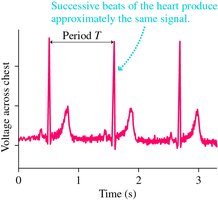
Period (T): The time required to complete one full cycle of motion.
Frequency (f): The number of cycles completed per second, measured in hertz (Hz).

Section 14.1: Equilibrium and Oscillation
Restoring Forces and Equilibrium
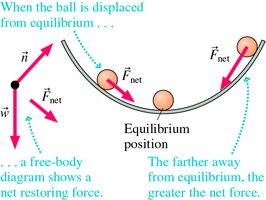
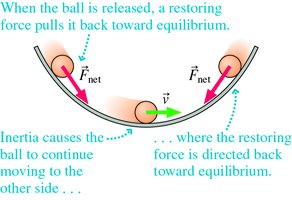
When a system is displaced from equilibrium, a restoring force acts to return it to equilibrium. For example, a marble in a bowl experiences a force toward the bottom of the bowl when displaced.
Restoring Force: Always directed toward equilibrium and proportional to displacement for simple systems.
Example: A marble rolling in a bowl oscillates about the lowest point due to gravity acting as a restoring force.
Period and Frequency
The period (T) is the time for one complete oscillation, and the frequency (f) is the number of oscillations per second. They are related by:
Units: 1 Hz = 1 cycle/second
Section 14.2: Simple Harmonic Motion (SHM)
Definition and Characteristics
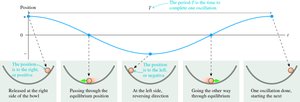
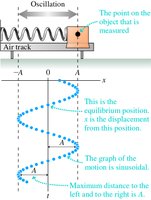
Simple Harmonic Motion (SHM) is a type of oscillatory motion where the restoring force is directly proportional to the displacement and acts in the opposite direction. The motion is sinusoidal in time and can be described by sine or cosine functions.
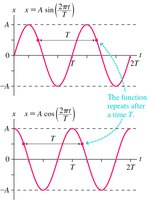
Sinusoidal Motion: The position as a function of time is given by , where A is amplitude, is angular frequency, and is phase.
Examples: Mass on a spring, pendulum (for small angles).
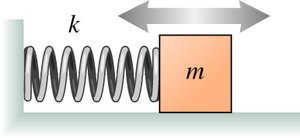

Linear Restoring Forces
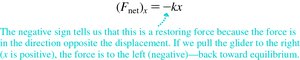
For a mass attached to a spring, the restoring force is given by Hooke's Law:
The negative sign indicates the force is opposite to displacement.
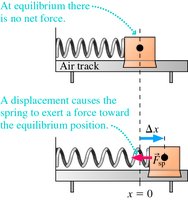
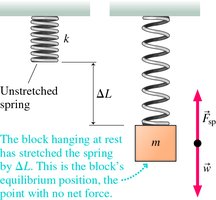
Horizontal and Vertical Mass-Spring Systems
Horizontal: The equilibrium position is where the spring is neither stretched nor compressed.
Vertical: The equilibrium position is shifted due to gravity, but the oscillation about this position is still SHM.
The Simple Pendulum
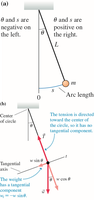
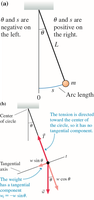
A simple pendulum consists of a mass suspended from a pivot. For small angles, the restoring force is proportional to the displacement, and the motion is SHM.
Small-Angle Approximation: (in radians) for small .
Restoring Force:
Section 14.3: Describing Simple Harmonic Motion
Position, Velocity, and Acceleration in SHM
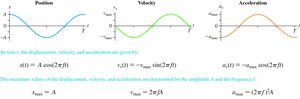
The motion of an object in SHM can be described by sinusoidal functions for position, velocity, and acceleration:
Position:
Velocity:
Acceleration:
Graphical Representation
The position-time graph for SHM is a cosine curve, while the velocity and acceleration graphs are also sinusoidal but with different phases.
At maximum displacement, velocity is zero and acceleration is maximum (opposite direction).
At equilibrium, velocity is maximum and acceleration is zero.
Uniform Circular Motion Connection
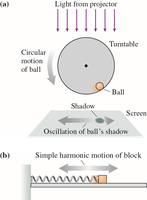
SHM can be visualized as the projection of uniform circular motion onto one axis. The x-component of a particle in circular motion follows the same equations as SHM.
Angular Frequency:
Position:
Section 14.4: Energy in Simple Harmonic Motion
Kinetic and Potential Energy
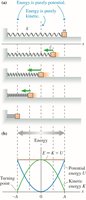
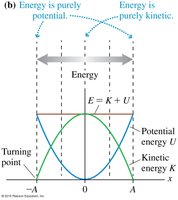
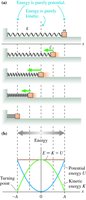
In SHM, energy oscillates between kinetic and potential forms. The total mechanical energy remains constant (if no damping):
Potential Energy (Spring):
Kinetic Energy:
Total Energy: (constant)
Summary Table: Key Quantities in Simple Harmonic Motion
Quantity | Symbol | Equation | Units |
|---|---|---|---|
Period | T | s | |
Frequency | f | Hz | |
Angular Frequency | rad/s | ||
Position (SHM) | x(t) | m | |
Velocity (SHM) | v(t) | m/s | |
Acceleration (SHM) | a(t) | m/s^2 | |
Potential Energy (Spring) | U | J | |
Kinetic Energy | K | J | |
Total Energy | E | J |
Applications and Examples
Radio Waves: Oscillate at high frequencies (e.g., 100 MHz for FM radio).
Buildings: Tall buildings sway with SHM during strong winds; engineers use this knowledge to design for safety.
Everyday Life: Swings, musical instruments, and even the motion of a microwave turntable can be analyzed using SHM principles.
Additional info: The notes above synthesize and expand upon the provided lecture slides, integrating definitions, equations, and examples for a comprehensive study guide on oscillations and simple harmonic motion.
