 Back
BackOscillations, Damping, and Resonance: Quality Factor and Forced Oscillations
Study Guide - Smart Notes
 Tailored notes based on your materials, expanded with key definitions, examples, and context.
Oscillations and Damping
Quality Factor (Q) for Damped Oscillators
The quality factor (Q) is a dimensionless parameter that characterizes the damping of an oscillator and the sharpness of its resonance. It is inversely proportional to the energy loss per cycle and is used to describe how underdamped a system is.
Definition: Q measures the ratio of energy stored to energy lost per cycle in an oscillator.
Energy Decay: The energy of an underdamped oscillator decreases exponentially with time, following , where is the decay time.
Decay Time (): The time at which the energy drops to of its initial value. where is mass and is the damping constant.
Fractional Energy Loss: For weak damping, the energy loss per period is a small fraction of the total energy.
Quality Factor Formula: , where is the natural frequency.
Relation to Energy Loss:
Interpretation: A high Q indicates low damping and sharp resonance; a low Q indicates strong damping and broad resonance.
Example: Guitar String Damping
A guitar string with a fundamental frequency of 82.41 Hz loses half its energy after 2.25 s. The decay time, Q factor, and fractional energy loss per period can be calculated using the above formulas.
Decay Time:
Q Factor:
Fractional Energy Loss:
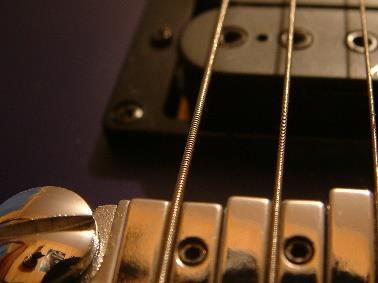
Image shows a guitar string, relevant to the example of energy loss and resonance in musical instruments.
Forced Oscillations and Resonance
Driven Damped Oscillator
When a damped oscillator is subjected to an external periodic force, it exhibits forced oscillations. The amplitude and phase of the oscillation depend on the driving frequency and the system's natural frequency.
Equation of Motion:
Solution: The displacement is , where is the amplitude and is the phase constant.
Amplitude:
Phase Constant:
Resonance: Maximum amplitude occurs when the driving frequency equals the natural frequency ().
Resonance Curve: The sharpness of the resonance peak is determined by Q; weak damping yields a sharp peak, strong damping yields a broad peak.
Width of Resonance Curve:
Resonance and Damping
At resonance, the oscillator absorbs maximum energy from the driving force. The phase difference between the driving force and the oscillator is at resonance, and when the driving frequency is much higher than the natural frequency.
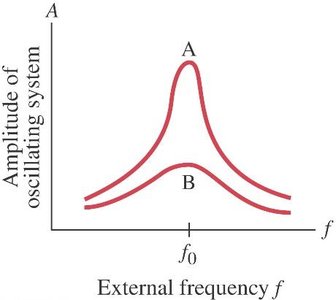
Image shows resonance curves for lightly (A) and heavily (B) damped oscillators, illustrating the effect of damping on resonance sharpness.
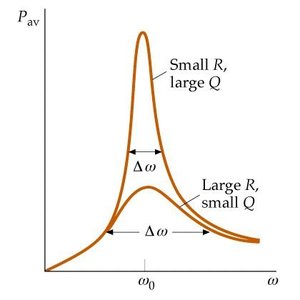
Image shows the relationship between resonance curve width (), resistance (R), and quality factor (Q). Small R and large Q yield a sharp peak; large R and small Q yield a broad peak.
Important Equations
Summary Table: Quality Factor and Resonance
Parameter | Formula | Description |
|---|---|---|
Quality Factor (Q) | Sharpness of resonance, inversely related to damping | |
Decay Time () | Time for energy to decrease to of initial value | |
Resonance Curve Width () | Width at half maximum amplitude | |
Amplitude at Resonance | Maximum amplitude when |
Example: In musical instruments, such as guitar strings, the Q factor determines how long the string vibrates and how sharp the resonance is, affecting sound quality and sustain.
