 Back
Oscillations, Simple Harmonic Motion, and Resonance
Study Guide - Smart Notes
 Tailored notes based on your materials, expanded with key definitions, examples, and context.
Oscillations and Simple Harmonic Motion
Introduction to Oscillations
Oscillations are repetitive motions about an equilibrium position. The study of oscillatory motion is fundamental in physics, as it describes a wide range of phenomena from playground swings to molecular vibrations.
Amplitude (A): The maximum displacement from equilibrium.
Period (T): The time required for one complete cycle of motion.
Frequency (f): The number of cycles per second, given by .
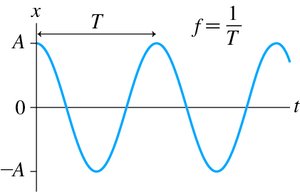
Simple Harmonic Motion (SHM)
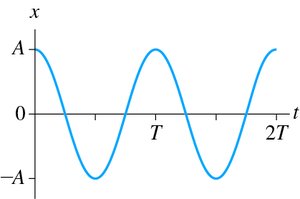
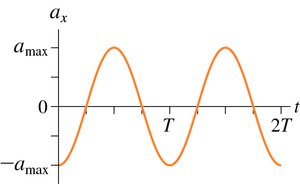
Simple harmonic motion is a type of oscillation described by sinusoidal functions. It occurs when a linear restoring force acts to return a system to equilibrium.
Position as a function of time:
Velocity as a function of time:
Acceleration as a function of time:
Angular frequency: for a mass-spring system
Energy in Simple Harmonic Motion
Energy Transformations
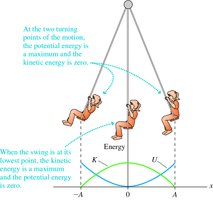
In SHM, energy oscillates between kinetic and potential forms, with the total mechanical energy conserved (in the absence of damping).
Kinetic Energy (K):
Potential Energy (U): for a spring, for a pendulum
Total Energy: (constant)
At the maximum displacement, all energy is potential; at equilibrium, all energy is kinetic.
Mass-Spring Systems
Frequency and Period
The frequency and period of a mass-spring system depend on the mass and the spring constant:
Frequency:
Period:
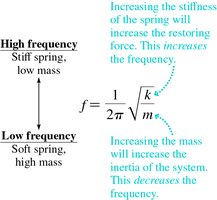
Increasing the spring constant increases the frequency; increasing the mass decreases the frequency.
Examples and Applications
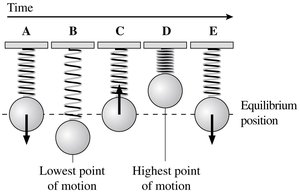
When a mass is attached to a spring and displaced, it oscillates with a frequency determined by the above equations.
At the equilibrium position, the kinetic energy is maximum and potential energy is zero; at the extremes, the potential energy is maximum and kinetic energy is zero.
Pendulum Motion
Simple Pendulum
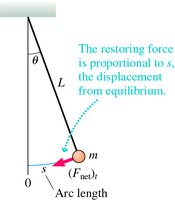
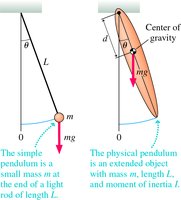
A simple pendulum consists of a mass m suspended from a string of length L. The restoring force is proportional to the displacement along the arc.
Restoring force: for small angles
Frequency:
Period:
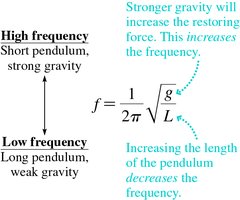
The period and frequency are independent of the mass and depend only on the length and gravitational acceleration.
Physical Pendulum
A physical pendulum is an extended object swinging about a pivot. The period depends on the distribution of mass (moment of inertia) and the distance from the pivot to the center of gravity.
Period:
Frequency:
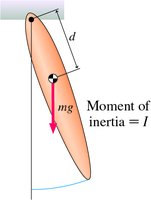
Applications include modeling the motion of limbs during walking.
Damped Oscillations
Damping and Exponential Decay
Damped oscillations occur when energy is lost from the system, typically due to friction or air resistance. The amplitude decreases exponentially over time.
Amplitude decay:
Time constant (\tau): Characterizes the rate of decay; after one time constant, amplitude decreases to of its initial value.
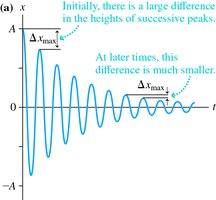
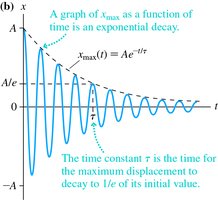
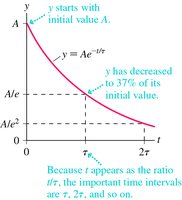
For practical purposes, the oscillation is considered to have ceased after several time constants.
Driven Oscillations and Resonance
Driven Oscillations
When an oscillator is subjected to a periodic external force, it undergoes driven oscillations. The response depends on the relationship between the driving frequency and the system's natural frequency.
Natural frequency (f0): The frequency at which the system oscillates when not driven.
Driving frequency (fext): The frequency of the external force.
Resonance
Resonance occurs when the driving frequency matches the natural frequency, resulting in a large amplitude response. Damping affects the sharpness and height of the resonance peak.
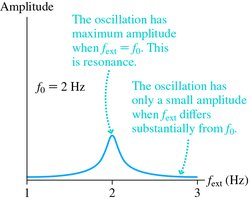
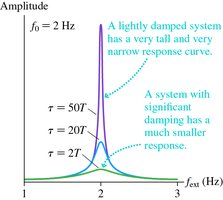
Resonance can be beneficial (e.g., in clocks) or dangerous (e.g., in bridges or railroad cars).
Summary Table: Key Equations and Concepts
System | Frequency (f) | Period (T) | Depends on |
|---|---|---|---|
Mass on Spring | Mass, Spring Constant | ||
Simple Pendulum | Length, Gravity | ||
Physical Pendulum | Moment of Inertia, Center of Gravity |
Key Takeaways
Oscillatory motion is characterized by amplitude, period, and frequency.
Simple harmonic motion is governed by a linear restoring force and described by sinusoidal functions.
Energy in SHM alternates between kinetic and potential forms, with total energy conserved in the absence of damping.
Damping causes the amplitude of oscillations to decrease exponentially over time.
Resonance occurs when the driving frequency matches the natural frequency, leading to large amplitude oscillations.
