 Back
BackOscillations: Simple Harmonic Motion, Energy, and Applications
Study Guide - Smart Notes
 Tailored notes based on your materials, expanded with key definitions, examples, and context.
Q14.8. Mass on a Spring: Forces, Velocity, and Acceleration in SHM
Background
Topic: Simple Harmonic Motion (SHM)
This question explores the dynamics of a mass oscillating vertically on a spring, focusing on the relationships between net force, velocity, acceleration, and the spring force at various points in the motion.
Key Terms and Formulas:
Equilibrium Position: The point where the net force on the mass is zero (restoring force balances gravity).
Amplitude (A): The maximum displacement from equilibrium.
Velocity in SHM:
Acceleration in SHM:
Spring Force:
Step-by-Step Guidance
For part (a), recall that the net force is zero at the equilibrium position. This is the point where the spring's restoring force exactly cancels the gravitational force.
For part (b), consider where the velocity of the mass is zero. In SHM, this occurs at the points of maximum displacement (the highest and lowest points in the oscillation).
For part (c), think about where the acceleration is greatest in magnitude. Since acceleration in SHM is proportional to displacement, it is largest (in magnitude) at the maximum displacement points.
For part (d), analyze when the spring force is zero. This would occur if the spring is at its natural (unstretched) length, which may not happen during normal oscillations around the weighted equilibrium position.
Try solving on your own before revealing the answer!
Q14.10. Determining Frequency and Amplitude from a Position-Time Graph
Background
Topic: Analyzing SHM Graphs
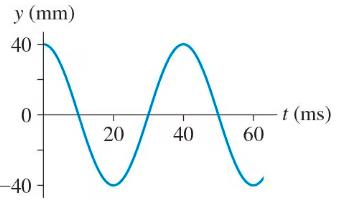
This question asks you to extract the frequency and amplitude of an oscillator from a position vs. time graph.
Key Terms and Formulas:
Amplitude (A): The maximum value of displacement from equilibrium (read from the graph).
Period (T): The time for one complete cycle (measured from the graph).
Frequency (f):
Step-by-Step Guidance
Identify the amplitude by measuring the maximum displacement from the equilibrium position on the graph.
Determine the period by finding the time interval between two consecutive peaks (or troughs) on the graph.
Calculate the frequency using , where is the period you found in the previous step.
Try solving on your own before revealing the answer!
P14.7. Air-Track Glider: Amplitude and Position in SHM
Background
Topic: Simple Harmonic Motion (SHM) – Amplitude and Position as a Function of Time
This problem involves an air-track glider oscillating on a spring. You are asked to find the amplitude using the maximum speed and period, and then determine the position at a specific time.
Key Terms and Formulas:
Maximum Speed in SHM:
Position as a Function of Time: (if released from maximum displacement)
Step-by-Step Guidance
Use the given maximum speed and period to solve for amplitude using .
Rearrange the formula to solve for .
For the position at s, substitute the values into .
Evaluate the cosine term and set up the expression for , but do not compute the final value yet.
Try solving on your own before revealing the answer!
P14.18. Maximum Acceleration of Hummingbird Wing Tips
Background
Topic: Maximum Acceleration in SHM
This question involves determining the maximum acceleration of a point undergoing simple harmonic motion, given amplitude and period (or frequency).
Key Terms and Formulas:
Maximum Acceleration:
Frequency (f):
Amplitude (A): Maximum displacement from equilibrium (convert units if necessary).
Step-by-Step Guidance
Read the amplitude and period from the provided graph (amplitude in mm, period in ms).
Convert amplitude to meters and period to seconds for SI units.
Calculate the frequency using .
Set up the formula for maximum acceleration: .
Try solving on your own before revealing the answer!
Q14.7. Effect of Doubling Amplitude on Maximum Kinetic Energy
Background
Topic: Energy in Simple Harmonic Motion
This question tests your understanding of how the total mechanical energy (and thus maximum kinetic energy) depends on the amplitude of oscillation.
Key Terms and Formulas:
Total Mechanical Energy in SHM:
Maximum Kinetic Energy: Equal to the total mechanical energy in SHM.
Step-by-Step Guidance
Recall that the maximum kinetic energy is given by .
Analyze how changes if the amplitude is doubled: substitute for in the formula.
Simplify the expression to see by what factor the energy increases.
Try solving on your own before revealing the answer!
P14.23. Oscillating Mass: Amplitude, Period, Spring Constant, Speed, Energy, and Velocity
Background
Topic: SHM – Analyzing the Equation of Motion
This problem involves extracting physical parameters from the equation of motion for a mass on a spring, and using them to find amplitude, period, spring constant, maximum speed, total energy, and velocity at a given time.
Key Terms and Formulas:
General SHM Equation:
Period:
Spring Constant:
Maximum Speed:
Total Energy:
Velocity at time t:
Step-by-Step Guidance
Identify amplitude and angular frequency from the equation .
Calculate the period using .
Find the spring constant using (convert mass to kg and to rad/s).
Set up the expression for maximum speed (convert amplitude to meters).
Write the formula for total energy .
Set up the expression for velocity at s: .
Try solving on your own before revealing the answer!
P14.30. Pendulum Periods on Earth and Moon
Background
Topic: Simple Pendulum Periods and Gravitational Acceleration
This question asks you to find the length of a pendulum on the moon that matches the period of a given pendulum on Earth, using the relationship between period, length, and gravitational acceleration.
Key Terms and Formulas:
Pendulum Period:
Step-by-Step Guidance
Write the period formula for both the Earth and the Moon: and .
Set the periods equal to each other and solve for in terms of , , and .
Substitute the given values ( m, m/s, m/s) into your equation.
Try solving on your own before revealing the answer!
P14.33. Moment of Inertia of a Lower Leg as a Physical Pendulum
Background
Topic: Physical Pendulum and Moment of Inertia
This question involves using the oscillation frequency of a physical pendulum to determine its moment of inertia.
Key Terms and Formulas:
Physical Pendulum Frequency:
Moment of Inertia (I): A measure of an object's resistance to rotational acceleration.
Step-by-Step Guidance
Start with the formula for the frequency of a physical pendulum: .
Rearrange the formula to solve for in terms of , , , and .
Substitute the given values ( kg, m, Hz, m/s) into your equation.
Try solving on your own before revealing the answer!
P14.50. Spring Constant, Period, and Graph for a Mass-Spring System
Background
Topic: Mass-Spring Systems and Hooke's Law
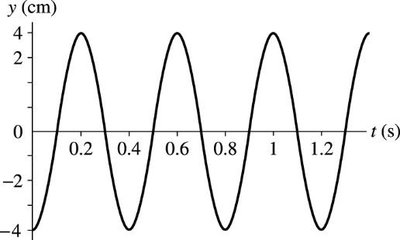
This problem involves finding the spring constant using Hooke's law, determining the period of oscillation, and sketching a position-time graph for a mass-spring system.
Key Terms and Formulas:
Hooke's Law:
Period of Mass-Spring System:
Step-by-Step Guidance
For part (a), use Hooke's law to solve for the spring constant using the weight of the ball and the stretch caused by it.
For part (b), use the formula for the period of a mass-spring system, substituting the mass and the spring constant you found.
For part (c), sketch a position vs. time graph for three cycles, labeling the amplitude and period on the axes. (You can use the equation for reference.)
Try solving on your own before revealing the answer!
