 Back
Oscillations: Simple Harmonic Motion, Energy, Damping, and Resonance
Study Guide - Smart Notes
 Tailored notes based on your materials, expanded with key definitions, examples, and context.
Oscillatory Motion
Introduction to Oscillators
Objects that undergo repetitive motion back and forth around an equilibrium position are called oscillators. The time to complete one full cycle is called the period (T), and the number of cycles per second is the frequency (f), measured in Hertz (Hz).
Period (T): The time for one complete oscillation.
Frequency (f): Number of oscillations per second. $f = \frac{1}{T}$
Equilibrium Position: The central point around which oscillation occurs.
Example: A pendulum swinging back and forth is an oscillator. 
Simple Harmonic Motion (SHM)
Definition and Characteristics
Simple Harmonic Motion is a specific type of oscillatory motion where the restoring force is proportional to the displacement and directed toward the equilibrium position.
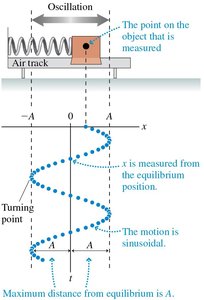
Amplitude (A): Maximum displacement from equilibrium.
Sinusoidal Motion: The position varies as a sine or cosine function of time.
Period and Frequency: SHM is characterized by constant period and frequency.
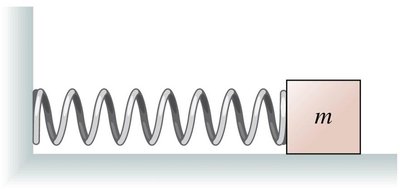
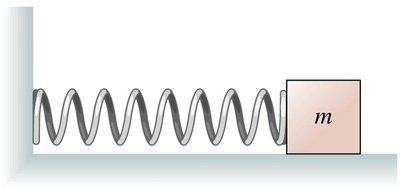
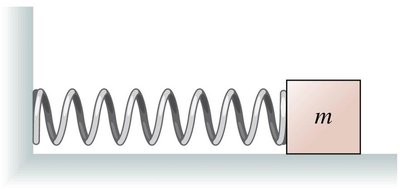
Example: An air-track glider attached to a spring exhibits SHM. 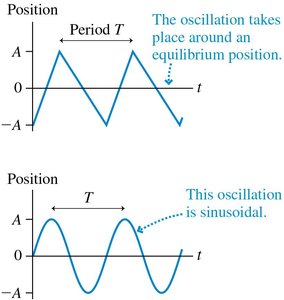
Mathematical Description
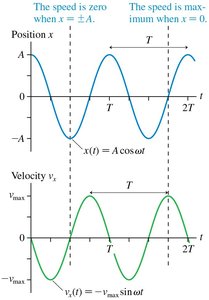
The position as a function of time for SHM is: $x(t) = A \cos(\omega t)$
Angular Frequency (\omega): $\omega = \frac{2\pi}{T} = 2\pi f$ (units: rad/s)
Velocity: $v(t) = -A \omega \sin(\omega t)$
Maximum Speed: $v_{\text{max}} = A \omega$
SHM and Circular Motion
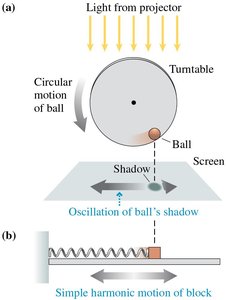
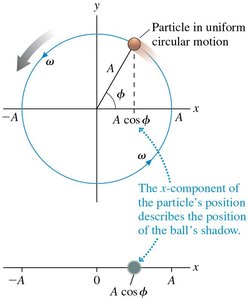
SHM can be visualized as the projection of uniform circular motion onto one axis.
The shadow of a ball moving in a circle exhibits SHM.
The x-component of a particle in uniform circular motion describes SHM.
The Phase Constant
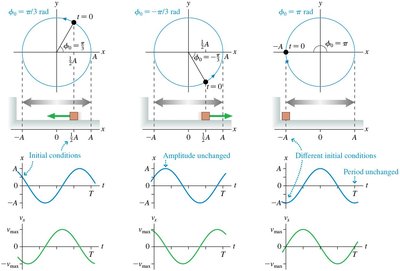
If the object is not at maximum displacement at t = 0, a phase constant (\phi_0) is included: $x(t) = A \cos(\omega t + \phi_0)$
Phase constant determines the initial position and direction of motion.
Different values of \phi_0 correspond to different starting points in the cycle.
Energy in Simple Harmonic Motion
Energy Transformations
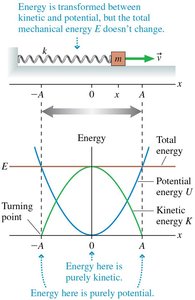
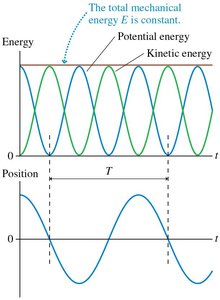
In SHM, energy oscillates between kinetic energy (K) and potential energy (U), but the total mechanical energy (E) remains constant.
$E = K + U = \frac{1}{2} m v^2 + \frac{1}{2} k x^2$
At maximum displacement (x = ±A), all energy is potential: $E = \frac{1}{2} k A^2$
At equilibrium (x = 0), all energy is kinetic: $E = \frac{1}{2} m v_{\text{max}}^2$
Frequency and Period of SHM
Dependence on System Parameters
The frequency and period of SHM depend on the mass (m) and spring constant (k):
$\omega = \sqrt{\frac{k}{m}}$
$f = \frac{1}{2\pi} \sqrt{\frac{k}{m}}$
$T = 2\pi \sqrt{\frac{m}{k}}$
Example: Doubling the mass increases the period; doubling the amplitude does not affect the period. 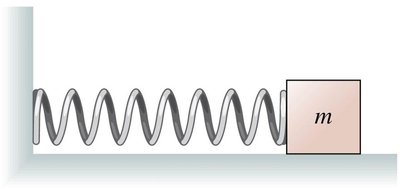
Acceleration and Dynamics in SHM
Acceleration in SHM
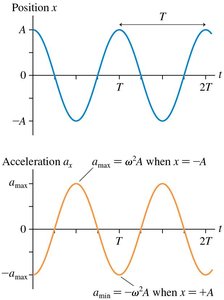
Acceleration is proportional to the negative of displacement: $a_x = -\omega^2 x$
Maximum acceleration occurs at maximum displacement.
Acceleration is zero at equilibrium.
Force and Newton's Second Law
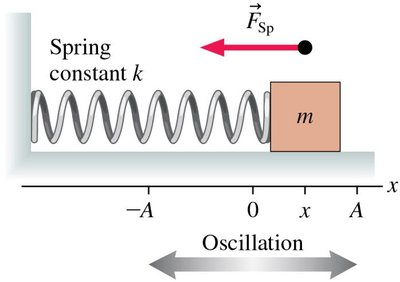
The restoring force is given by Hooke's Law: $F_{\text{sp}} = -k x$
Newton's second law: $ma = -k x$
Leads to $\omega = \sqrt{\frac{k}{m}}$
Vertical Oscillations
Mass on a Vertical Spring
The equilibrium position is shifted by gravity: $\Delta L = \frac{mg}{k}$
Oscillations occur about the new equilibrium position.
The Simple Pendulum
Pendulum Motion
A mass m attached to a string of length L swings back and forth. For small angles (<10°), the motion is SHM.
Restoring force: $F_t = -mg \sin \theta$
Small angle approximation: $\sin \theta \approx \theta$ (radians)
Angular frequency: $\omega = \sqrt{\frac{g}{L}}$
Period: $T = 2\pi \sqrt{\frac{L}{g}}$
Damped Oscillations
Energy Dissipation
Damped oscillations occur when energy is lost, often due to drag forces.
Drag force: $F_{\text{drag}} = -bv$
Position: $x(t) = A e^{-\frac{b}{2m} t} \cos(\omega t + \phi_0)$
Angular frequency: $\omega = \sqrt{\frac{k}{m} - \frac{b^2}{4m^2}}$
Exponential Decay
Mechanical energy decays exponentially: $E(t) = E_0 e^{-t/\tau}$
Time constant: $\tau = \frac{m}{b}$
Driven Oscillations and Resonance
Resonance Phenomenon
When an external force drives an oscillator at its natural frequency, the amplitude increases dramatically—a phenomenon called resonance.
Driving frequency ($f_{\text{ext}}$) close to natural frequency ($f_0$) causes large amplitude.
Resonance amplitude is higher and narrower with less damping.
Summary Table: Key Equations in SHM
Quantity | Equation | Description |
|---|---|---|
Position | $x(t) = A \cos(\omega t + \phi_0)$ | Displacement as a function of time |
Velocity | $v(t) = -A \omega \sin(\omega t + \phi_0)$ | Velocity as a function of time |
Acceleration | $a(t) = -\omega^2 x(t)$ | Acceleration as a function of time |
Angular Frequency | $\omega = \sqrt{\frac{k}{m}}$ | For mass-spring system |
Period | $T = 2\pi \sqrt{\frac{m}{k}}$ | For mass-spring system |
Energy | $E = \frac{1}{2} k A^2$ | Total mechanical energy |
Pendulum Period | $T = 2\pi \sqrt{\frac{L}{g}}$ | For simple pendulum |
Additional info:
All equations are provided in LaTeX format for clarity and academic rigor.
Images included are directly relevant to the explanation and reinforce key concepts.
